Stock Analysis · Lennar Corporation (LEN)
Overview
Lennar Corporation is one of the largest homebuilders in the United States. Its core business is straightforward: it acquires land, develops communities, builds single-family homes and other residential properties, and sells them to homebuyers. The company also operates related businesses that support the homebuying process, including mortgage financing, title services, and other real estate-related activities.
For long-term readers, Lennar is best understood as a large-scale housing company whose results are heavily tied to U.S. housing demand, mortgage rates, affordability, and land discipline. The company has emphasized a more asset-lighter model in recent years, using land options and partnerships more actively rather than relying only on heavy land ownership. That approach is meant to improve flexibility across housing cycles.
Based on recent annual reporting, Lennar’s revenue mix is still dominated by home sales, with smaller but strategically useful contributions from financing and ancillary services.
- Home sales: roughly mid-90% of total revenue. This is the main engine of the business and includes sales of completed homes and related residential products.
- Financial services: roughly 2% to 4%. This includes mortgage origination, title, and closing services tied to home purchases.
- Multifamily, Lennar Other, and related activities: roughly 1% to 3% combined, depending on the year and project timing.
That concentration means Lennar’s long-term outlook mostly depends on whether it can keep selling homes at healthy margins while adjusting to changes in mortgage rates, construction costs, and consumer affordability.
The business still converts a very large revenue base into meaningful operating profit, but the recent trend points to margin compression rather than expansion. Revenue has remained sizable, while the share left after construction and operating costs has narrowed compared with the stronger housing conditions seen a few years earlier.
Key Figures
| Metric | Value | Sector ⓘ |
|---|---|---|
| Date | Sep 12, 2026 | |
| Context | ||
| Sector | Consumer Cyclical | |
| Industry | Residential Construction | |
| Market Cap ⓘ | $19.18B | |
| Beta ⓘ | 1.40 | |
Value (Cheapness) | ||
| P/E Ratio ⓘ | 12.21 | 17.10 |
| FCF Yield ⓘ | 4.29% | 8.53% |
| EBIT / EV ⓘ | N/A | 6.46% |
| PEG ⓘ | 11.30 | |
Growth (Business expansion) | ||
| Revenue Growth ⓘ | -5.20% | 5.75% |
| RPS Growth (5Y CAGR) ⓘ | 10.65% | 9.14% |
| EPS Growth (5Y CAGR) ⓘ | -42.62% | -18.21% |
| Margin Growth (5Y Trend) ⓘ | -13.08% | -0.23% |
| FCF Growth (5Y CAGR) ⓘ | -67.31% | 4.91% |
Quality (Business durability) | ||
| ROIC (Latest) ⓘ | N/A | 12.61% |
| ROIC (5Y Median) ⓘ | 14.63% | 10.72% |
| Net Debt / EBIT (Latest) ⓘ | N/A | 2.10 |
| Net Debt / EBIT (5Y Median) ⓘ | -0.10 | 2.32 |
| Operating Margin (Latest) ⓘ | N/A | 9.25% |
| Operating Margin (5Y Median) ⓘ | 16.15% | 9.64% |
| Debt to Equity (Latest) ⓘ | 28.67% | 75.78% |
| Profit Margin (Latest) ⓘ | 4.93% | 5.33% |
| Free Cash Flow (Latest) ⓘ | $821.77M | |
Momentum (Price trend) | ||
| 3Y Return ⓘ | -18.94% | +14.53% |
| 12M Return (excl. last month) ⓘ | -30.17% | +3.08% |
| 6M Return ⓘ | -13.01% | +0.55% |
| Price vs. 200-Day MA ⓘ | -17.71% | -0.54% |
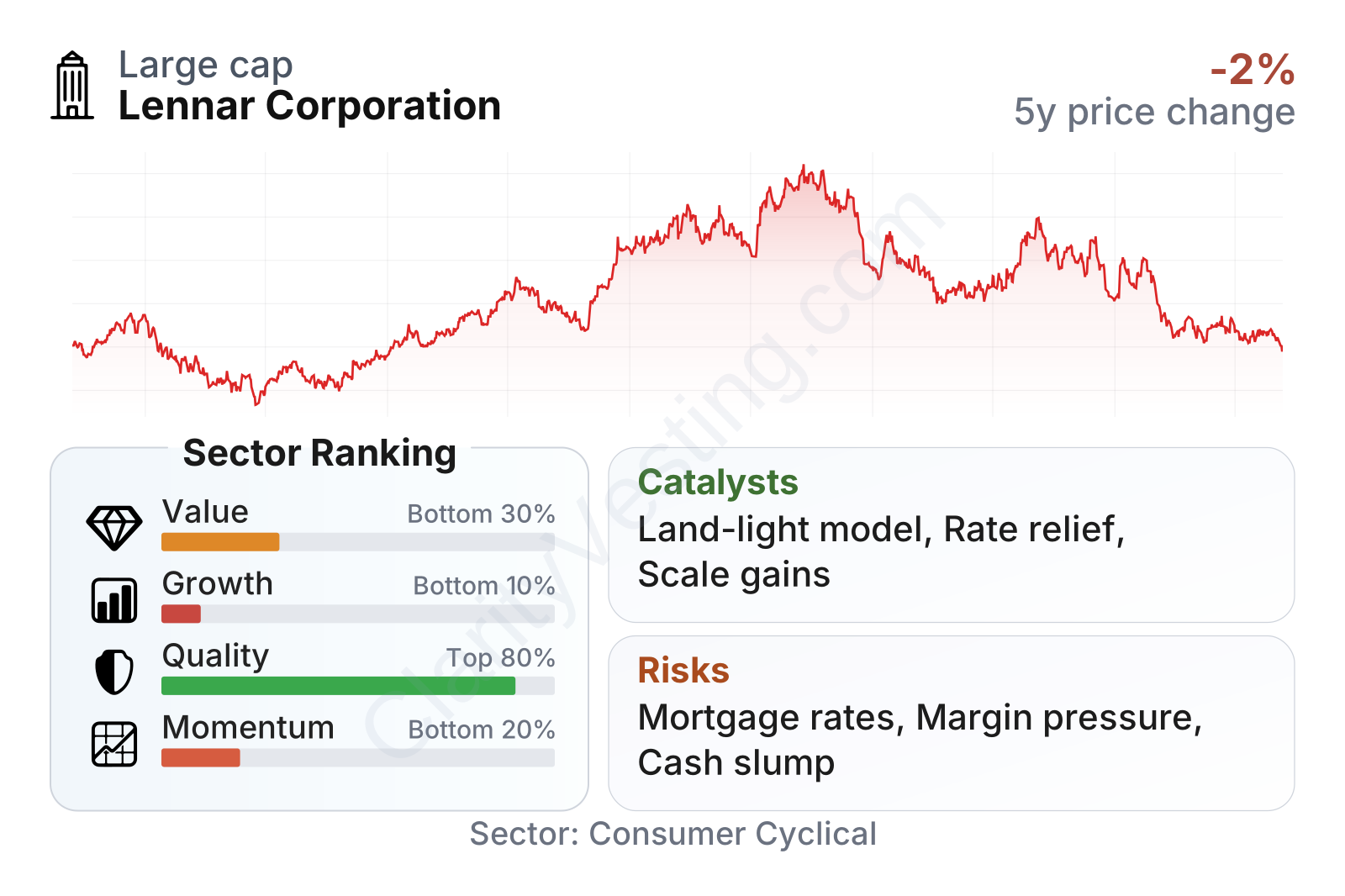
Lennar currently sits in an unusual position: business quality remains relatively solid, but growth, momentum, and some valuation measures look less attractive. The company’s market value is around the low-$20 billions, making it one of the larger public homebuilders, and the stock has shown above-average volatility with a beta around 1.4. Relative to the broader consumer cyclical universe, the shares trade at a lower earnings multiple than many peers, but that discount comes alongside slowing fundamentals and weak recent price performance. On balance, the picture is one of a financially durable company facing a tougher part of the cycle.
Growth
The long-term sector backdrop is still supported by real demand for housing in the United States. Demographic needs, a structurally limited housing supply in many markets, and years of underbuilding provide a real foundation for residential construction over time. In that sense, Lennar operates in a sector with enduring relevance rather than a fading industry.
That said, housing rarely grows in a straight line. In the near term, affordability remains the key constraint. Elevated mortgage rates and higher monthly payments make it harder for buyers to qualify, which can pressure order growth, pricing, and margins across the industry. Lennar’s strategy has been to keep homes moving through incentives, product mix adjustments, and faster inventory turnover rather than trying to defend price at all costs. This can protect volume, but it usually comes with pressure on profitability.
The recent revenue trend shows that Lennar has moved from strong post-pandemic expansion into contraction. Year-over-year growth was very strong earlier in the cycle, then cooled sharply and turned negative. That does not erase the company’s respectable five-year revenue growth record, but it clearly signals that current conditions are more difficult than the backdrop that drove the earlier surge.
Free cash flow has also become a lot less supportive recently. A business like Lennar can produce large cash swings because land spending, construction timing, and inventory changes can move cash generation dramatically from one year to the next. Earlier periods showed very strong cash creation, while the latest trailing figure has fallen close to break-even. For a homebuilder, this does not automatically mean the model is broken, but it does show that the balance between growth, land investment, and profitability has become more demanding.
A meaningful long-term catalyst is Lennar’s operating model. Management has continued pushing a “land-light” structure that relies more on optioned land and third-party capital relationships. If executed well, that can reduce risk, improve returns on capital, and allow the company to stay active even when the housing market weakens. Another catalyst is scale: Lennar can spread purchasing, marketing, and financing capabilities over a very large national platform. If mortgage rates stabilize or gradually decline, large builders like Lennar may be well placed to capture demand because smaller operators typically have less flexibility on incentives and financing support.
Recent company communications have also highlighted ongoing community development, capital return activity, and efforts to match production pace with market conditions. None of these removes the cycle, but they support the idea that Lennar is trying to operate for durability rather than chase short-lived peaks.
Risks
This article is for informational purposes only and does not constitute financial advice. Some content is AI-generated. See Disclaimer


