Stock Analysis · Lennar Corporation (LEN-B)
Overview
Lennar Corporation is one of the largest homebuilders in the United States. The company primarily develops and sells newly built homes, with a focus on entry-level, first move-up, and active adult buyers. In addition to construction, Lennar also operates businesses tied to the home purchase process, including mortgage financing, title and closing services, and some multifamily and land-related activities.
Its revenue is still overwhelmingly driven by homebuilding. Based on recent annual reporting, the business mix is approximately:
- Home sales: about 94% to 96% of total revenue. This includes the sale of completed homes and homes under construction across many U.S. markets.
- Financial services: about 2% to 3% of revenue. This mainly includes mortgage origination, title, and closing services provided to homebuyers.
- Multifamily and other: about 1% to 3% of revenue. This covers apartment-related activities, land sales, and other smaller operations.
Lennar’s model is built around scale, fast inventory turnover, and a broad geographic footprint. That matters in homebuilding because profits depend not only on selling homes, but also on controlling land costs, construction timing, and financing conditions. The business flow over the last few years shows revenue staying at a very large level while profitability has narrowed from the unusually strong housing conditions seen earlier in the cycle.
The operating picture suggests a company that is still producing substantial revenue, but with margins that have come down as pricing power eased and costs remained elevated. Interest expense has stayed relatively low compared with the size of the business, which supports financial flexibility.
Key Figures
| Metric | Value | Sector ⓘ |
|---|---|---|
| Date | Jul 20, 2026 | |
| Context | ||
| Sector | Consumer Cyclical | |
| Industry | Residential Construction | |
| Market Cap ⓘ | $19.79B | |
| Beta ⓘ | 1.39 | |
Value (Cheapness) | ||
| P/E Ratio ⓘ | 12.88 | 18.58 |
| FCF Yield ⓘ | 4.15% | 7.99% |
| EBIT / EV ⓘ | N/A | 5.91% |
| PEG ⓘ | 11.31 | |
Growth (Business expansion) | ||
| Revenue Growth ⓘ | -5.20% | 5.50% |
| RPS Growth (5Y CAGR) ⓘ | 10.65% | 9.20% |
| EPS Growth (5Y CAGR) ⓘ | -43.00% | -26.43% |
| Margin Growth (5Y Trend) ⓘ | -13.25% | -0.18% |
| FCF Growth (5Y CAGR) ⓘ | -67.31% | 5.02% |
Quality (Business durability) | ||
| ROIC (Latest) ⓘ | N/A | 12.03% |
| ROIC (5Y Median) ⓘ | 14.10% | 10.82% |
| Net Debt / EBIT (Latest) ⓘ | N/A | 2.12 |
| Net Debt / EBIT (5Y Median) ⓘ | 0.26 | 2.25 |
| Operating Margin (Latest) ⓘ | N/A | 9.28% |
| Operating Margin (5Y Median) ⓘ | 16.15% | 9.64% |
| Debt to Equity (Latest) ⓘ | 28.67% | 75.23% |
| Profit Margin (Latest) ⓘ | 4.93% | 5.28% |
| Free Cash Flow (Latest) ⓘ | $821.77M | |
Momentum (Price trend) | ||
| 3Y Return ⓘ | -22.78% | +10.68% |
| 12M Return (excl. last month) ⓘ | -14.26% | +5.26% |
| 6M Return ⓘ | -24.71% | -2.41% |
| Price vs. 200-Day MA ⓘ | -16.53% | +1.55% |
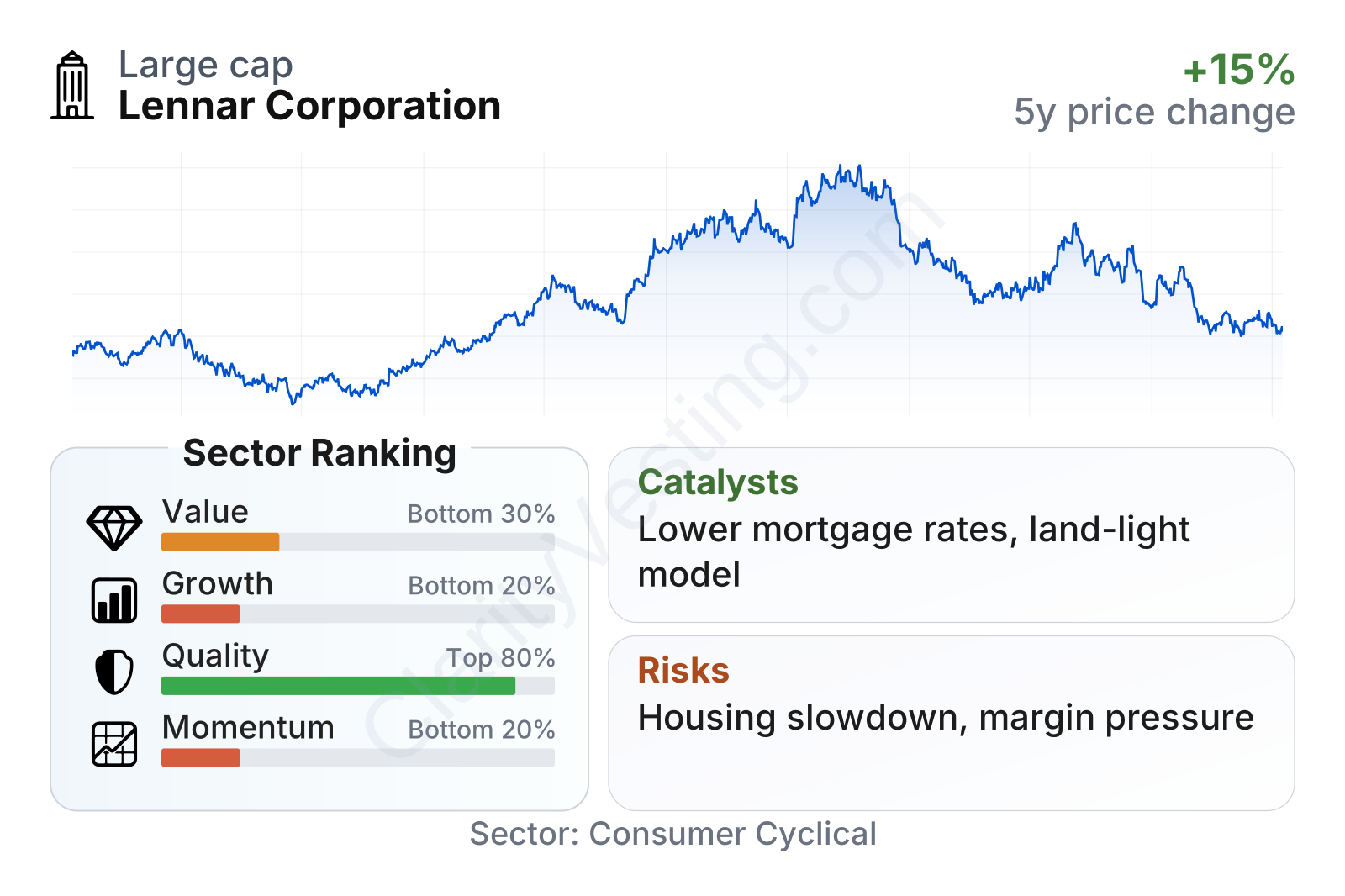
Lennar stands out as a large company in residential construction with a stock that has been notably volatile. The table points to a mixed profile: balance-sheet quality remains strong compared with much of the sector, while recent growth and share-price momentum are weak. Valuation multiples are below sector norms, but that discount comes alongside slowing earnings, lower cash generation, and softer recent demand conditions.
Growth
Homebuilding is a cyclical industry, but the long-term backdrop still has supportive elements. The U.S. continues to face a structural housing shortage in many markets, and affordability constraints have pushed builders to adapt products and pricing rather than rely only on luxury demand. That is an area where Lennar’s scale can help. The company has emphasized volume, incentives, and a lighter land strategy to keep homes moving even when mortgage rates pressure buyers.
Lennar’s strategy broadly makes sense for a tougher housing environment. It has been working to reduce risk tied to owning too much land directly, using more land-option structures instead. This can lower capital intensity and help the company stay more flexible if demand shifts. For a homebuilder, that is important because land mistakes made during a strong market often become painful later.
Recent growth has clearly cooled. Revenue growth turned negative after a stronger period in 2021 through 2024, showing that the business is now operating in a less favorable part of the cycle. Over a five-year view, however, revenue per share growth still looks better than the sector median, which suggests that the current slowdown follows a meaningful expansion period rather than a structurally weak business.
Cash generation has also become much less robust than it was at the peak. Free cash flow was very strong in earlier periods, then fell sharply as the market normalized and working-capital needs shifted. That does not automatically signal a broken model, because homebuilders often show uneven cash flow as they buy land, build inventory, and close communities at different rates. Still, it does show that Lennar is no longer benefiting from the exceptional conditions that lifted the industry a few years ago.
One of the clearest future catalysts is any easing in mortgage rates. Lower financing costs could improve affordability, expand the buyer pool, and reduce the need for heavy incentives. Another catalyst is Lennar’s continued use of its asset-lighter land approach, which could support returns if executed well. The company has also continued to return capital through repurchases and dividends while maintaining a relatively conservative balance sheet, giving it room to operate through slower periods.
Recent company updates have also highlighted operational initiatives around community count, construction cycle times, and inventory turn. Those are not dramatic headline items, but for a large builder they can have meaningful effects on profitability and cash generation over time.
Risks
The biggest risk is straightforward: Lennar is highly exposed to the U.S. housing cycle. Demand for new homes depends heavily on mortgage rates, employment, consumer confidence, and affordability. If rates stay high for longer, monthly payments remain difficult for many buyers, and builders may need to offer more concessions to keep sales moving. That can pressure both margins and returns.
On leverage, Lennar looks stronger than many peers. Its debt-to-equity ratio has generally stayed well below the sector median, and even after rising from the lowest levels reached in 2023 and 2024, it remains relatively conservative. That is an important advantage in a cyclical industry because it gives the company more room to absorb weaker orders or pricing pressure without facing the same level of balance-sheet stress as more heavily indebted competitors.
The more immediate concern is profitability. Lennar’s profit margin has fallen sharply from the very strong levels reached earlier in the cycle and has recently moved to around the sector median, even slightly below it. This trend suggests that the company’s emphasis on maintaining sales pace through pricing adjustments and incentives is helping volume, but at the cost of lower profitability per home.
Lennar does have competitive advantages. It is one of the national leaders in homebuilding, with major scale, broad geographic reach, established supplier relationships, and access to financing and customer service capabilities that smaller builders cannot easily match. Its in-house financial services operation can also make the homebuying process smoother and help support sales conversion.
Still, it operates in a very competitive market. Main public competitors include D.R. Horton, PulteGroup, NVR, Toll Brothers, Taylor Morrison, and KB Home. D.R. Horton is generally seen as the scale leader in entry-level homebuilding, while NVR is often viewed as a benchmark for asset-light discipline and high returns. Toll Brothers is more concentrated in luxury housing. Lennar sits near the top tier by size and national presence, but it is not unchallenged on margins or business model quality. Compared with NVR, for example, Lennar has historically carried more direct exposure to land and cyclical swings.
Other risks include construction-cost inflation, labor shortages, land availability, insurance costs, and local regulatory delays. There is also the possibility of impairments if land values weaken in certain markets. No major recent scandal or governance shock stands out as a defining issue, but the absence of a headline problem does not reduce the underlying sensitivity of the business to housing conditions.
Valuation
Lennar’s valuation looks modest on a plain P/E basis relative to the broader consumer cyclical universe. The current multiple is around 13x, versus a sector median closer to 18x. That discount is not new, however. The shares have traded below the sector median for years, reflecting the cyclical nature of homebuilding and the market’s tendency to avoid assigning high earnings multiples to profits that may be near mid-cycle or above normalized levels.
The valuation picture is therefore more nuanced than “cheap” or “expensive.” Relative to peers and sector averages, Lennar does not look stretched. But the company’s weak recent growth, declining margins, lower free cash flow, and soft stock momentum explain why the market is cautious. The higher PEG ratio also suggests that a low P/E alone does not fully capture the slowdown in earnings growth expectations.
In context, the current price appears to reflect a company with solid financial quality and scale advantages, but also one facing cyclical pressure and less favorable near-term economics than during the post-pandemic housing boom. The market seems to be recognizing both sides at once: quality balance sheet, but lower confidence in the next leg of profit growth.
Conclusion
Lennar remains one of the most important companies in U.S. homebuilding, with national scale, a relatively conservative balance sheet, and a business model that is adapting toward lower land risk. Those characteristics give it resilience and help explain why its profitability and returns have often held up better than many builders through changing market conditions.
The challenge is that the company is no longer operating in the unusually favorable environment that once drove exceptional margins and cash flow. Revenue growth has turned negative, free cash flow has weakened sharply, and profitability has compressed toward industry norms. That does not erase Lennar’s strengths, but it does make the current phase look more like a cyclical reset than a clean growth stretch.
Overall, Lennar appears positioned as a financially solid industry leader moving through a tougher part of the housing cycle. The valuation remains restrained rather than exuberant, which fits a business with clear long-term relevance but limited near-term visibility. The most constructive interpretation rests on durability, scale, and balance-sheet strength, while the main limitation is that better housing conditions are likely needed before the company can recapture its earlier earnings power in a convincing way.
Sources:
- Lennar Corporation — Annual Report on Form 10-K for fiscal year ended November 30, 2025
- Lennar Corporation — Quarterly Report on Form 10-Q for quarterly periods in 2026
- SEC EDGAR — Lennar Corporation filings database
- Lennar Investor Relations — earnings releases and shareholder materials
- Lennar Investor Relations — conference call transcripts and webcast materials
- Wikipedia — Lennar Corporation
This article is for informational purposes only and does not constitute financial advice. Some content is AI-generated. See Disclaimer