Stock Analysis · Leggett & Platt Incorporated (LEG)
Overview
Leggett & Platt Incorporated is a long-established American manufacturer that supplies components used inside many everyday products rather than selling most items directly to consumers. Its products are mainly found in bedding, furniture, flooring, home textiles, and certain specialized industrial applications. The company is best known for innersprings used in mattresses, but its portfolio is broader and includes seat support systems, foam and private-label finished mattresses, work furniture mechanisms, hydraulic cylinders, aerospace tubing, and wire products.
For long-term analysis, the main point is that Leggett & Platt is tied to end markets such as housing, furniture demand, consumer spending on the home, and replacement cycles in bedding. That makes it a real industrial business with recognizable products, but also one whose results can move up and down with the economic cycle.
Based on the company’s recent segment reporting, revenue is mainly generated from the following activities, ordered from largest to smallest:
- Bedding Products: approximately 45% to 50% of revenue. This includes steel coil innersprings, specialty foam, and private-label finished mattresses used by bedding brands and retailers.
- Specialized Products: approximately 20% to 25% of revenue. This segment includes automotive and aerospace components, hydraulic cylinders, and tubing products.
- Furniture, Flooring & Textile Products: approximately 20% to 25% of revenue. This includes motion hardware, seating systems, flooring underlayments, and home textile components.
The business mix matters because bedding remains the earnings anchor, while specialized industrial operations add some diversification beyond household demand. Over the last few years, however, the company has also been simplifying its portfolio and exiting or reducing weaker operations, which has lowered total sales but aims to improve the quality of earnings.
The multi-year financial flow shows a clear pattern: revenue has fallen from above $5 billion in 2021-2022 to a little above $4 billion in 2025, while profitability weakened sharply in 2023 and 2024 before recovering in 2025. Cost of goods remains the largest drain on sales, and selling and administrative costs have stayed relatively sticky, which helps explain why margins came under pressure when volumes fell.
Key Figures
| Metric | Value | Sector ⓘ |
|---|---|---|
| Date | Sep 12, 2026 | |
| Context | ||
| Sector | Consumer Cyclical | |
| Industry | Furnishings, Fixtures & Appliances | |
| Market Cap ⓘ | $1.26B | |
| Beta ⓘ | 0.75 | |
Value (Cheapness) | ||
| P/E Ratio ⓘ | 5.90 | 17.10 |
| FCF Yield ⓘ | 12.49% | 8.53% |
| EBIT / EV ⓘ | 14.13% | 6.46% |
| PEG ⓘ | 2.96 | |
Growth (Business expansion) | ||
| Revenue Growth ⓘ | -5.50% | 5.75% |
| RPS Growth (5Y CAGR) ⓘ | -5.94% | 9.14% |
| EPS Growth (5Y CAGR) ⓘ | -33.68% | -18.21% |
| Margin Growth (5Y Trend) ⓘ | -2.86% | -0.23% |
| FCF Growth (5Y CAGR) ⓘ | 14.29% | 4.91% |
Quality (Business durability) | ||
| ROIC (Latest) ⓘ | 10.78% | 12.61% |
| ROIC (5Y Median) ⓘ | 11.62% | 10.72% |
| Net Debt / EBIT (Latest) ⓘ | 3.31 | 2.10 |
| Net Debt / EBIT (5Y Median) ⓘ | 3.22 | 2.32 |
| Operating Margin (Latest) ⓘ | 8.56% | 9.25% |
| Operating Margin (5Y Median) ⓘ | 8.94% | 9.64% |
| Debt to Equity (Latest) ⓘ | 152.20% | 75.78% |
| Profit Margin (Latest) ⓘ | 5.64% | 5.33% |
| Free Cash Flow (Latest) ⓘ | $156.90M | |
Momentum (Price trend) | ||
| 3Y Return ⓘ | -63.41% | +14.53% |
| 12M Return (excl. last month) ⓘ | +6.81% | +3.08% |
| 6M Return ⓘ | -18.38% | +0.55% |
| Price vs. 200-Day MA ⓘ | -13.45% | -0.54% |
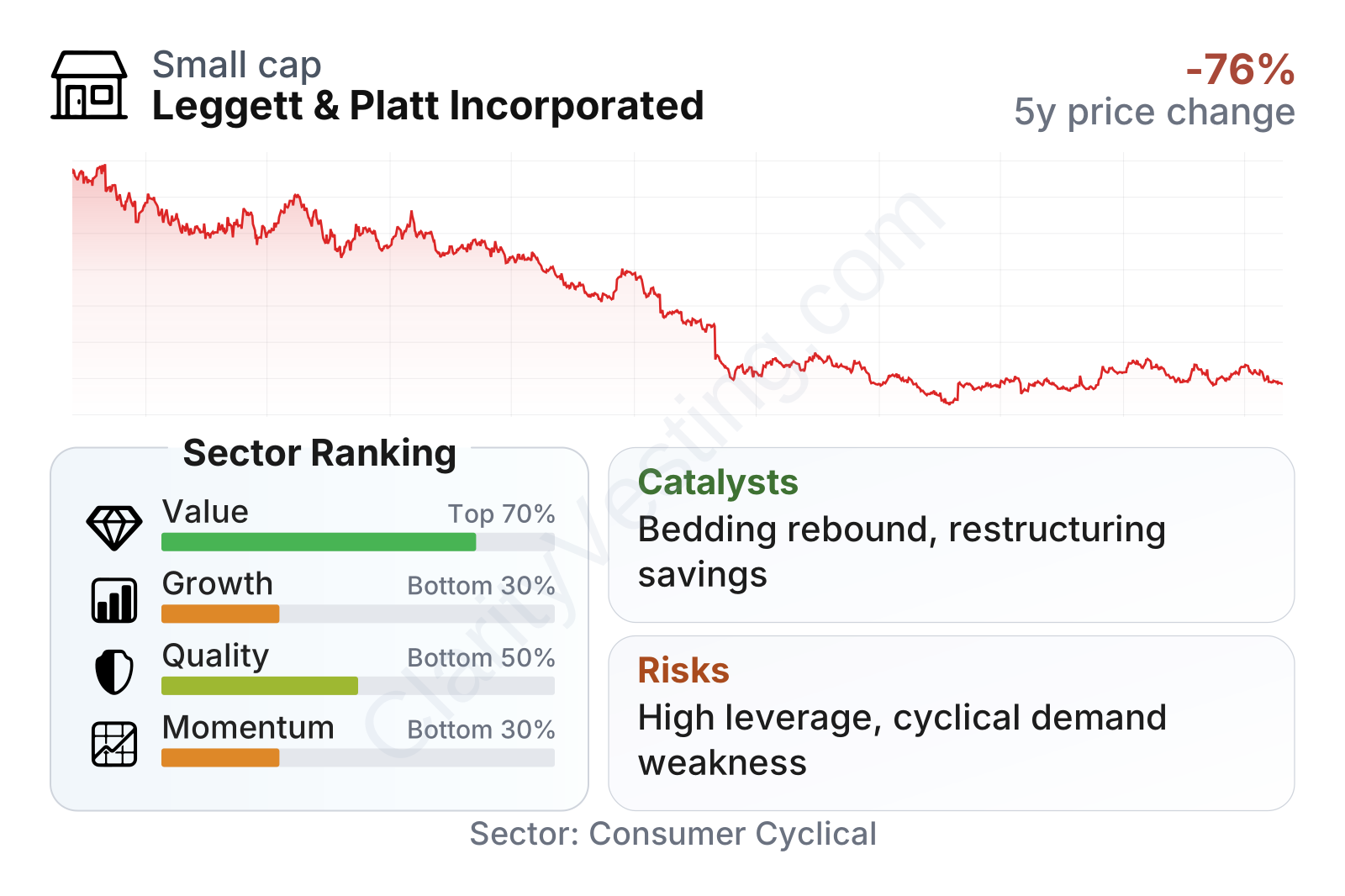
Leggett & Platt is now a small-cap company with a stock price that is far below where it traded a few years ago. The current metrics show a mixed picture. On valuation measures, it screens cheaply versus much of its sector, with a low earnings multiple and a free cash flow yield above the sector median. On the other hand, growth and momentum remain weak relative to peers, and balance-sheet leverage is still elevated. Quality is not broken, but it is not especially strong either, mainly because returns and margins are only around average while debt remains clearly above the sector norm.
Growth
Leggett & Platt operates in mature categories rather than in fast-expanding industries. Mattresses, furniture components, and flooring products usually grow with housing activity, household formation, replacement demand, and general consumer confidence. That means this is not a structural high-growth company. Its long-term potential is more about cyclical recovery, operational improvement, and product mix than about rapid market expansion.
The company’s current strategy still makes industrial sense. Management has focused on restructuring, reducing costs, simplifying the portfolio, closing or divesting weaker operations, and emphasizing businesses where Leggett & Platt has scale or technical know-how. In practical terms, that can help even if revenue growth stays muted, because better factory utilization, lower overhead, and stronger product mix can lift profits materially in a cyclical rebound.
Revenue trends show how difficult the recent backdrop has been. Year-over-year sales growth has been negative for an extended period, with declines often in the mid-single digits to low-double digits. That places the company well below the sector median and confirms that end-market demand has been soft for longer than expected. Still, the more recent readings suggest the rate of decline has moderated compared with the worst part of the downturn, which is an early sign of stabilization rather than a full recovery.
Cash generation is more encouraging than the sales line. Free cash flow has remained positive through the downturn, even though it has come down from earlier peaks. That resilience is important for a business in transition because it gives management room to manage debt, fund restructuring, and support core operations without relying entirely on revenue growth. Over five years, free cash flow has actually grown at a stronger pace than the sector median, showing that the company’s underlying cash conversion has held up better than its recent income statement might suggest.
The clearest catalyst is a recovery in U.S. bedding and home-related demand. If mattress volumes improve, fixed manufacturing costs can be spread across more units, which could have an outsized effect on margins. A second catalyst is the restructuring program itself: plant rationalization, cost reduction, and portfolio cleanup can improve earnings even before a strong sales rebound arrives. The specialized products segment also offers some support because automotive and aerospace demand drivers are not perfectly correlated with furniture and bedding.
Recent company updates have also emphasized debt reduction, footprint optimization, and operational discipline. Those are not exciting growth headlines, but for a mature manufacturer they can be meaningful because they improve the earnings base from which the next cycle starts.
Risks
This article is for informational purposes only and does not constitute financial advice. Some content is AI-generated. See Disclaimer