Stock Analysis · Lear Corporation (LEA)
Overview
Lear Corporation is a global automotive supplier focused on two major product lines: seating systems and vehicle electrical systems. In simple terms, it makes many of the parts that drivers see and use every day inside a car, especially seats, seat structures, seat covers, electronics distribution systems, connection hardware, and software-enabled power and communication architecture. Its customers are mainly large vehicle manufacturers, and the business depends heavily on global auto production volumes.
The company’s revenue is primarily split between two segments, with seating remaining the larger business. Based on recent company reporting, the mix is approximately:
- Seating — about 75% to 80%: complete seat systems, seat structures, mechanisms, foam, trim covers including leather and fabric, thermal comfort features, and related components.
- E-Systems — about 20% to 25%: electrical distribution systems, connection systems, terminals, battery disconnect units, low-voltage and high-voltage power distribution, and selected software and electronics content used in modern vehicles.
This mix matters because seating is a large but mature business, while E-Systems is more exposed to the rising electronic content per vehicle, especially in electric and software-defined vehicles. Over the last several years, sales have increased from roughly $19 billion in 2021 to more than $23 billion in 2025, but profitability has remained relatively restrained because the auto supply business carries high material costs and tight customer pricing.
The company’s cost structure shows that most of its revenue is absorbed by manufacturing and input costs. Gross profit improved over the 2021–2025 period, but net income did not rise in a straight line, highlighting how sensitive results are to program launches, labor, inflation, production schedules, and pricing recovery with automakers.
The overall picture is of a large, established supplier with strong customer relationships and global manufacturing scale, but with earnings still shaped by the demanding economics of the auto parts industry.
Key Figures
| Metric | Value | Sector ⓘ |
|---|---|---|
| Date | Sep 12, 2026 | |
| Context | ||
| Sector | Consumer Cyclical | |
| Industry | Auto Parts | |
| Market Cap ⓘ | $8.71B | |
| Beta ⓘ | 1.27 | |
Value (Cheapness) | ||
| P/E Ratio ⓘ | 12.18 | 17.10 |
| FCF Yield ⓘ | 9.75% | 8.53% |
| EBIT / EV ⓘ | 10.52% | 6.46% |
| PEG ⓘ | 0.36 | |
Growth (Business expansion) | ||
| Revenue Growth ⓘ | 3.00% | 5.75% |
| RPS Growth (5Y CAGR) ⓘ | 8.02% | 9.14% |
| EPS Growth (5Y CAGR) ⓘ | -1.95% | -18.21% |
| Margin Growth (5Y Trend) ⓘ | -0.16% | -0.23% |
| FCF Growth (5Y CAGR) ⓘ | 57.81% | 4.91% |
Quality (Business durability) | ||
| ROIC (Latest) ⓘ | 8.72% | 12.61% |
| ROIC (5Y Median) ⓘ | 11.05% | 10.72% |
| Net Debt / EBIT (Latest) ⓘ | 2.97 | 2.10 |
| Net Debt / EBIT (5Y Median) ⓘ | 3.62 | 2.32 |
| Operating Margin (Latest) ⓘ | 3.57% | 9.25% |
| Operating Margin (5Y Median) ⓘ | 3.49% | 9.64% |
| Debt to Equity (Latest) ⓘ | 67.86% | 75.78% |
| Profit Margin (Latest) ⓘ | 2.35% | 5.33% |
| Free Cash Flow (Latest) ⓘ | $849.40M | |
Momentum (Price trend) | ||
| 3Y Return ⓘ | -1.01% | +14.53% |
| 12M Return (excl. last month) ⓘ | +24.40% | +3.08% |
| 6M Return ⓘ | +14.42% | +0.55% |
| Price vs. 200-Day MA ⓘ | +3.73% | -0.54% |
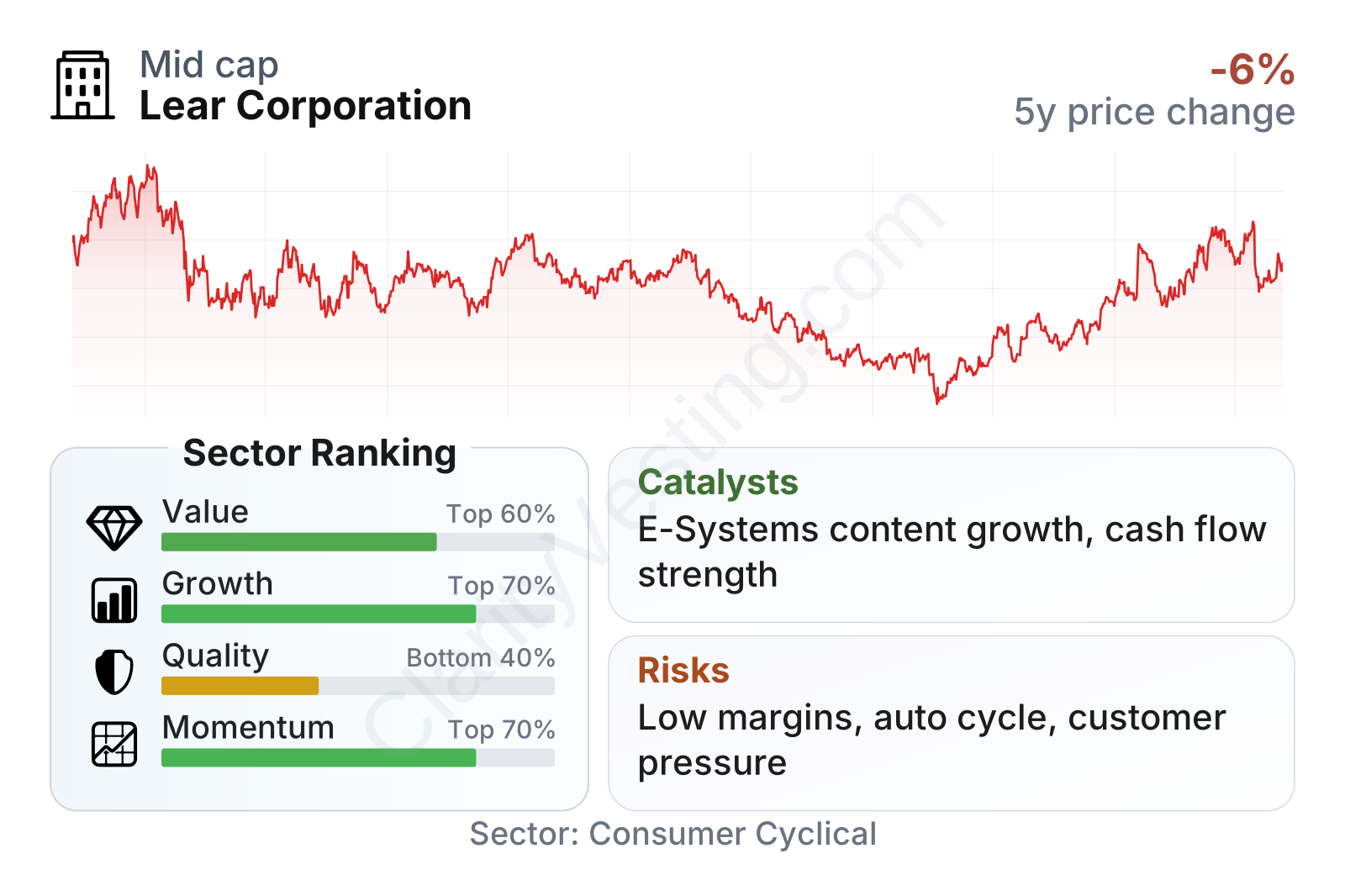
Lear appears mid-sized within the public auto-parts universe, with share-price behavior that is more volatile than the broader market. On valuation metrics, it screens cheaper than the sector median, with a P/E ratio around the low teens and stronger-than-median cash flow yield. Growth is more mixed: recent revenue growth has been positive but modest, while five-year free cash flow expansion stands out as a clear strength. The weaker area is quality, where margins and returns on capital remain below typical sector levels, even though leverage on a debt-to-equity basis is not especially stretched compared with peers.
Growth
Lear operates in a sector that is not a classic high-growth industry, but it does sit in parts of the vehicle market that can still expand faster than overall auto production. The most important long-term growth angle is the rising amount of electronics, power management, connectivity, and comfort content inside each vehicle. Even if global car production grows only slowly, suppliers can still grow if the value of their content per vehicle rises. That is especially relevant for Lear’s E-Systems segment.
The company’s strategy is broadly logical for this environment. Seating gives it scale, long customer relationships, and recurring platform business. E-Systems gives it exposure to trends that matter for the next generation of vehicles, including electrification, energy management, zonal architecture, and higher electrical complexity. This combination can be attractive because one segment provides breadth and manufacturing reach while the other offers a better structural growth profile.
Revenue growth has been uneven, which is normal in auto supply because production schedules, model launches, and regional demand swings can cause abrupt changes. After stronger growth in 2022 and 2023, the pace slowed materially in 2024 and then improved again into 2025 and 2026, landing in the low-single-digit percentage range most recently. That suggests the business is still growing, but not at a pace that removes pressure on execution.
Cash generation is a more encouraging part of the picture. Trailing free cash flow has recovered sharply from the low levels seen earlier in the cycle and has moved into a much stronger range. For a mature manufacturer, this matters because durable cash flow can support new program spending, debt management, restructuring needs, and capital returns without relying too heavily on outside financing.
Recent company communications have also emphasized operational improvement, restructuring actions, and efforts to focus resources on higher-value programs. In addition, automakers continue to push new electrical architectures and more advanced interior features, which creates a practical opening for suppliers that already have global engineering and production footprints. For Lear, the strongest catalyst is not a single headline event but the possibility of steadily increasing content per vehicle in E-Systems while keeping seating profitable and disciplined.
Risks
This article is for informational purposes only and does not constitute financial advice. Some content is AI-generated. See Disclaimer