Stock Analysis · Leidos Holdings Inc (LDOS)
Overview
Leidos Holdings is a large U.S. government contractor focused on technology-enabled services. In simple terms, it helps federal agencies and other customers run complex missions involving national security, health, civil government operations, digital modernization, data analytics, managed services, and engineering. Its work ranges from supporting defense and intelligence programs to modernizing IT systems for civilian agencies and operating transportation or public-health related platforms.
The business is largely driven by long-term contracts, with the U.S. government as the core customer base. That usually makes demand steadier than in many commercial technology markets, but it also means results are closely tied to federal budgets, procurement timing, and contract execution.
Based on the company’s segment reporting, revenue is mainly generated from the following activities:
- National Security & Digital: approximately 44% of revenue. This includes work for the Defense Department, intelligence community, homeland security customers, cyber operations, digital modernization, mission software, and related technical services.
- Health & Civil: approximately 36% of revenue. This covers civilian federal agencies and public-sector health programs, including managed health and benefits platforms, IT modernization, scientific support, and citizen-service systems.
- Commercial & International: approximately 20% of revenue. This segment includes transportation, energy, utilities, aviation, and selected international government and commercial contracts.
Over the past few years, the company has expanded revenue while also lifting gross profit and operating income after a difficult 2023. That matters because Leidos is not just growing sales; it has recently shown a clearer ability to convert that activity into earnings and cash generation.
The long-term pattern points to a business with rising revenue, improving gross profit, and a notable recovery in profitability after the 2023 setback. Cost of revenue remains high, which is normal for a services-heavy contractor, so margin discipline and contract execution are especially important.
Key Figures
| Metric | Value | Sector ⓘ |
|---|---|---|
| Date | Sep 12, 2026 | |
| Context | ||
| Sector | Technology | |
| Industry | Information Technology Services | |
| Market Cap ⓘ | $16.26B | |
| Beta ⓘ | 0.57 | |
Value (Cheapness) | ||
| P/E Ratio ⓘ | 11.96 | 29.51 |
| FCF Yield ⓘ | 13.30% | 4.25% |
| EBIT / EV ⓘ | 10.24% | 2.85% |
| PEG ⓘ | 2.46 | |
Growth (Business expansion) | ||
| Revenue Growth ⓘ | 7.20% | 15.40% |
| RPS Growth (5Y CAGR) ⓘ | 7.79% | 8.56% |
| EPS Growth (5Y CAGR) ⓘ | -0.88% | -11.88% |
| Margin Growth (5Y Trend) ⓘ | 3.88% | 0.46% |
| FCF Growth (5Y CAGR) ⓘ | 15.07% | 9.80% |
Quality (Business durability) | ||
| ROIC (Latest) ⓘ | 16.21% | 9.44% |
| ROIC (5Y Median) ⓘ | 10.16% | 8.30% |
| Net Debt / EBIT (Latest) ⓘ | 3.07 | 0.54 |
| Net Debt / EBIT (5Y Median) ⓘ | 4.29 | 0.44 |
| Operating Margin (Latest) ⓘ | 12.18% | 9.58% |
| Operating Margin (5Y Median) ⓘ | 8.38% | 8.25% |
| Debt to Equity (Latest) ⓘ | 124.49% | 33.33% |
| Profit Margin (Latest) ⓘ | 7.80% | 7.14% |
| Free Cash Flow (Latest) ⓘ | $2.16B | |
Momentum (Price trend) | ||
| 3Y Return ⓘ | +39.20% | +45.48% |
| 12M Return (excl. last month) ⓘ | -20.32% | +23.48% |
| 6M Return ⓘ | -25.42% | +20.93% |
| Price vs. 200-Day MA ⓘ | -14.87% | +7.43% |
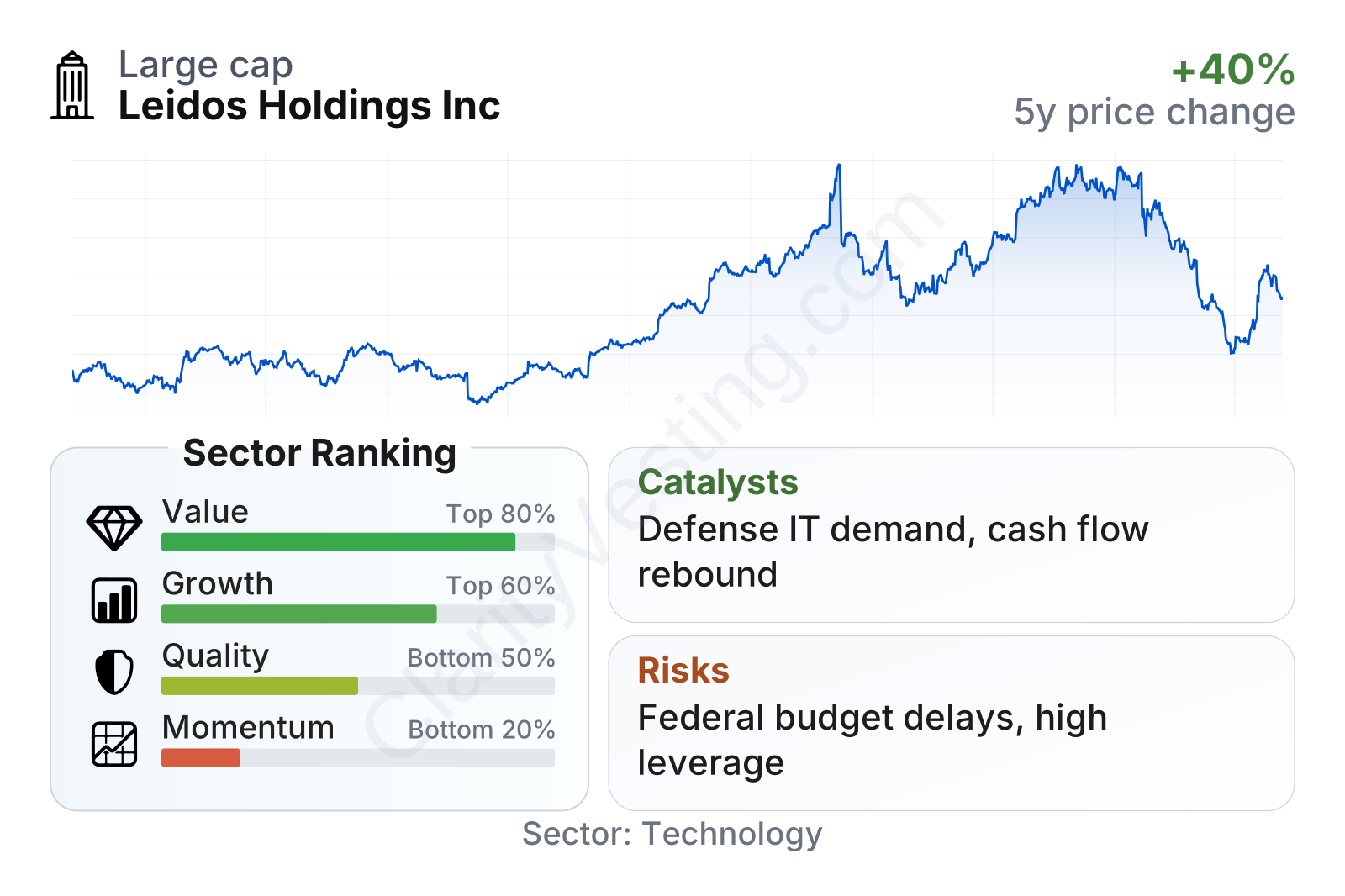
Leidos stands out more for cash generation and valuation than for rapid expansion. The company screens well on value, with an earnings multiple well below the sector median and a free cash flow yield that is much stronger than most peers. Growth is more moderate: recent revenue growth is positive, but below the broader technology median. Quality is mixed, with healthy returns on invested capital and solid operating margins offset by much heavier leverage than is typical in the sector. Share-price momentum has been weak in the recent period despite a solid longer-term performance record.
In size, Leidos is a large mid-cap to lower large-cap company. Its beta is below 1, which suggests the stock has historically moved less violently than the broader market.
Growth
Leidos operates in several areas with durable long-term demand. Defense IT, cyber, intelligence support, digital modernization of government systems, health platform outsourcing, and critical infrastructure technology are all backed by structural needs rather than short-lived consumer trends. Governments still need secure networks, data tools, mission software, and specialized engineering, and those needs tend to persist across economic cycles.
The company’s strategy is coherent for that environment. Leidos focuses on mission-critical contracts where technical expertise, security clearances, past performance, and the ability to manage large programs matter more than flashy product launches. That can create a more predictable path to growth than in many traditional software names, even if the pace is slower. Its recent financial trend supports that view: revenue has generally advanced in the mid-single-digit range to high-single-digit range, with a return to stronger profitability after 2023.
Revenue growth has not been perfectly smooth, but the broader pattern remains positive. After a brief contraction late in 2025, growth turned positive again and moved back into the high-single-digit area by mid-2026. That suggests demand has remained intact even if contract timing creates occasional bumps.
Cash generation has improved sharply over the last several years, with trailing free cash flow rising from well under $1 billion to roughly $2 billion. That is one of the most encouraging features in the current profile because strong cash conversion gives Leidos more flexibility for debt management, acquisitions, share repurchases, and continued investment in capabilities.
Recent company updates have also highlighted demand in areas such as defense modernization, managed health services, and AI-enabled mission support. Leidos has been positioning itself around higher-priority federal spending categories including cyber resilience, digital engineering, and advanced analytics. Those are sensible areas to target because they align with customer needs that are becoming more important, not less.
A meaningful catalyst is the broader U.S. defense and national security environment. Even when budget debates slow individual contract awards, the need for intelligence, cybersecurity, border and homeland security support, and military modernization remains elevated. Another catalyst is the company’s backlog and pipeline of recompetes and new awards, which can support multi-year revenue visibility if execution stays disciplined.
Risks
This article is for informational purposes only and does not constitute financial advice. Some content is AI-generated. See Disclaimer


