Stock Analysis · LCI Industries (LCII)
Overview
LCI Industries is a supplier of components used mainly in recreational vehicles, but also in adjacent transportation and outdoor markets. Through its Lippert operating brand, the company designs and manufactures products that go into RVs, trailers, boats, buses, trucks, and a range of aftermarket upgrades. In simple terms, it is not primarily selling finished campers or trailers to consumers; it is selling the parts, systems, and accessories that manufacturers and owners use.
The business is built around both original equipment sales, meaning parts sold to vehicle manufacturers, and aftermarket sales, meaning replacement parts and upgrades sold after the vehicle has been purchased. That mix matters because original equipment demand tends to rise and fall with production cycles, while aftermarket demand is usually steadier.
Based on recent company reporting, revenue is organized across several end markets. The largest source remains the North American RV market, with diversification efforts aimed at reducing dependence on that single category over time.
- North American OEM RV components: approximately 57% of revenue in 2025. This includes chassis and suspension parts, slide-out systems, windows, doors, furniture, awnings, steps, kitchen and bathroom components, and other content installed by RV manufacturers.
- Aftermarket components and accessories: approximately 22% of revenue. This includes replacement parts, upgrades, towing products, accessories, and consumer-facing items sold through dealers, distributors, and e-commerce channels.
- Adjacent OEM businesses outside RV: approximately 21% of revenue. This includes marine, utility trailer, automotive aftermarket, bus, and truck-related products.
This mix shows a company that is still heavily tied to RV production, but no longer only an RV supplier. Over the last several years, management has emphasized aftermarket expansion, marine exposure, and other adjacent categories to make results less cyclical than they were in the past.
The broader financial picture shows a manufacturer with high cost of goods relative to revenue, which is normal for a component supplier, and earnings that can swing sharply depending on volume. Revenue peaked above $5 billion in 2022, fell during the industry downturn in 2023 and 2024, and then recovered in 2025, while profitability also improved from the trough.
The business model is therefore straightforward: large production volumes can lift margins quickly, but lower factory activity in RVs can pressure sales and earnings just as quickly.
Key Figures
| Metric | Value | Sector ⓘ |
|---|---|---|
| Date | Sep 12, 2026 | |
| Context | ||
| Sector | Consumer Cyclical | |
| Industry | Recreational Vehicles | |
| Market Cap ⓘ | $2.27B | |
| Beta ⓘ | 1.18 | |
Value (Cheapness) | ||
| P/E Ratio ⓘ | 10.82 | 17.10 |
| FCF Yield ⓘ | 7.91% | 8.53% |
| EBIT / EV ⓘ | N/A | 6.46% |
| PEG ⓘ | 1.04 | |
Growth (Business expansion) | ||
| Revenue Growth ⓘ | -12.50% | 5.75% |
| RPS Growth (5Y CAGR) ⓘ | -1.46% | 9.14% |
| EPS Growth (5Y CAGR) ⓘ | -26.46% | -18.21% |
| Margin Growth (5Y Trend) ⓘ | -1.90% | -0.23% |
| FCF Growth (5Y CAGR) ⓘ | N/A | 4.91% |
Quality (Business durability) | ||
| ROIC (Latest) ⓘ | N/A | 12.61% |
| ROIC (5Y Median) ⓘ | 9.64% | 10.72% |
| Net Debt / EBIT (Latest) ⓘ | N/A | 2.10 |
| Net Debt / EBIT (5Y Median) ⓘ | 3.53 | 2.32 |
| Operating Margin (Latest) ⓘ | N/A | 9.25% |
| Operating Margin (5Y Median) ⓘ | 7.05% | 9.64% |
| Debt to Equity (Latest) ⓘ | 80.05% | 75.78% |
| Profit Margin (Latest) ⓘ | 5.24% | 5.33% |
| Free Cash Flow (Latest) ⓘ | $179.53M | |
Momentum (Price trend) | ||
| 3Y Return ⓘ | -12.91% | +14.53% |
| 12M Return (excl. last month) ⓘ | +10.38% | +3.08% |
| 6M Return ⓘ | -23.91% | +0.55% |
| Price vs. 200-Day MA ⓘ | -21.03% | -0.54% |
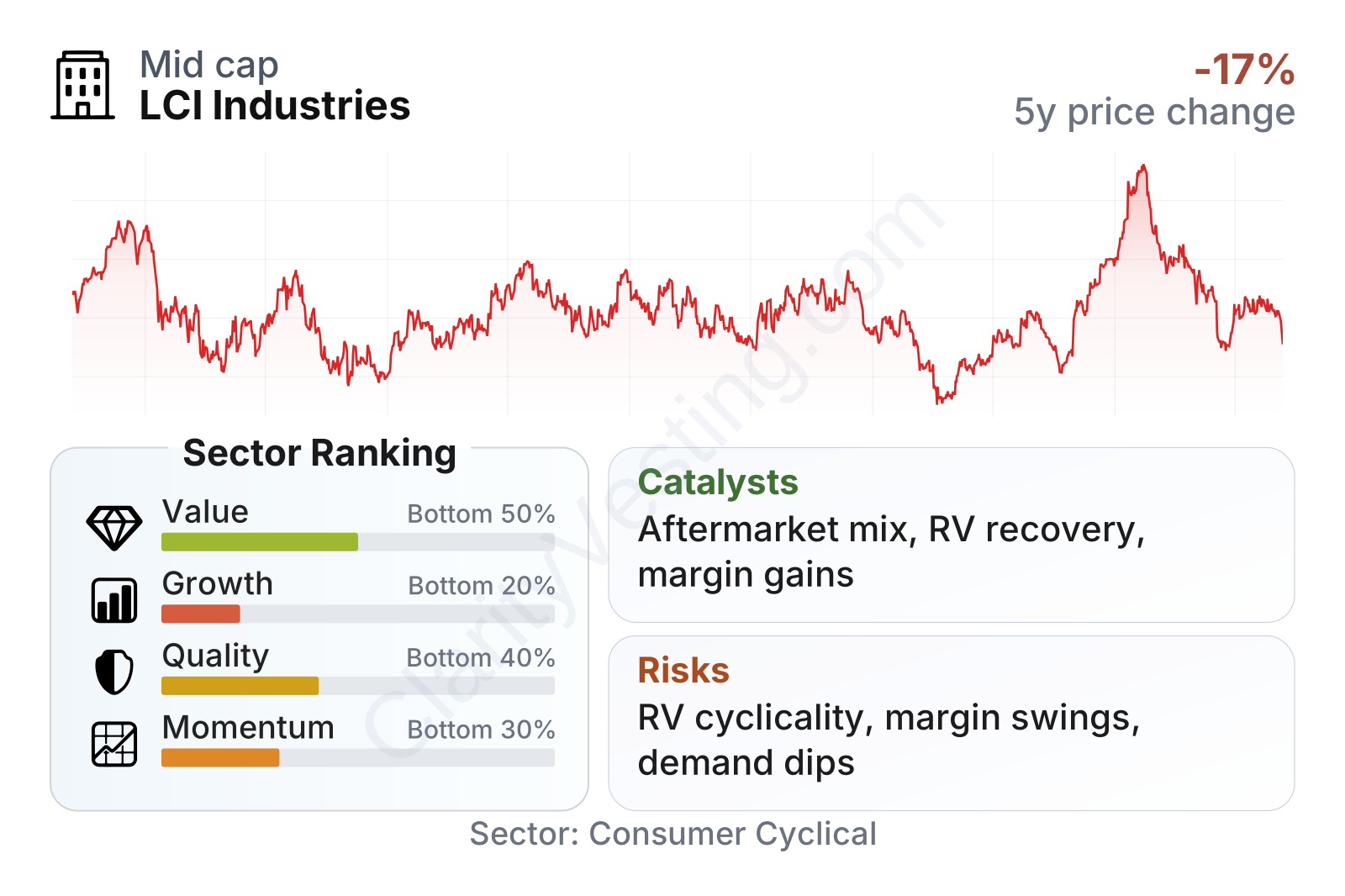
LCI Industries is a mid-sized company with a stock that has been notably cyclical. The share price moved through a strong rise, a deep pullback, and then another sharp rebound before weakening again, which fits the pattern of a business exposed to discretionary consumer demand. On the factor view, valuation looks cheaper than the sector on earnings, but the company ranks weaker on growth, below average on quality, and soft on recent momentum. In other words, the market is not assigning a premium multiple because recent operating trends have been mixed and the business remains tied to a volatile industry cycle.
Growth
The long-term growth case is tied to two ideas happening at the same time. First, RV and outdoor recreation remain meaningful consumer categories in North America, supported by campground investment, aging vehicle fleets, and a large installed base that needs maintenance and upgrades. Second, LCI is trying to expand faster-growing and more resilient lines, especially aftermarket, towing, marine, and international opportunities.
That strategy makes sense because the company’s biggest challenge has always been concentration in RV production. If more sales come from replacement parts, accessories, and non-RV markets, revenue should become less dependent on new unit builds. This is especially important in an industry where dealer inventories, interest rates, and consumer confidence can all move demand quickly.
Recent revenue growth shows exactly how cyclical the business can be. After very strong gains in 2021 and early 2022, sales contracted sharply through 2023, stabilized during 2024, improved again through much of 2025, and then turned negative in the latest period at roughly -13% year over year. That pattern suggests recovery is not yet firmly established. It also explains why the company screens poorly on longer-term growth measures despite signs of improvement from the downturn.
Cash generation tells a similar but slightly more encouraging story. Free cash flow turned strongly positive after the downturn and remained solid for several periods, although the latest trailing twelve-month level is much lower than the peak years. That suggests the company still has the ability to produce cash through the cycle, but not with the same consistency as less cyclical industrial businesses.
One of the more important catalysts is content growth per unit. Even if RV production grows only modestly, LCI can still expand if it supplies more systems and accessories on each vehicle. The company has also continued to broaden its product lineup, which can deepen customer relationships and raise the value of each build it serves.
Another potential opportunity comes from normalization in dealer inventory and replacement demand. When vehicle production recovers from low levels, suppliers can see earnings rebound faster than sales because fixed costs are spread across more units. For LCI, that operating leverage is meaningful. Company communications in 2026 also continued to highlight restructuring, operational efficiency, and portfolio management efforts, which could support margins if volume improves.
Risks
This article is for informational purposes only and does not constitute financial advice. Some content is AI-generated. See Disclaimer


