Stock Analysis · Lucid Group Inc (LCID)
Overview
Lucid Group is an electric vehicle manufacturer focused on premium cars, related software, and EV technology. The company designs, engineers, produces, and sells its vehicles directly to customers, with a current lineup centered on the Lucid Air sedan and the newer Lucid Gravity SUV. It also develops core technologies such as battery systems, powertrains, charging architecture, and vehicle software. For a long-term reader, the simplest way to see Lucid is as a young EV maker trying to turn advanced engineering into a scalable car business.
Revenue is still concentrated in vehicle sales, with other streams remaining much smaller. Based on recent annual filings, the mix is approximately:
- Vehicle sales: about 90% to 95% of revenue. This includes sales of Lucid Air and early Lucid Gravity deliveries where recognized.
- Regulatory credits: about 4% to 8%. These are credits sold to other automakers that need help meeting emissions rules.
- Services and other: about 1% to 3%. This includes after-sales activities and other smaller commercial items.
That concentration matters. Lucid is not yet a diversified industrial group with large software subscriptions or financing income. It is still mainly a car company, and that means production, pricing, and delivery execution have an outsized impact on results.
The business flow also shows a familiar pattern for an early-stage automaker: revenue has climbed sharply from the first commercial years, but manufacturing costs and operating expenses have remained far above sales. Research and development spending is still heavy, reflecting ongoing work on new models, efficiency improvements, and platform expansion.
One notable trend is that revenue has expanded a lot since commercialization began, but the cost of building vehicles has continued to exceed sales, keeping gross profit negative. At the same time, spending on engineering and selling infrastructure remains elevated, which shows Lucid is still in a build-out phase rather than a mature earnings phase.
Key Figures
| Metric | Value | Sector ⓘ |
|---|---|---|
| Date | Sep 12, 2026 | |
| Context | ||
| Sector | Consumer Cyclical | |
| Industry | Auto Manufacturers | |
| Market Cap ⓘ | $1.65B | |
| Beta ⓘ | 0.81 | |
Value (Cheapness) | ||
| P/E Ratio ⓘ | N/A | 17.10 |
| FCF Yield ⓘ | -398.30% | 8.53% |
| EBIT / EV ⓘ | -84.91% | 6.46% |
| PEG ⓘ | N/A | |
Growth (Business expansion) | ||
| Revenue Growth ⓘ | 56.20% | 5.75% |
| RPS Growth (5Y CAGR) ⓘ | 83.32% | 9.14% |
| EPS Growth (5Y CAGR) ⓘ | -20.59% | -18.21% |
| Margin Growth (5Y Trend) ⓘ | N/A | -0.23% |
| FCF Growth (5Y CAGR) ⓘ | N/A | 4.91% |
Quality (Business durability) | ||
| ROIC (Latest) ⓘ | -99.50% | 12.61% |
| ROIC (5Y Median) ⓘ | -32.94% | 10.72% |
| Net Debt / EBIT (Latest) ⓘ | N/A | 2.10 |
| Net Debt / EBIT (5Y Median) ⓘ | N/A | 2.32 |
| Operating Margin (Latest) ⓘ | -251.27% | 9.25% |
| Operating Margin (5Y Median) ⓘ | -331.73% | 9.64% |
| Debt to Equity (Latest) ⓘ | 181.87% | 75.78% |
| Profit Margin (Latest) ⓘ | -249.21% | 5.33% |
| Free Cash Flow (Latest) ⓘ | -$6.56B | |
Momentum (Price trend) | ||
| 3Y Return ⓘ | -92.86% | +14.53% |
| 12M Return (excl. last month) ⓘ | -71.19% | +3.08% |
| 6M Return ⓘ | -57.11% | +0.55% |
| Price vs. 200-Day MA ⓘ | -49.24% | -0.54% |
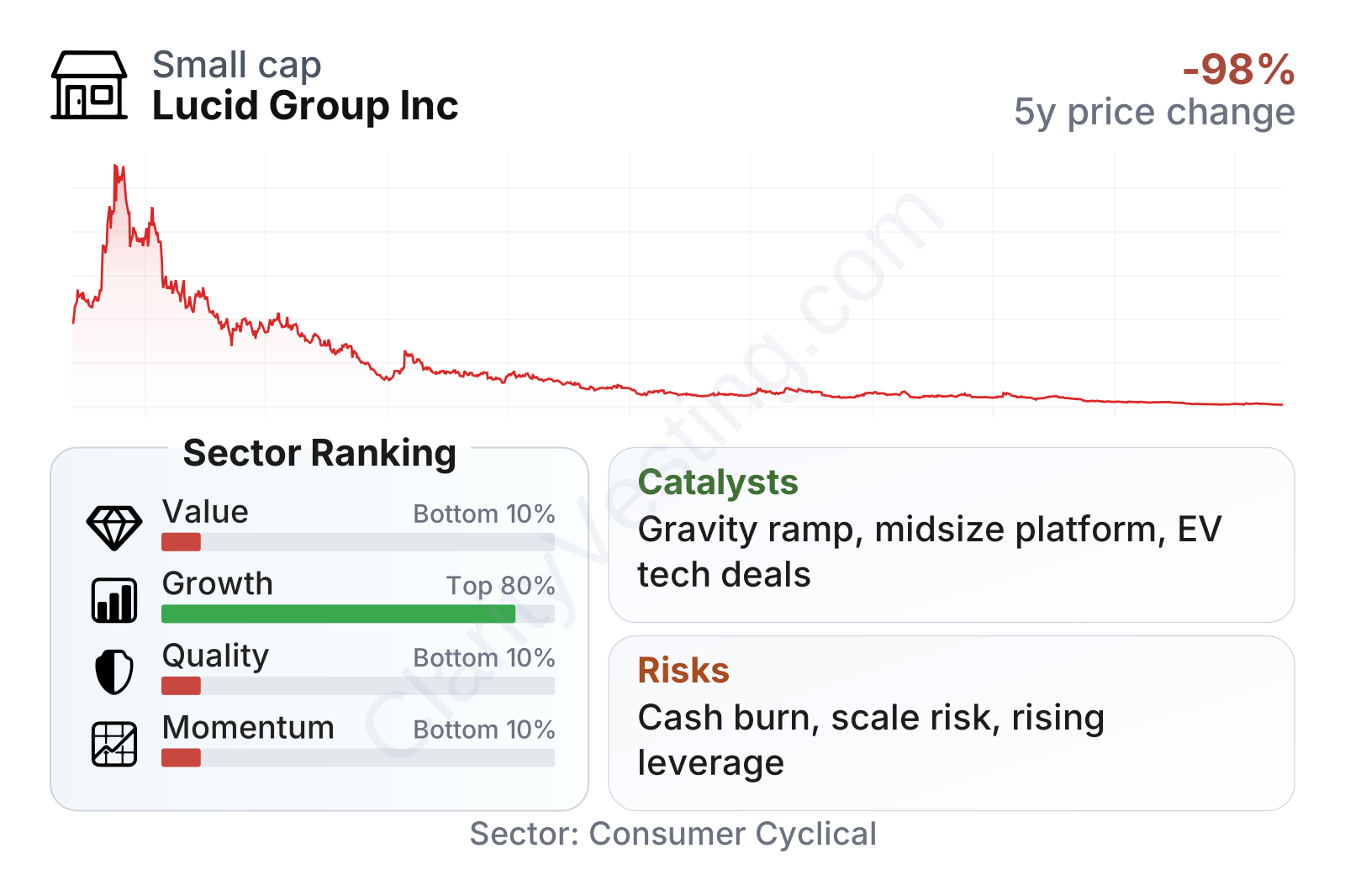
Lucid sits in the lower end of its sector on value, quality, and share-price momentum, while ranking much better on revenue growth. In plain English, the market is looking at a company that is growing sales faster than many auto peers, but doing so with weak profitability, deeply negative cash generation, and a stock that has lost substantial ground over several years. Its size is now much smaller than during the market’s earlier EV enthusiasm, and its beta below 1 suggests the shares have not recently behaved like the most extreme high-volatility names, even though the long-term decline has been severe.
Growth
Lucid operates in the electric vehicle market, which is still a structurally growing segment of the auto industry even if growth has become less uniform than a few years ago. Over the long run, tighter emissions rules, battery improvements, software-defined vehicles, and consumer interest in lower-fuel-cost transportation continue to support EV adoption. That broad backdrop is favorable, but the sector has also become more competitive and more price-sensitive.
Lucid’s strategy for growth is built around differentiation rather than volume leadership today. The company emphasizes long driving range, powertrain efficiency, premium design, and in-house engineering. That approach makes strategic sense if Lucid can build a durable luxury brand and later apply its technology to a wider set of vehicles. The Gravity SUV is especially important because SUVs are a much larger category than luxury sedans in the U.S. market, which could improve the company’s addressable demand if production ramps smoothly.
Revenue growth has been strong on a year-over-year basis, with the latest reading around 56%, far above the sector median near 6%. That is encouraging, but context matters: Lucid is growing from a relatively small base, and earlier quarterly growth rates were highly volatile. For a business at this stage, the key question is not just whether revenue rises, but whether higher deliveries lead to better manufacturing efficiency and a path toward less negative margins.
That remains the major growth challenge. Free cash flow is still deeply negative, and the recent trend shows large ongoing cash use rather than a steady improvement. In practical terms, Lucid is still spending heavily to scale production, develop future vehicles, and support its retail and service footprint. Growth is real, but it is expensive growth.
Recent company updates have kept attention on production expansion, Gravity launch progress, and Lucid’s broader technology ambitions. Another potential catalyst is the planned midsize platform, which management has presented as a route toward a more accessible price point and meaningfully larger market opportunity than the current premium lineup. If Lucid can move from a niche luxury player into a broader premium-to-upper-mainstream EV space without losing its efficiency edge, the long-term opportunity becomes easier to understand.
There is also a strategic angle beyond selling cars. Lucid has repeatedly highlighted its proprietary EV technology, and any future partnerships, licensing, or supply agreements could strengthen the business model. Those opportunities are not yet the core revenue engine, but they help explain why the company is often evaluated on engineering capability as much as current sales volume.
Risks
This article is for informational purposes only and does not constitute financial advice. Some content is AI-generated. See Disclaimer


