Stock Analysis · Liberty Global PLC (LBTYB)
Overview
Liberty Global PLC is a telecommunications and connectivity company. In simple terms, it owns and operates broadband, video, mobile, and business-to-business communications networks, mainly in Europe. The group has changed a lot over the years through asset sales, joint ventures, and portfolio reshaping, so today it is less of a traditional single-country cable operator and more of a holding company built around core telecom assets, infrastructure interests, and strategic investments.
Its main operating businesses are centered on consumer broadband and mobile subscriptions, pay TV and entertainment services, and connectivity solutions for companies. Liberty Global also has exposure to network infrastructure and digital platforms through joint ventures and investments, which can make reported results less straightforward than those of a simpler telecom operator.
Based on recent annual reporting, the largest recurring revenue streams come from its telecom operations. Approximate revenue mix can be summarized as follows:
- Broadband and fixed connectivity: about 35% to 40% — residential internet access, often bundled with Wi‑Fi equipment and related services.
- Mobile services: about 25% to 30% — postpaid and prepaid plans, handset-related activity, and mobile data usage.
- Video and entertainment: about 15% to 20% — pay TV packages, content distribution, and set-top related services.
- Business services: about 10% to 15% — connectivity, voice, data, and IT-related telecom solutions for enterprises and smaller businesses.
- Other revenue: under 10% — installation, interconnection, wholesale, advertising, and other ancillary items.
One important point for long-term readers is that Liberty Global’s reported profit can swing sharply because the company also records gains, losses, revaluations, and restructuring effects tied to investments and portfolio moves. That means the business is best understood through its asset base, cash generation, and strategic direction rather than net income alone.
The business mix has become smaller in revenue terms than it was several years ago, but recent years show a steadier gross profit base and lower interest expense than earlier periods. Reported earnings remain volatile, which reflects the holding-company structure and asset revaluations more than a simple deterioration in day-to-day telecom demand.
Key Figures
| Metric | Value | Sector ⓘ |
|---|---|---|
| Date | Sep 12, 2026 | |
| Context | ||
| Sector | Communication Services | |
| Industry | Telecom Services | |
| Market Cap ⓘ | $4.31B | |
| Beta ⓘ | 0.74 | |
Value (Cheapness) | ||
| P/E Ratio ⓘ | N/A | 18.61 |
| FCF Yield ⓘ | -17.11% | 13.68% |
| EBIT / EV ⓘ | 1.78% | 4.54% |
| PEG ⓘ | 0.35 | |
Growth (Business expansion) | ||
| Revenue Growth ⓘ | -7.70% | 5.40% |
| RPS Growth (5Y CAGR) ⓘ | -7.21% | 4.62% |
| EPS Growth (5Y CAGR) ⓘ | -43.15% | -18.01% |
| Margin Growth (5Y Trend) ⓘ | -281.16% | 1.10% |
| FCF Growth (5Y CAGR) ⓘ | N/A | 5.88% |
Quality (Business durability) | ||
| ROIC (Latest) ⓘ | 0.37% | 8.38% |
| ROIC (5Y Median) ⓘ | 2.52% | 8.32% |
| Net Debt / EBIT (Latest) ⓘ | 36.47 | 1.99 |
| Net Debt / EBIT (5Y Median) ⓘ | 3.33 | 2.94 |
| Operating Margin (Latest) ⓘ | 3.70% | 14.89% |
| Operating Margin (5Y Median) ⓘ | 36.82% | 12.96% |
| Debt to Equity (Latest) ⓘ | 98.37% | 59.59% |
| Profit Margin (Latest) ⓘ | -62.14% | 8.77% |
| Free Cash Flow (Latest) ⓘ | -$738.10M | |
Momentum (Price trend) | ||
| 3Y Return ⓘ | -30.11% | +46.64% |
| 12M Return (excl. last month) ⓘ | +13.08% | +2.16% |
| 6M Return ⓘ | +0.08% | +5.05% |
| Price vs. 200-Day MA ⓘ | -2.19% | +2.88% |
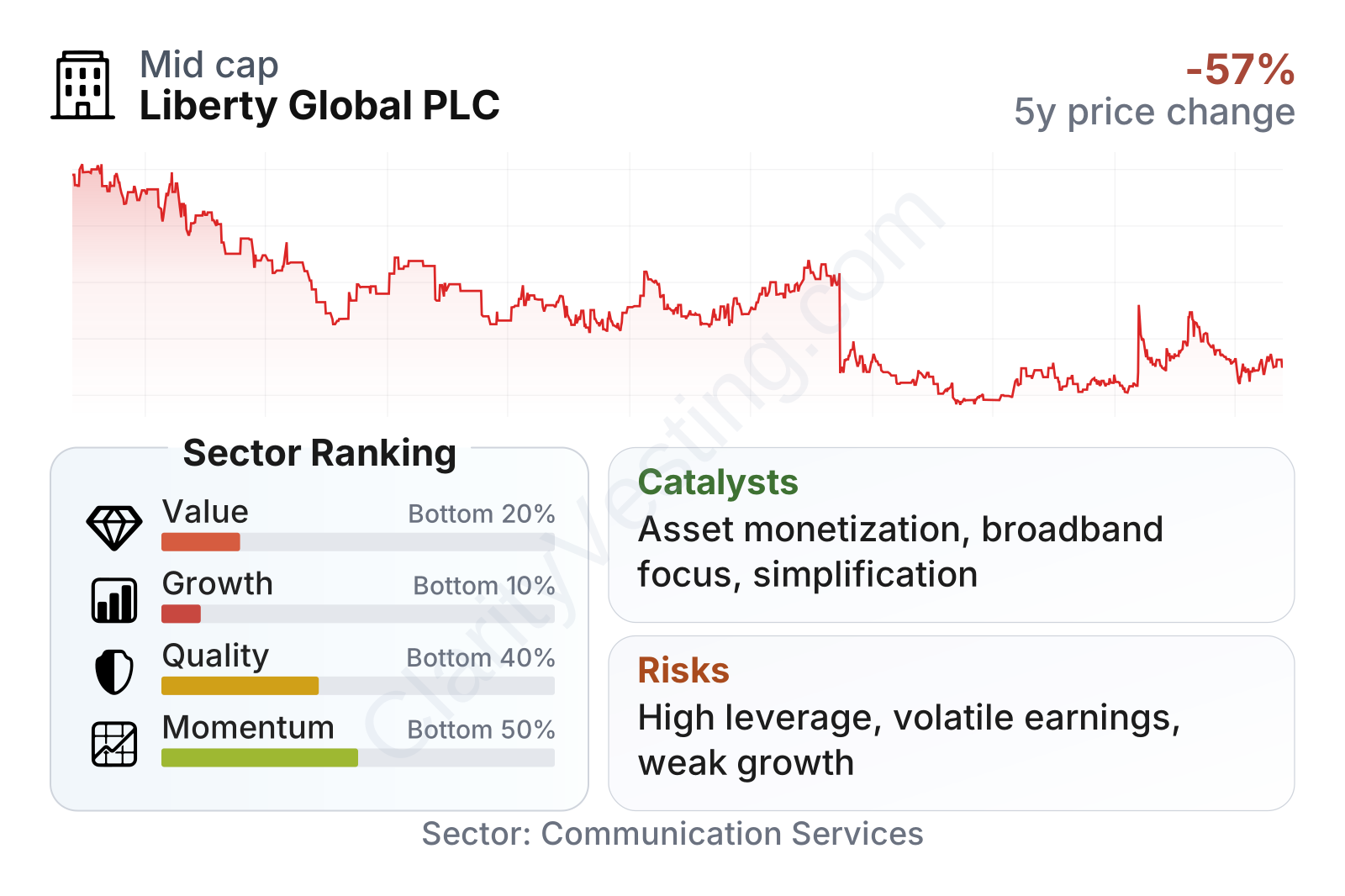
The company sits in the lower half of the sector on value measures overall, even though its free cash flow yield stands out as strong. Growth is the weakest area, with revenue and earnings trends trailing the sector by a wide margin. Quality is also below average because leverage is high and recent returns on invested capital have been low. Momentum has improved more recently, helped by a rebound from depressed levels, but the longer stock record is still uneven.
Liberty Global is a mid-sized public company by market value, and its beta below 1 suggests the shares have been somewhat less sensitive than the broader market. That said, the stock’s own history shows large swings, which fits a business where transactions, restructurings, and asset marks can heavily influence sentiment.
Growth
Telecom and broadband remain essential services, so Liberty Global operates in a sector with durable demand. Households continue to need high-speed internet, mobile connectivity, and home networking, while businesses still rely on data and communications infrastructure. That supports a stable long-term industry backdrop, even if mature European telecom markets usually grow slowly.
Where the growth debate becomes more specific is strategy. Liberty Global has been repositioning itself toward higher-quality connectivity assets, network partnerships, and capital recycling. In practical terms, that means focusing less on being a broad empire of cable systems and more on owning valuable platforms, improving operating efficiency, and unlocking value through joint ventures, infrastructure deals, and targeted investments.
Revenue growth has been inconsistent. There were periods of recovery and positive year-over-year improvement, but the broader pattern remains choppy, and the latest comparison is negative. That supports the view that this is not a straightforward top-line growth company. For long-term analysis, the more relevant question is whether the asset portfolio can produce resilient cash flows and benefit from consolidation and infrastructure demand.
Free cash flow has historically been meaningful, but the recent trend has weakened sharply from earlier levels. Even after that decline, Liberty Global still generates cash, which matters because telecom assets often require heavy network investment and carry substantial financing obligations. A recovery in cash generation would be one of the clearest signs that the current structure is becoming more productive.
Potential catalysts exist. Broadband upgrades, mobile convergence, and monetization of infrastructure or non-core holdings can all create value without requiring very fast underlying market growth. The company has also continued to work through portfolio simplification and capital allocation decisions that could make the business easier to assess over time. In a company like Liberty Global, strategic actions can matter as much as organic subscriber growth.
Recent company communications have continued to emphasize portfolio optimization, operating discipline, and the value of core connectivity assets. That does not automatically translate into fast expansion, but it does suggest a credible path built around efficiency, selective investment, and asset monetization rather than aggressive spending.
Risks
This article is for informational purposes only and does not constitute financial advice. Some content is AI-generated. See Disclaimer


