Stock Analysis · Liberty Broadband (LBRDK)
Overview
Liberty Broadband is a holding company whose value is tied mainly to broadband and cable infrastructure rather than a broad collection of operating businesses. Its most important asset is its large ownership stake in Charter Communications, the cable and broadband company that operates the Spectrum brand in the United States. Liberty Broadband also owns GCI, a telecommunications provider in Alaska offering broadband, wireless, and business connectivity services.
That structure matters for long-term analysis because Liberty Broadband is not a typical telecom operator. In practice, shareholders are getting a combination of two pieces: a large look-through exposure to Charter’s nationwide broadband business and a smaller but directly consolidated operating business through GCI. The company has also been simplifying its structure in recent years, which makes the Charter stake even more central to the investment case.
The main sources of revenue are therefore concentrated and relatively easy to understand:
- GCI operating revenue: likely the large majority of reported revenue, generated from consumer broadband, wireless, video, and enterprise telecom services in Alaska.
- Other operating and corporate items: a small share of reported revenue or corporate activity.
- Economic value from Charter stake: this is the most important driver of Liberty Broadband’s net asset value, even though it is not reported as ordinary operating revenue in the same way as GCI sales.
Recent annual revenue has been around the $1 billion level, which indicates that reported sales mostly reflect GCI, while the company’s market value is influenced far more by the changing value of its Charter ownership. That is why Liberty Broadband can look unusual on standard revenue and earnings measures compared with ordinary telecom companies.
The flow of earnings over the last few years also shows this mixed profile. Revenue had been relatively stable near $1 billion through 2024, with healthy gross profit, but 2025 brought a sharp break with lower reported revenue and a large accounting loss. That kind of swing is consistent with a holding-company structure where valuation changes, restructuring effects, or asset-related charges can distort headline profit.
The broad picture is a business with steady underlying telecom revenue from Alaska, paired with a much larger strategic exposure to U.S. broadband through Charter. That makes Liberty Broadband less diversified than its size might suggest, but also easier to understand once the ownership structure is clear.
Key Figures
| Metric | Value | Sector ⓘ |
|---|---|---|
| Date | Jun 22, 2026 | |
| Context | ||
| Sector | Communication Services | |
| Industry | Telecom Services | |
| Market Cap ⓘ | $4.25B | |
| Beta ⓘ | 0.65 | |
Value (Cheapness) | ||
| P/E Ratio ⓘ | N/A | 18.53 |
| FCF Yield ⓘ | -3.93% | 12.78% |
| EBIT / EV ⓘ | N/A | 4.61% |
| PEG ⓘ | N/A | |
Growth (Business expansion) | ||
| Revenue Growth ⓘ | 6.10% | 6.10% |
| RPS Growth (5Y CAGR) ⓘ | -7.06% | 5.02% |
| EPS Growth (5Y CAGR) ⓘ | -41.65% | -30.26% |
| Margin Growth (5Y Trend) ⓘ | -575.31% | 1.41% |
| FCF Growth (5Y CAGR) ⓘ | N/A | 5.63% |
Quality (Business durability) | ||
| ROIC (Latest) ⓘ | N/A | 8.93% |
| ROIC (5Y Median) ⓘ | 0.18% | 8.02% |
| Net Debt / EBIT (Latest) ⓘ | N/A | 1.94 |
| Net Debt / EBIT (5Y Median) ⓘ | 3.35 | 2.94 |
| Operating Margin (Latest) ⓘ | N/A | 15.80% |
| Operating Margin (5Y Median) ⓘ | 2.87% | 13.53% |
| Debt to Equity (Latest) ⓘ | 43.49% | 53.17% |
| Profit Margin (Latest) ⓘ | N/A | 9.56% |
| Free Cash Flow (Latest) ⓘ | -$167.00M | |
Momentum (Price trend) | ||
| 3Y Return ⓘ | -58.69% | +36.98% |
| 12M Return (excl. last month) ⓘ | -64.09% | +7.39% |
| 6M Return ⓘ | -39.14% | 0.00% |
| Price vs. 200-Day MA ⓘ | -39.68% | +3.18% |
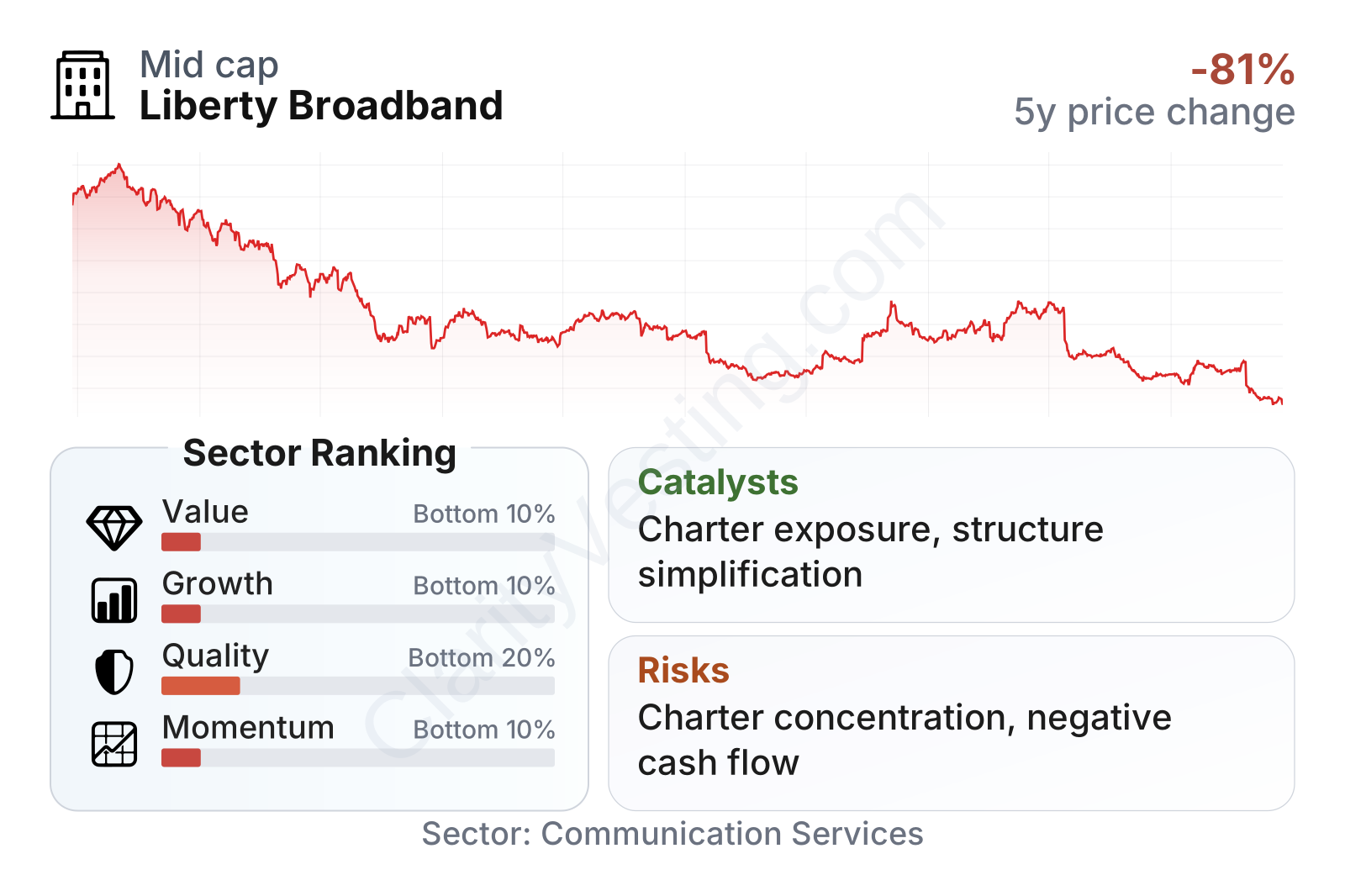
At a high level, the current profile looks weak on conventional factor screens. Market capitalization is in the mid-single-digit billions, and share price performance has been poor over one, three, and even shorter periods. Growth, quality, and momentum all rank near the bottom of the communication-services sector, while valuation metrics are difficult to read cleanly because earnings and free cash flow have recently been distorted. The lower beta suggests the stock has not moved as violently as some peers, but that has not prevented a major decline from 2021 levels.
Growth
Liberty Broadband sits in a sector that still matters for long-term connectivity demand. Broadband remains essential infrastructure for households, mobile backhaul, streaming, cloud services, and enterprise networking. That is supportive in principle. The more difficult question is whether Liberty Broadband itself is positioned to convert that demand into clear, durable per-share growth.
The answer is mixed. Through Charter, the company has exposure to one of the largest cable broadband networks in the country, which remains strategically valuable because replacing fixed network infrastructure is expensive and time-consuming. Through GCI, Liberty Broadband serves Alaska, a market with high barriers to entry due to geography, logistics, and infrastructure needs. Those are real assets in a business where scale and network density matter.
Still, the company’s own reported growth record has been modest. Recent year-over-year revenue growth has recovered into the mid-single digits after a long stretch of flat performance, but the five-year picture remains weak. Revenue per share and earnings trends over that longer period have moved in the wrong direction, which helps explain why the company screens poorly on growth despite some recent improvement.
The more important long-term catalyst is strategic simplification around Charter. If Liberty Broadband continues to narrow the gap between its market value and the value of the assets it owns, that could matter more than small changes in Alaska operating revenue. A cleaner structure can make valuation easier for the market to understand and may reduce the persistent discount that often affects holding companies.
Another area to watch is cash generation. Free cash flow has remained negative on a trailing twelve-month basis and has not yet established a durable positive trend. Even so, the losses have been less severe than a few years ago, which suggests some stabilization rather than a full recovery.
Recent company disclosures have also centered on corporate actions involving its relationship with Charter and broader simplification efforts. For Liberty Broadband, those developments matter because they can reshape how investors value the company more than a normal quarterly sales increase would. In other words, the strongest catalyst is not explosive operating growth; it is the possibility of a more transparent structure built around a prized broadband asset.
Risks
This article is for informational purposes only and does not constitute financial advice. Some content is AI-generated. See Disclaimer