Stock Analysis · nLIGHT Inc (LASR)
Overview
nLIGHT Inc designs and manufactures high-performance lasers and laser-based systems. In simple terms, its products create and control very precise beams of light that are used in industrial manufacturing, aerospace and defense, and other demanding applications. The company has built its business around fiber lasers, diode lasers, semiconductor lasers, and beam-combining technologies that help customers cut, weld, clean, sense, illuminate, or counter threats with high accuracy.
For long-term readers, the most important point is that nLIGHT sits at the intersection of two attractive markets: advanced manufacturing and defense technology. Industrial customers use its lasers in production equipment, while defense customers use its technology in areas such as directed energy, target tracking, and infrared sensing. That gives the company exposure to both cyclical factory spending and longer-cycle government programs.
Based on the company’s recent filings, revenue is mainly organized into two broad end markets.
- Aerospace and Defense: approximately 56% of 2025 revenue. This includes high-energy laser components and systems, directed energy programs, laser sensing, and infrared-related products used in military and aerospace applications.
- Industrial and Microfabrication: approximately 44% of 2025 revenue. This includes lasers and related solutions for cutting, welding, additive manufacturing, battery processing, and precision manufacturing tools.
That mix matters because it shows a business that is no longer mainly tied to industrial demand. Defense has become the larger contributor, which can support growth when factory spending is uneven, although it also brings reliance on program timing and government budgets.
The longer-term financial picture also shows a business that has been investing heavily in research and commercialization. Revenue declined from 2021 through 2024 before recovering in 2025, while operating expenses remained elevated. In 2025, gross profit improved sharply as sales rebounded, but the company still reported a net loss, which means the business is moving in a better direction but has not fully reached durable profitability.
The business mix has become more favorable in the latest year: revenue recovered meaningfully, gross profit expanded, and losses narrowed. The remaining challenge is turning that better sales base into consistent operating profit rather than only periodic improvement.
Key Figures
| Metric | Value | Sector ⓘ |
|---|---|---|
| Date | Sep 12, 2026 | |
| Context | ||
| Sector | Technology | |
| Industry | Semiconductors | |
| Market Cap ⓘ | $2.33B | |
| Beta ⓘ | 2.30 | |
Value (Cheapness) | ||
| P/E Ratio ⓘ | N/A | 29.51 |
| FCF Yield ⓘ | 2.12% | 4.25% |
| EBIT / EV ⓘ | -0.50% | 2.85% |
| PEG ⓘ | 1.78 | |
Growth (Business expansion) | ||
| Revenue Growth ⓘ | 33.80% | 15.40% |
| RPS Growth (5Y CAGR) ⓘ | -5.41% | 8.56% |
| EPS Growth (5Y CAGR) ⓘ | N/A | -11.88% |
| Margin Growth (5Y Trend) ⓘ | N/A | 0.46% |
| FCF Growth (5Y CAGR) ⓘ | N/A | 9.80% |
Quality (Business durability) | ||
| ROIC (Latest) ⓘ | -2.19% | 9.44% |
| ROIC (5Y Median) ⓘ | -13.65% | 8.30% |
| Net Debt / EBIT (Latest) ⓘ | N/A | 0.54 |
| Net Debt / EBIT (5Y Median) ⓘ | N/A | 0.44 |
| Operating Margin (Latest) ⓘ | -3.16% | 9.58% |
| Operating Margin (5Y Median) ⓘ | -21.16% | 8.25% |
| Debt to Equity (Latest) ⓘ | 3.37% | 33.33% |
| Profit Margin (Latest) ⓘ | -4.02% | 7.14% |
| Free Cash Flow (Latest) ⓘ | $49.40M | |
Momentum (Price trend) | ||
| 3Y Return ⓘ | +295.78% | +45.48% |
| 12M Return (excl. last month) ⓘ | +91.48% | +23.48% |
| 6M Return ⓘ | -35.69% | +20.93% |
| Price vs. 200-Day MA ⓘ | -29.83% | +7.43% |
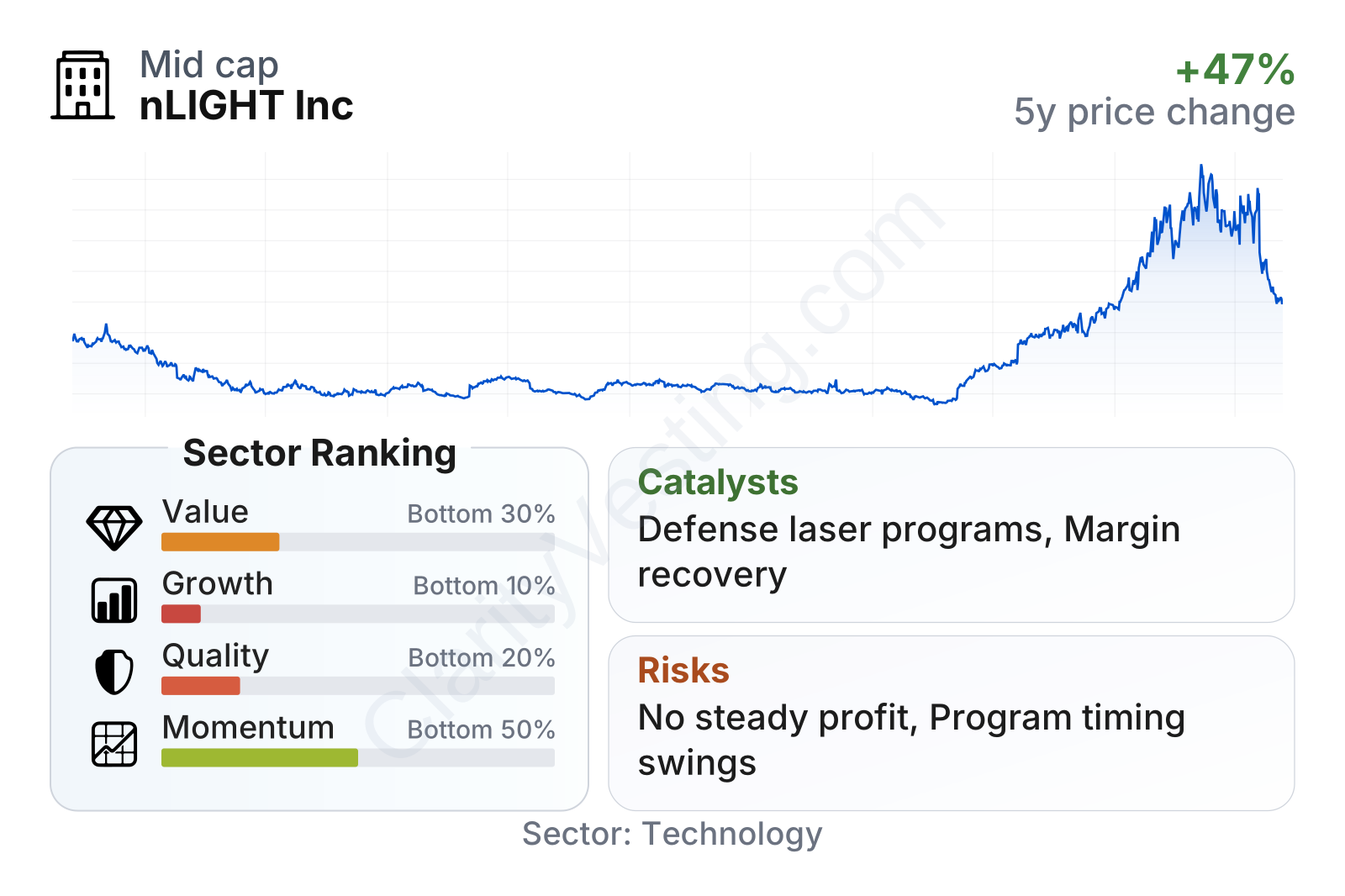
nLIGHT is a mid-sized semiconductor and photonics company with unusually strong share-price momentum over the past one to three years, but the operating profile still looks weaker than much of the sector. Growth recently accelerated well above the industry median, yet profitability, returns on capital, and cash flow yield remain below typical semiconductor levels. The company also carries very little balance-sheet leverage, which is a meaningful stabilizer given its uneven earnings history.
Growth
nLIGHT operates in segments that have long-term expansion potential. Precision laser tools benefit from trends such as factory automation, electrification, battery manufacturing, additive manufacturing, and increasingly complex semiconductor and electronics production. On the defense side, demand is supported by rising interest in counter-drone systems, directed energy weapons, advanced targeting, and electro-optical sensing. These are not niche ideas anymore; they are areas receiving sustained budget and engineering attention across the U.S. and allied countries.
The company’s strategy also makes logical sense. Instead of competing only in standard industrial lasers, where pricing can be very tough, nLIGHT has pushed further into higher-performance applications that require more specialized engineering. Its acquisitions and internal development have strengthened its position in defense and infrared technologies, giving it more ways to supply complete subsystems rather than just standalone laser parts.
Recent revenue trends show a clear rebound after a weak stretch in 2022 through 2024. Growth turned positive again in late 2024 and accelerated materially through 2025 and into 2026, with year-over-year increases moving well above the sector median. That is encouraging, but it is also important to remember that part of the strength comes from recovering off a depressed base rather than from a long uninterrupted expansion.
Cash generation has also improved from earlier negative levels. Free cash flow moved back into positive territory after being inconsistent for several years, which suggests better working capital discipline and stronger conversion from revenue into cash. For a company still reporting net losses, this is one of the more constructive signals because it indicates the business may be getting closer to self-funded growth.
A notable catalyst is the continued scaling of defense programs. nLIGHT has highlighted progress in directed energy and sensing-related products in its public communications, and these programs can become meaningful if they transition from development and testing into larger production orders. Another opportunity comes from industrial normalization: if manufacturing demand improves at the same time defense grows, the company would have two engines supporting expansion rather than one.
Risks
This article is for informational purposes only and does not constitute financial advice. Some content is AI-generated. See Disclaimer