Stock Analysis · Lithia Motors Inc (LAD)
Overview
Lithia Motors, Inc. is one of the largest automotive retailers in the United States. Through its network of dealerships and digital tools, the company sells new and used vehicles, arranges financing, offers vehicle service and repairs, and sells parts and insurance-related products. It operates under the Lithia & Driveway strategy, often called LAD or Driveway, which combines traditional dealership locations with online shopping and transaction support.
The business is still centered on dealership economics: attracting customers, turning inventory, financing purchases, and keeping drivers in the service ecosystem after the sale. That matters for long-term analysis because dealership groups usually earn lower margins on vehicle sales themselves and stronger margins from finance, insurance, parts, and service.
Based on recent annual filings, Lithia’s revenue mix is heavily weighted toward vehicle sales, with smaller but more profitable contributions from after-sale activities and finance-related products.
- Used vehicle retail sales: approximately 45% of revenue. This includes used cars and trucks sold directly to consumers through dealerships and digital channels.
- New vehicle retail sales: approximately 38% of revenue. This is the sale of new vehicles from brands represented at Lithia stores.
- Used vehicle wholesale sales: approximately 10% of revenue. These are vehicles sold through auctions or to other dealers rather than to retail customers.
- Finance and insurance: approximately 3% of revenue. This includes arranging vehicle loans, leases, protection products, and similar offerings; the revenue share is small, but profit contribution is typically much higher than the revenue share suggests.
- Service, body, and parts: approximately 3% to 4% of revenue. This covers maintenance, repairs, collision work, and replacement parts.
Lithia has expanded rapidly over the last several years through acquisitions, and that has pushed total revenue much higher. At the same time, the business model remains sensitive to used-car prices, financing costs, and consumer demand for large-ticket purchases.
The financial flow over recent years shows a clear pattern: sales have grown substantially, gross profit has also expanded, but operating costs and especially interest expense have risen fast enough to pressure net income. That helps explain why the company looks larger today without showing the same level of earnings efficiency seen earlier in the cycle.
Key Figures
| Metric | Value | Sector ⓘ |
|---|---|---|
| Date | Sep 12, 2026 | |
| Context | ||
| Sector | Consumer Cyclical | |
| Industry | Auto & Truck Dealerships | |
| Market Cap ⓘ | $8.05B | |
| Beta ⓘ | 1.23 | |
Value (Cheapness) | ||
| P/E Ratio ⓘ | 12.18 | 17.10 |
| FCF Yield ⓘ | -6.27% | 8.53% |
| EBIT / EV ⓘ | 4.19% | 6.46% |
| PEG ⓘ | 0.68 | |
Growth (Business expansion) | ||
| Revenue Growth ⓘ | 2.20% | 5.75% |
| RPS Growth (5Y CAGR) ⓘ | 17.13% | 9.14% |
| EPS Growth (5Y CAGR) ⓘ | -23.48% | -18.21% |
| Margin Growth (5Y Trend) ⓘ | -2.04% | -0.23% |
| FCF Growth (5Y CAGR) ⓘ | -75.21% | 4.91% |
Quality (Business durability) | ||
| ROIC (Latest) ⓘ | 3.50% | 12.61% |
| ROIC (5Y Median) ⓘ | 11.37% | 10.72% |
| Net Debt / EBIT (Latest) ⓘ | 15.93 | 2.10 |
| Net Debt / EBIT (5Y Median) ⓘ | 5.49 | 2.32 |
| Operating Margin (Latest) ⓘ | 2.68% | 9.25% |
| Operating Margin (5Y Median) ⓘ | 6.10% | 9.64% |
| Debt to Equity (Latest) ⓘ | 257.70% | 75.78% |
| Profit Margin (Latest) ⓘ | 1.88% | 5.33% |
| Free Cash Flow (Latest) ⓘ | -$504.30M | |
Momentum (Price trend) | ||
| 3Y Return ⓘ | +22.73% | +14.53% |
| 12M Return (excl. last month) ⓘ | +26.83% | +3.08% |
| 6M Return ⓘ | +40.47% | +0.55% |
| Price vs. 200-Day MA ⓘ | +14.78% | -0.54% |
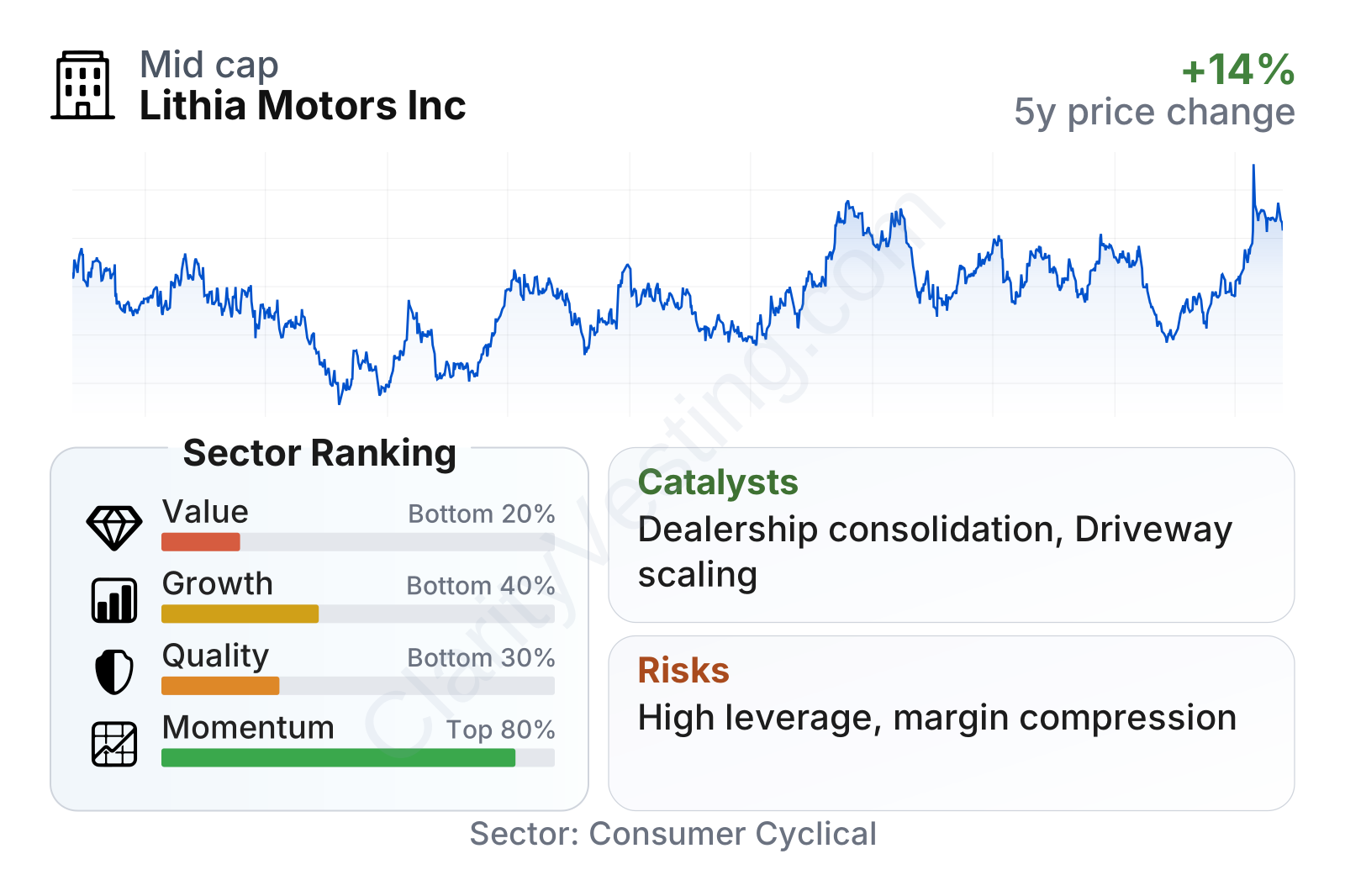
Lithia is a large public company in the dealership space, with stock volatility somewhat above the broader market. On relative metrics, it screens as inexpensive on earnings compared with the sector median, but that weaker valuation profile is matched by softer quality and growth rankings. The biggest pressure points are low recent profitability, negative trailing free cash flow, and leverage that remains meaningfully above typical sector levels. On the other hand, the longer-term revenue-per-share record is stronger than the sector median, showing that the company has been able to scale materially over time even if recent execution has been less efficient.
Growth
The auto retail market is not a high-growth industry in the way software or semiconductors can be, but it is a very large and essential market. People and businesses continue to need transportation, and the dealership model remains important because buyers often want financing, trade-ins, service support, and local inventory access. For a company like Lithia, growth usually comes less from the industry growing quickly and more from gaining share, consolidating smaller dealerships, improving used-vehicle sourcing, and increasing higher-margin service and finance revenue per customer.
Lithia’s strategy broadly fits that model. The company has spent years building scale through acquisitions while also investing in Driveway, its omnichannel platform. If the platform helps Lithia source vehicles more efficiently, widen its customer reach beyond the immediate dealership radius, and keep more of the customer relationship in-house, it could support future growth without relying only on opening or buying more stores.
Recent growth, however, has clearly slowed. Year-over-year revenue gains that were once very strong have cooled to low single-digit percentages, and that suggests Lithia is now operating in a more mature phase of the expansion cycle. Even so, the five-year revenue-per-share trend remains solid, reflecting how much the company has grown through acquisitions and network expansion.
Cash generation is the more important issue to watch than sales growth alone. Free cash flow has been volatile and recently negative again, which means revenue growth is not consistently turning into excess cash after inventory needs, capital spending, and other demands. For a dealership group pursuing scale, that does not automatically signal structural weakness, but it does raise the bar for future execution.
One notable opportunity is ongoing industry consolidation. The U.S. dealership market is still fragmented compared with many other retail industries, and Lithia has already shown that it can integrate acquisitions at large scale. Another supportive factor is the aging vehicle fleet in the U.S., which can strengthen parts and service demand even when new-vehicle affordability becomes harder for consumers. In addition, if financing conditions become more favorable over time, both vehicle affordability and used-car turnover could improve.
Recent company communications have also continued to emphasize expansion of the omnichannel model, improvements in procurement and used-vehicle ecosystems, and the goal of lifting earnings power as acquired stores mature. Those are sensible growth levers, but they need to translate into steadier margins and cash flow to carry more weight in a long-term assessment.
Risks
This article is for informational purposes only and does not constitute financial advice. Some content is AI-generated. See Disclaimer


