Stock Analysis · Kyivstar Group Ltd. Common Shares (KYIV)
Overview
Kyivstar Group Ltd. is a telecom company centered on Ukraine through its main operating business, Kyivstar, one of the country’s largest mobile and digital connectivity providers. In simple terms, it sells mobile communication services, fixed internet access, and a growing set of digital products built around its network and customer base. Its business is essential in nature: people and businesses rely on it for calls, messaging, mobile data, home internet, and increasingly for online services delivered through smartphones.
The company’s revenue base is still dominated by traditional telecom activities, with mobile services clearly at the top. Based on public company information and operating disclosures, the mix can be described approximately as follows:
- Mobile services: about 75% to 85% of revenue. This includes prepaid and contract mobile plans, voice, SMS, roaming, and especially mobile data usage.
- Fixed-line and broadband services: about 10% to 20%. This mainly covers home internet, business connectivity, and related fixed network services.
- Digital services and other revenue: about 5% to 10%. This can include enterprise digital solutions, cloud-related services, content, fintech-adjacent offerings, and other value-added products.
That structure matters for long-term analysis because the largest profit engine is still the mobile network, while the smaller segments provide room for expansion beyond basic telecom access. The business model also benefits from recurring demand: customers tend to keep phone service and internet connectivity even in difficult economic periods, although spending levels can still fluctuate.
Recent financial flow trends suggest a company that expanded revenue strongly into 2025, while profitability became more uneven. Revenue moved from a little over $900 million in 2023 and 2024 to more than $1.1 billion in 2025, but net income dropped materially that year. That combination points to a business still growing its commercial footprint, while facing pressure from costs, investment needs, or non-operating items.
The broad picture is attractive on the top line: a larger revenue base, solid gross profit, and operating profitability that remains positive. The weaker element is that a much higher sales level did not translate into stronger annual net earnings in 2025, which makes margin durability an important point to watch.
Key Figures
| Metric | Value | Sector ⓘ |
|---|---|---|
| Date | Sep 12, 2026 | |
| Context | ||
| Sector | Communication Services | |
| Industry | Telecom Services | |
| Market Cap ⓘ | $3.14B | |
| Beta ⓘ | N/A | |
Value (Cheapness) | ||
| P/E Ratio ⓘ | 20.01 | 18.61 |
| FCF Yield ⓘ | 8.69% | 13.68% |
| EBIT / EV ⓘ | 9.66% | 4.54% |
| PEG ⓘ | 1.38 | |
Growth (Business expansion) | ||
| Revenue Growth ⓘ | 19.40% | 5.40% |
| RPS Growth (5Y CAGR) ⓘ | 16.21% | 4.62% |
| EPS Growth (5Y CAGR) ⓘ | 3674.93% | -18.01% |
| Margin Growth (5Y Trend) ⓘ | -23.18% | 1.10% |
| FCF Growth (5Y CAGR) ⓘ | -8.71% | 5.88% |
Quality (Business durability) | ||
| ROIC (Latest) ⓘ | 16.69% | 8.38% |
| ROIC (5Y Median) ⓘ | N/A | 8.32% |
| Net Debt / EBIT (Latest) ⓘ | 0.57 | 1.99 |
| Net Debt / EBIT (5Y Median) ⓘ | 1.08 | 2.94 |
| Operating Margin (Latest) ⓘ | 24.53% | 14.89% |
| Operating Margin (5Y Median) ⓘ | 46.68% | 12.96% |
| Debt to Equity (Latest) ⓘ | 39.28% | 59.59% |
| Profit Margin (Latest) ⓘ | 12.50% | 8.77% |
| Free Cash Flow (Latest) ⓘ | $273.00M | |
Momentum (Price trend) | ||
| 3Y Return ⓘ | N/A | +46.64% |
| 12M Return (excl. last month) ⓘ | +11.86% | +2.16% |
| 6M Return ⓘ | +33.43% | +5.05% |
| Price vs. 200-Day MA ⓘ | +4.51% | +2.88% |
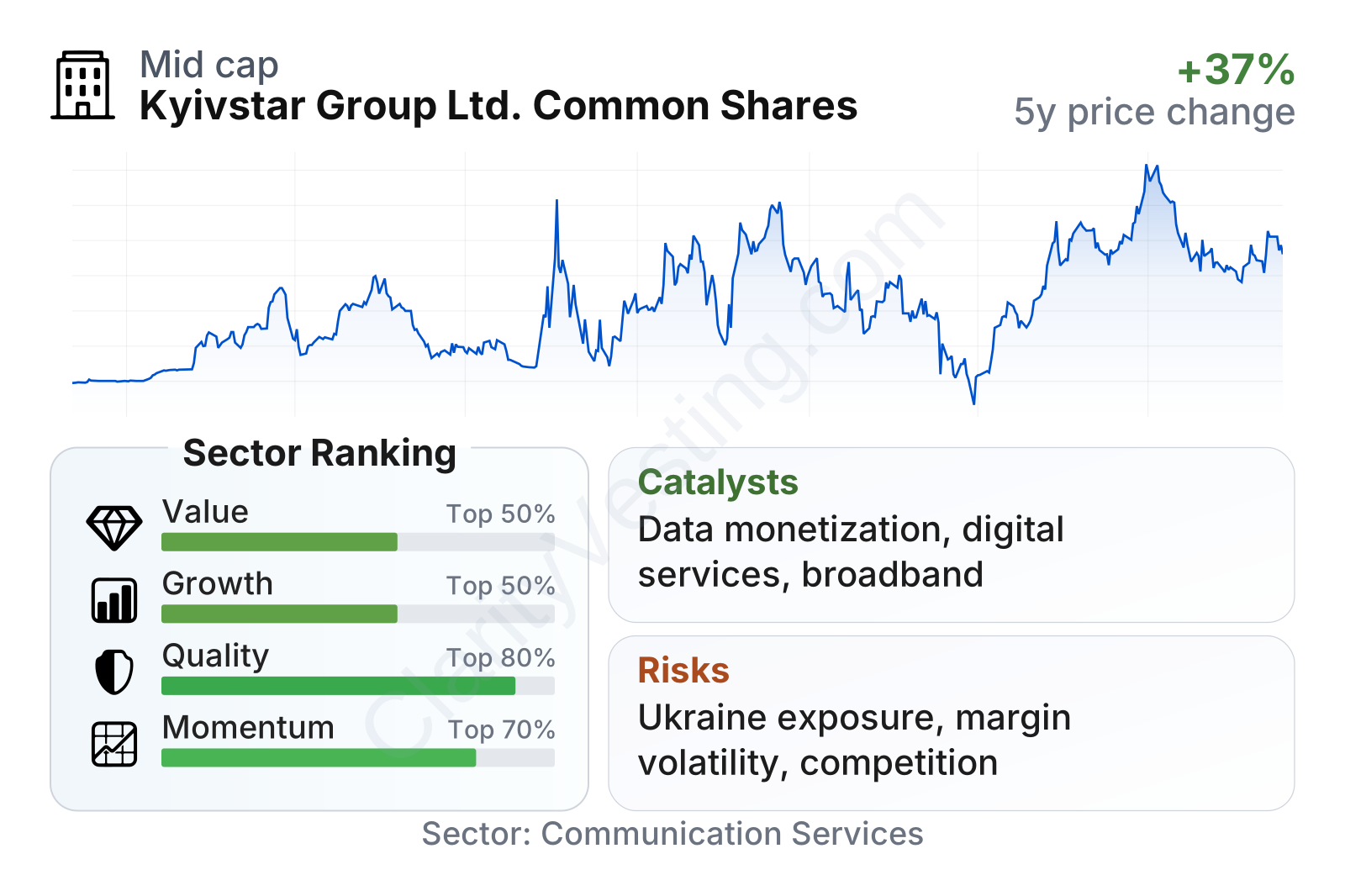
Kyivstar sits in the mid-cap range, so it is large enough to have national relevance in its home market but still small compared with global telecom groups. The latest profile looks mixed but generally solid. Growth metrics are comfortably above the sector median, especially for recent revenue expansion and longer-term revenue per share trends. Quality metrics also stand out in several areas, with return on invested capital above the sector median, a healthier debt burden than many peers, and operating margins that remain stronger than the typical telecom name in the sector.
The main softer points are on cash generation and consistency. Free cash flow yield is below the sector median, and the longer-run free cash flow trend has been negative even though trailing twelve-month free cash flow remains positive. Momentum has been strong, with stock performance over the last year and six months well ahead of the sector median, suggesting the market has become more constructive on the company’s outlook.
Growth
Kyivstar operates in a sector that is mature in basic connectivity but still capable of meaningful growth in data consumption, digital services, enterprise solutions, and fixed broadband upgrades. That means the long-term opportunity is not mainly about more people getting a phone connection; it is about each user consuming more data, adopting more digital services, and moving toward higher-value plans and bundled offerings.
For Kyivstar specifically, that strategy makes sense. A telecom operator with a strong network and broad customer reach can use that position to expand into adjacent services at relatively low customer acquisition cost. In Ukraine, network resilience, mobile data demand, and home internet availability are especially important, which supports the relevance of both the company’s mobile and fixed-line assets.
Recent growth has clearly been strong, even if the pace has moderated from very high levels. Year-over-year revenue growth remained around 19% to 28% across the latest reported periods, which is far better than the sector median of roughly 6%. That is a meaningful outperformance, and it suggests the company is not simply drifting with industry conditions but gaining from pricing, usage growth, business recovery, or a richer mix of services.
Cash generation has also improved in the most recent trailing periods. Free cash flow rose from a little above $100 million to roughly the mid-$100 million range in the periods shown, while the latest trailing free cash flow in the metrics snapshot is materially higher still. That is important because telecom businesses need ongoing network investment, so growth is more convincing when it begins to show up in cash rather than only in accounting earnings.
A major catalyst is the company’s ability to monetize rising data usage and digital engagement from a very large subscriber base. Another is the potential to deepen fixed broadband and enterprise services, which can diversify revenue away from a pure mobile model. Any continued modernization of Ukraine’s digital infrastructure could also create a multi-year demand tailwind for the stronger domestic operators.
There is also a market-structure angle. Telecom tends to reward scale: broader networks, recognized brands, and larger subscriber bases usually support better unit economics. If Kyivstar continues to defend or extend its network leadership and cross-sell newer services, growth can remain stronger than that of a typical mature telecom company.
Risks
This article is for informational purposes only and does not constitute financial advice. Some content is AI-generated. See Disclaimer


