Stock Analysis · Kinaxis Inc (KXSCF)
Overview
Kinaxis is a Canadian software company focused on supply chain planning and orchestration. In simple terms, it sells tools that help large companies decide what to make, where to source materials, how to respond to disruptions, and how to balance customer demand with inventory and production capacity. Its best-known product is RapidResponse, a cloud-based platform used by businesses in sectors such as automotive, life sciences, industrials, consumer products, and high tech.
The company operates in enterprise software, but its niche is narrower and easier to understand than many broad software names: it helps complex global manufacturers and distributors make faster planning decisions. That matters because supply chains have become harder to manage after years of geopolitical tension, shipping disruptions, inflation, and changing customer demand patterns. Kinaxis positions itself as a system for real-time planning rather than a collection of disconnected spreadsheets and older planning tools.
Its revenue base is mainly recurring, which is usually a positive sign for business stability. Based on company reporting, the mix is broadly organized as follows:
- Subscription software revenue: the largest source, representing the clear majority of total revenue, roughly around three-quarters or more in recent years.
- Professional services: implementation, configuration, and customer support tied to deployments, generally the second-largest source.
- Maintenance and other revenue: a smaller category linked to legacy arrangements and related services.
Geographically, Kinaxis serves customers globally, with North America still important but with meaningful exposure to Europe and Asia-Pacific. Its customer base tends to be large enterprises, which can make sales cycles longer, but also tends to support larger contracts and deeper long-term relationships.
One notable business trend is that revenue has expanded meaningfully over the last several years while profitability improved sharply in the latest period. At the same time, the company has continued to invest in research and development, which suggests it is trying to strengthen its product while scaling.
The business model shows a healthy software profile: gross profit remains substantial, research and development spending is significant, and operating income improved materially by 2025 after a weaker 2024 bottom line. That combination points to a company that has been growing first and is now showing clearer operating leverage.
Key Figures
| Metric | Value | Sector ⓘ |
|---|---|---|
| Date | Jul 18, 2026 | |
| Context | ||
| Sector | Technology | |
| Industry | Software - Application | |
| Market Cap ⓘ | $3.00B | |
| Beta ⓘ | 0.76 | |
Value (Cheapness) | ||
| P/E Ratio ⓘ | 37.36 | 31.76 |
| FCF Yield ⓘ | 4.67% | 4.18% |
| EBIT / EV ⓘ | 3.82% | 2.56% |
| PEG ⓘ | N/A | |
Growth (Business expansion) | ||
| Revenue Growth ⓘ | 24.70% | 13.50% |
| RPS Growth (5Y CAGR) ⓘ | 20.39% | 8.57% |
| EPS Growth (5Y CAGR) ⓘ | -11.46% | -21.87% |
| Margin Growth (5Y Trend) ⓘ | 13.74% | 0.41% |
| FCF Growth (5Y CAGR) ⓘ | 62.64% | 9.76% |
Quality (Business durability) | ||
| ROIC (Latest) ⓘ | N/A | 8.54% |
| ROIC (5Y Median) ⓘ | 1.68% | 8.12% |
| Net Debt / EBIT (Latest) ⓘ | -1.76 | 0.38 |
| Net Debt / EBIT (5Y Median) ⓘ | -8.73 | 0.38 |
| Operating Margin (Latest) ⓘ | 17.99% | 9.58% |
| Operating Margin (5Y Median) ⓘ | 3.30% | 8.25% |
| Debt to Equity (Latest) ⓘ | 12.15% | 33.52% |
| Profit Margin (Latest) ⓘ | 14.50% | 6.96% |
| Free Cash Flow (Latest) ⓘ | $140.22M | |
Momentum (Price trend) | ||
| 3Y Return ⓘ | -23.94% | +30.91% |
| 12M Return (excl. last month) ⓘ | -26.25% | +28.90% |
| 6M Return ⓘ | -8.08% | +5.38% |
| Price vs. 200-Day MA ⓘ | -1.72% | +7.61% |
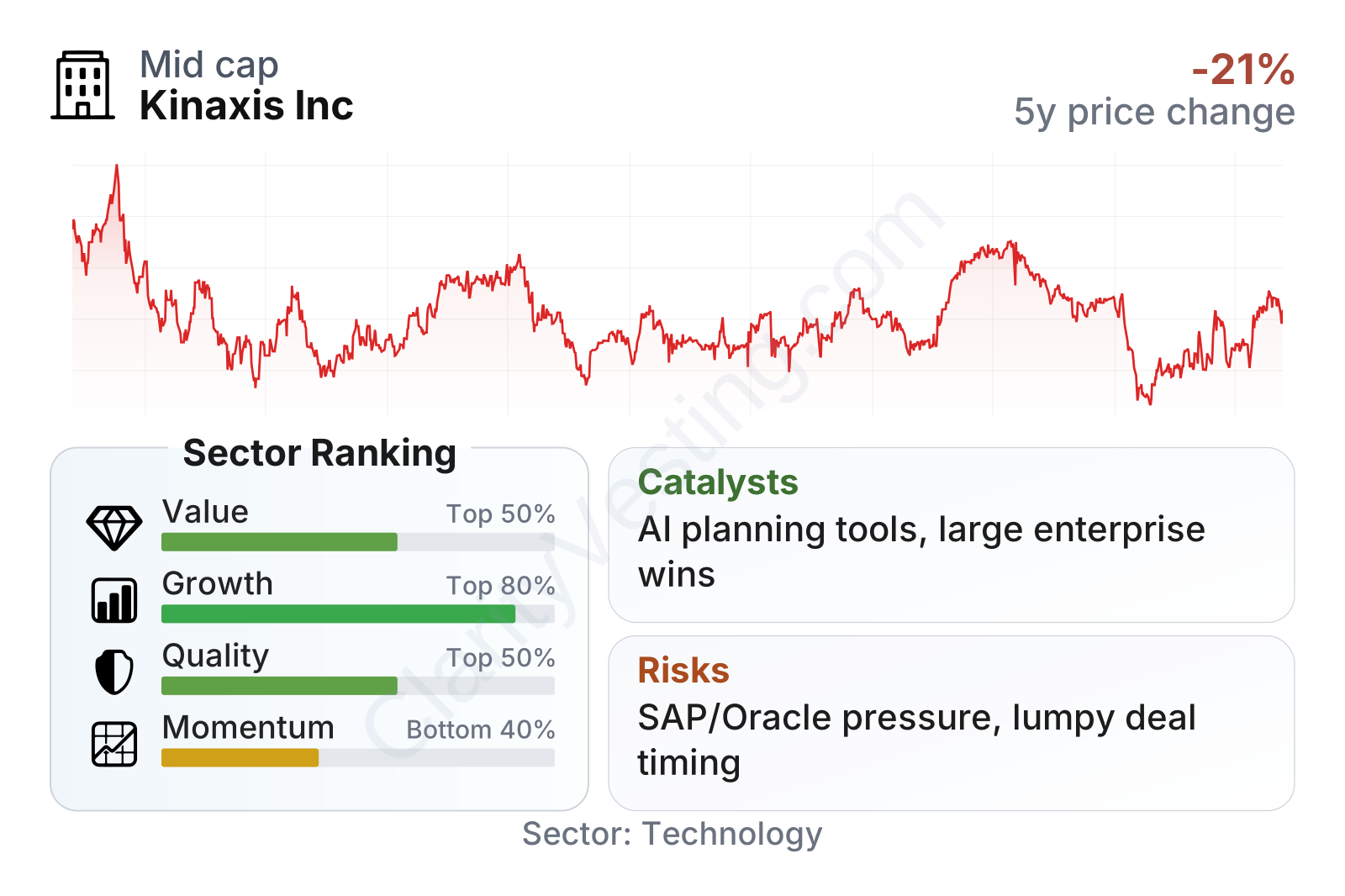
Kinaxis currently sits in a somewhat unusual position: growth metrics are strong relative to much of the software sector, quality is solid, and cash generation is better than many peers, while share-price momentum has been weak. The company’s market value is around the mid-cap range, and its below-1 beta suggests the stock has historically been less volatile than many technology names. Overall, the picture is of a business whose operations have improved faster than market sentiment.
The stock history reflects that gap. Shares have moved through strong rallies and sharp pullbacks over the last few years, and recent performance has lagged the broader software group. That often happens when a company is transitioning from an earlier high-expectation phase toward a more earnings- and cash-flow-driven profile.
Growth
Kinaxis operates in a part of software with durable long-term demand. Supply chain planning is not a passing trend: companies increasingly need better tools to manage uncertainty, especially those with global manufacturing footprints and thousands of products or components. This is a growing area because many businesses still rely on older systems that are less flexible, slower to update, and harder to use across departments.
The company’s strategy makes sense for this environment. It focuses on cloud delivery, large enterprise customers, and industry-specific deployments where planning complexity is high. That specialization can make its software more valuable than general-purpose tools. It also supports expansion within existing accounts, since a customer may start with one planning function and later add others such as supply planning, inventory planning, demand planning, or scenario modeling.
Recent revenue growth has remained strong, with the latest year-over-year pace running well above the sector median. The pattern has not been perfectly smooth quarter to quarter, but the broader direction still points to a business expanding faster than many software peers. The five-year revenue-per-share trend also supports the idea that this is not just short-term growth driven by acquisitions or accounting noise.
Free cash flow has risen dramatically over the last several years, moving from modest levels to well above $100 million on a trailing basis. That matters because cash generation is often a stronger sign of business durability than accounting earnings alone. It suggests Kinaxis is becoming more efficient as it scales, even while continuing to invest in the platform.
As for catalysts, one of the clearest is the continued shift by large companies toward more resilient and more digitized supply chains. Another is the company’s deeper use of artificial intelligence and machine learning features inside planning workflows, which management has highlighted as part of its product roadmap. Kinaxis has also been extending partnerships and implementation capacity, which can help support new customer wins and larger deployments.
Recent company updates have pointed to continued customer demand, a growing recurring revenue base, and stronger profitability. For long-term analysis, that combination is more important than short-term market moves. If the company continues converting revenue growth into operating income and cash flow, that would reinforce the case that the model is maturing well.
Risks
The biggest business risk is competition. Kinaxis is well known in supply chain planning, but it is not alone. It competes with large enterprise software vendors such as SAP and Oracle, as well as specialists like Blue Yonder and OMP. Some of these rivals are larger, have broader product suites, or have longer-established relationships with major corporate customers. In large software deals, being best-in-class is helpful, but not always enough if a customer prefers a bundled solution from an incumbent vendor.
Another risk is customer concentration in large enterprise accounts. Kinaxis sells to major organizations with complex needs, which is good for contract size, but it can also create lumpiness. A delayed implementation, a slower customer decision, or a major contract renewal going differently than expected can affect results more than it would at a company with a highly diversified small-business customer base.
A third issue is execution risk. Professional services are necessary to deploy software successfully, but they can pressure margins if projects become more costly or if the company needs partner capacity to keep up with demand. The company has shown improving profitability, yet implementation-heavy growth can still create uneven results from one period to another.
Balance-sheet risk looks relatively limited. Debt to equity has stayed low, around the low teens as a percentage of equity, and consistently below the software sector median. The company also carries net cash relative to EBIT, which provides financial flexibility and reduces refinancing pressure.
Profitability has improved meaningfully. Net margin was weak and sometimes near break-even in earlier periods, but more recently it moved into the mid-teens, ahead of the sector median. That is encouraging, although the historical path shows margins have not always been stable. Investors looking at the long term should see both sides: the recent improvement is real, but the business has not yet shown many years of consistently high earnings margins.
On competitive advantages, Kinaxis appears to have a credible position rather than an unquestioned leadership monopoly. Its strengths include specialization in concurrent planning, deep supply chain functionality, and a reputation with complex global manufacturers. Those are real advantages. However, larger software platforms can compete on ecosystem reach, procurement convenience, and broader enterprise integration. So the company looks better described as a strong specialist than a dominant winner across all of enterprise software.
There have not been widely known public issues suggesting a major scandal or severe reputation event from the company itself. The more relevant recent risk signals are operational and market-based: the stock’s weak momentum, the company’s still-evolving margin profile, and the possibility that macroeconomic caution could slow enterprise software spending or customer implementations.
Valuation
Kinaxis does not look like a bargain on simple headline multiples, but it no longer looks priced like an extreme software favorite either. The current price-to-earnings ratio is in the mid-30s, modestly above the sector median. On its own, that suggests some premium remains in the shares.
The more interesting point is how much the valuation has changed. In prior years, the earnings multiple was often extremely high because profits were thin. As earnings improved, the ratio compressed sharply and moved closer to normal software-sector levels. That shift can matter more than the raw number, because it suggests the market is now valuing Kinaxis on more tangible profitability rather than mainly on future promise.
Other valuation signals are somewhat more favorable. Free-cash-flow yield is slightly better than the sector median, and EBIT relative to enterprise value also compares well. In other words, the stock does not screen especially cheap, but the company’s cash generation and balance sheet help support the current valuation better than the earnings multiple alone might suggest.
Whether the current price is justified depends largely on confidence in sustained growth and margin expansion. With revenue growth still above many peers, a recurring revenue model, rising cash flow, and low leverage, the valuation appears grounded in real business progress. At the same time, because this is still a competitive software niche and not a hypergrowth company anymore, there is less room for disappointment than when the market multiple was much lower.
Conclusion
Kinaxis stands out as a focused enterprise software company serving a practical and durable need: helping large organizations run more resilient supply chains. The business has attractive characteristics for long-term analysis, including recurring revenue, a specialized product, improving margins, rising free cash flow, and a conservative balance sheet. Recent financial progress has been stronger than the stock’s market performance, which suggests the operating picture has improved faster than sentiment.
The main challenge is that this is a competitive market where large vendors and specialized rivals are all pursuing the same customers. Kinaxis does not appear untouchable, and its growth can still be uneven because enterprise deals and implementations are inherently complex. That said, the company looks increasingly like a maturing quality software business rather than a purely speculative growth name.
From a valuation standpoint, the shares still carry a premium, but that premium now looks more connected to actual profitability and cash generation than in the past. The overall direction is favorable: Kinaxis appears well positioned in an important software niche, with better fundamentals than its recent share-price trend would suggest, though its long-term appeal still depends on continued execution against larger competitors.
Sources:
- Kinaxis Inc. — Annual Information Form 2026
- Kinaxis Inc. — Management’s Discussion and Analysis for Q1 2026
- Kinaxis Inc. — Condensed Interim Consolidated Financial Statements for Q1 2026
- Kinaxis Investor Relations — Press releases and quarterly results updates
- SEDAR+ — Kinaxis Inc. public filings
- Wikipedia — Kinaxis basic company background
This article is for informational purposes only and does not constitute financial advice. Some content is AI-generated. See Disclaimer


