Stock Analysis · Kontoor Brands Inc (KTB)
Overview
Kontoor Brands is an apparel company best known for owning the Wrangler and Lee brands. It was separated from VF Corporation in 2019 and focuses on denim, casual apparel, footwear, and related accessories sold through wholesale partners, company-operated stores, and e-commerce. Its business is centered on everyday clothing rather than fast fashion, with a strong presence in jeanswear and work-inspired apparel.
The company’s revenue base is fairly concentrated, which makes the business easy to understand. Based on recent annual reporting, the main sources of revenue are approximately:
- Wrangler: about 60% of revenue. This includes jeans, tops, outerwear, workwear, western apparel, and some footwear.
- Lee: about 35% of revenue. This brand also covers denim and casual apparel, with sales spread across North America and international markets.
- Other brands and businesses: about 5%. This includes smaller labels, licensing, and newer additions such as Helly Hansen, depending on the reporting period and closing timeline of acquisitions.
Geographically, the business has historically been led by the U.S. market, with additional sales from Europe and Asia-Pacific. Distribution is also mixed: wholesale remains the biggest channel, while direct-to-consumer and digital sales are important because they usually offer better pricing control and closer customer relationships.
What stands out in Kontoor’s business model is that it combines mass-market reach with established heritage brands. The company does not need to invent a new category; instead, it tries to refresh and expand brands that already have global awareness. Over the last several years, revenue has been relatively stable overall, while profitability has held up better than many apparel peers, suggesting disciplined cost control and a durable brand base.
The business mix shows a company that has kept gross profit solid even when revenue was uneven. Operating income has remained resilient over time, although selling and administrative costs rose sharply in the latest full-year view, which is worth monitoring because it can limit how much future sales growth reaches the bottom line.
Key Figures
| Metric | Value | Sector ⓘ |
|---|---|---|
| Date | Sep 12, 2026 | |
| Context | ||
| Sector | Consumer Cyclical | |
| Industry | Apparel Manufacturing | |
| Market Cap ⓘ | $3.64B | |
| Beta ⓘ | 0.89 | |
Value (Cheapness) | ||
| P/E Ratio ⓘ | 13.38 | 17.10 |
| FCF Yield ⓘ | 11.62% | 8.53% |
| EBIT / EV ⓘ | 6.66% | 6.46% |
| PEG ⓘ | N/A | |
Growth (Business expansion) | ||
| Revenue Growth ⓘ | 18.60% | 5.75% |
| RPS Growth (5Y CAGR) ⓘ | 7.62% | 9.14% |
| EPS Growth (5Y CAGR) ⓘ | -14.79% | -18.21% |
| Margin Growth (5Y Trend) ⓘ | 0.11% | -0.23% |
| FCF Growth (5Y CAGR) ⓘ | 23.08% | 4.91% |
Quality (Business durability) | ||
| ROIC (Latest) ⓘ | 16.56% | 12.61% |
| ROIC (5Y Median) ⓘ | 24.31% | 10.72% |
| Net Debt / EBIT (Latest) ⓘ | 3.13 | 2.10 |
| Net Debt / EBIT (5Y Median) ⓘ | 2.24 | 2.32 |
| Operating Margin (Latest) ⓘ | 12.39% | 9.25% |
| Operating Margin (5Y Median) ⓘ | 11.98% | 9.64% |
| Debt to Equity (Latest) ⓘ | 205.77% | 75.78% |
| Profit Margin (Latest) ⓘ | 7.80% | 5.33% |
| Free Cash Flow (Latest) ⓘ | $423.19M | |
Momentum (Price trend) | ||
| 3Y Return ⓘ | +67.00% | +14.53% |
| 12M Return (excl. last month) ⓘ | +19.35% | +3.08% |
| 6M Return ⓘ | +1.91% | +0.55% |
| Price vs. 200-Day MA ⓘ | -6.22% | -0.54% |
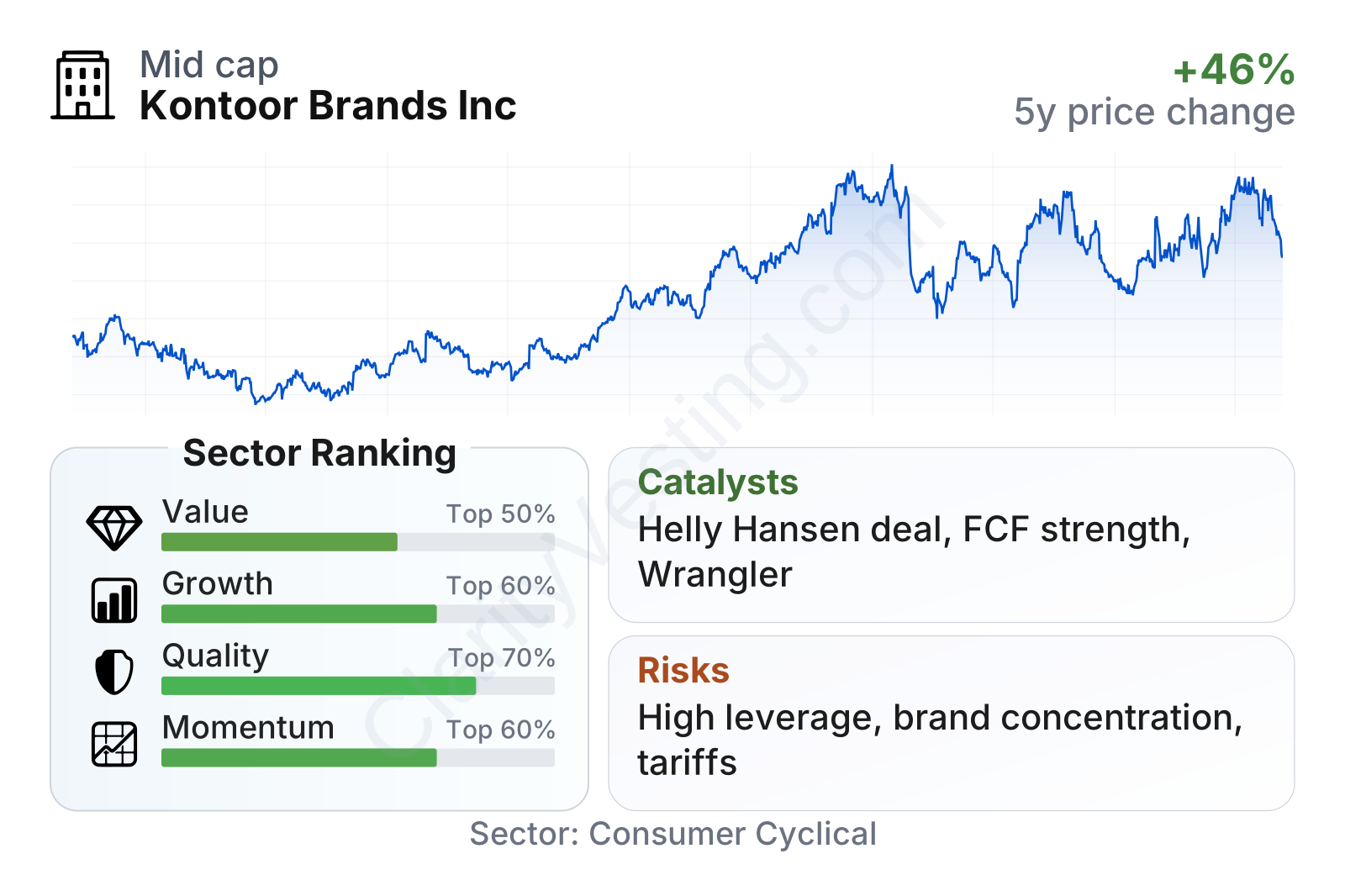
Kontoor currently sits in the middle of the pack on classic valuation measures, while standing stronger on profitability, cash generation, and share-price momentum. Growth metrics are mixed but better than many sector peers on a trailing basis, and returns on invested capital remain notably above the industry median. The main offset is leverage: debt-related measures are clearly heavier than the typical apparel company, so the quality profile is good overall, but not without balance-sheet pressure.
The stock’s multi-year price trend has been strong compared with much of the consumer discretionary space, although recent moves also show that sentiment can shift quickly when the market becomes concerned about retail demand, tariffs, or brand execution. That combination often produces a stock that is neither obviously cheap nor obviously stretched without looking deeper into the business outlook.
Growth
Kontoor operates in a mature part of apparel, not a high-growth niche. Jeanswear and casual basics usually grow more slowly than categories like luxury, sports performance, or beauty. That said, mature categories can still produce attractive long-term outcomes when brands are strong, inventories are controlled, and management expands internationally or raises direct-to-consumer penetration. In Kontoor’s case, the growth case is less about explosive demand and more about disciplined brand management, pricing, category expansion, and operational execution.
A central part of the company’s strategy has been to keep investing in its core labels while broadening product lines beyond traditional denim. Wrangler has been expanding in western, workwear, outdoor-adjacent, and women’s categories, while Lee has been repositioned in parts of the portfolio to improve relevance and margins. The company has also emphasized digital channels, supply chain responsiveness, and international growth. Those priorities make strategic sense because they can improve both revenue quality and margin resilience, even if total industry growth stays modest.
Recent revenue growth has been volatile rather than linear. There were periods of contraction followed by a strong rebound, and the most recent quarterly pattern points to renewed pressure after a very strong comparison period. That suggests Kontoor is still exposed to timing effects, channel inventory changes, and consumer demand swings. For long-term analysis, the key point is that top-line growth has improved in bursts, but it has not yet become consistently steady.
Free cash flow has been one of the more encouraging parts of the picture. After a weak period, cash generation recovered sharply and has stayed at a healthy level, recently around $400 million on a trailing basis. That matters because strong free cash flow gives management room to support dividends, manage debt, fund brand investments, and pursue acquisitions without relying too heavily on new financing.
A major recent catalyst is the company’s move to add Helly Hansen, a premium outdoor and workwear brand, through acquisition. Strategically, this broadens Kontoor beyond denim and gives it exposure to a category with better global growth characteristics than basic jeanswear. If integrated well, it could diversify revenue, improve international reach, and reduce dependence on Wrangler and Lee alone. More broadly, the combination of stable heritage brands, category expansion, and stronger cash flow creates a clearer runway than the company had as a pure denim-focused operator.
Risks
This article is for informational purposes only and does not constitute financial advice. Some content is AI-generated. See Disclaimer