Stock Analysis · Kohl's Corporation (KSS)
Overview
Kohl’s Corporation is a U.S. department store retailer focused on moderately priced apparel, footwear, accessories, beauty, and home products. The company operates stores across the United States and also sells through its digital platform. Its model is built around a broad assortment for families, a well-known loyalty program, promotional pricing, and a mix of national brands and private labels. In recent years, Kohl’s has also tried to make its stores more productive through partnerships, including Sephora shop-in-shops, while continuing to resize inventory and streamline costs.
Revenue is still overwhelmingly generated by merchandise sales to retail customers. Based on recent annual reporting, the main revenue sources can be summarized as follows:
- Women’s products: about 29% of net sales, including apparel, footwear, and accessories.
- Men’s products: about 24% of net sales, including apparel, footwear, and related categories.
- Home products: about 18% of net sales, including bedding, bath, kitchen, décor, and small household items.
- Children’s products: about 13% of net sales, including apparel, footwear, and accessories.
- Accessories: about 8% of net sales, typically handbags, fine jewelry, and watches.
- Footwear: about 7% of net sales as a separate disclosed category in some company breakdowns, though footwear is also embedded across gender and age group shopping missions.
- Other revenue: less than 1%, mainly credit-related and miscellaneous items rather than core merchandise.
Kohl’s business mix shows a retailer still centered on discretionary consumer spending rather than a diversified platform with large service or subscription income. That matters for long-term analysis because performance depends heavily on traffic, inventory discipline, promotions, and the health of the middle-income consumer. Over the last five fiscal years, total revenue has trended down from roughly $19.4 billion to about $15.5 billion, while gross profit has also contracted, showing that stabilization remains more important than expansion at this stage.
The business has become smaller over time, with sales down materially from the 2022 fiscal year level. At the same time, operating profit and net income have recovered from the sharp weakness seen in 2023, suggesting that cost control and inventory management have helped offset part of the revenue pressure, even if the overall earnings base remains well below earlier levels.
Key Figures
| Metric | Value | Sector ⓘ |
|---|---|---|
| Date | Sep 12, 2026 | |
| Context | ||
| Sector | Consumer Cyclical | |
| Industry | Department Stores | |
| Market Cap ⓘ | $1.95B | |
| Beta ⓘ | 1.40 | |
Value (Cheapness) | ||
| P/E Ratio ⓘ | 7.39 | 17.10 |
| FCF Yield ⓘ | 50.58% | 8.53% |
| EBIT / EV ⓘ | 7.89% | 6.46% |
| PEG ⓘ | 1.24 | |
Growth (Business expansion) | ||
| Revenue Growth ⓘ | -0.90% | 5.75% |
| RPS Growth (5Y CAGR) ⓘ | 0.70% | 9.14% |
| EPS Growth (5Y CAGR) ⓘ | -29.89% | -18.21% |
| Margin Growth (5Y Trend) ⓘ | -3.59% | -0.23% |
| FCF Growth (5Y CAGR) ⓘ | -9.78% | 4.91% |
Quality (Business durability) | ||
| ROIC (Latest) ⓘ | 8.50% | 12.61% |
| ROIC (5Y Median) ⓘ | 8.23% | 10.72% |
| Net Debt / EBIT (Latest) ⓘ | 9.46 | 2.10 |
| Net Debt / EBIT (5Y Median) ⓘ | 10.43 | 2.32 |
| Operating Margin (Latest) ⓘ | 3.84% | 9.25% |
| Operating Margin (5Y Median) ⓘ | 4.02% | 9.64% |
| Debt to Equity (Latest) ⓘ | 154.05% | 75.78% |
| Profit Margin (Latest) ⓘ | 1.75% | 5.33% |
| Free Cash Flow (Latest) ⓘ | $988.00M | |
Momentum (Price trend) | ||
| 3Y Return ⓘ | -11.46% | +14.53% |
| 12M Return (excl. last month) ⓘ | +54.87% | +3.08% |
| 6M Return ⓘ | +33.06% | +0.55% |
| Price vs. 200-Day MA ⓘ | +1.25% | -0.54% |
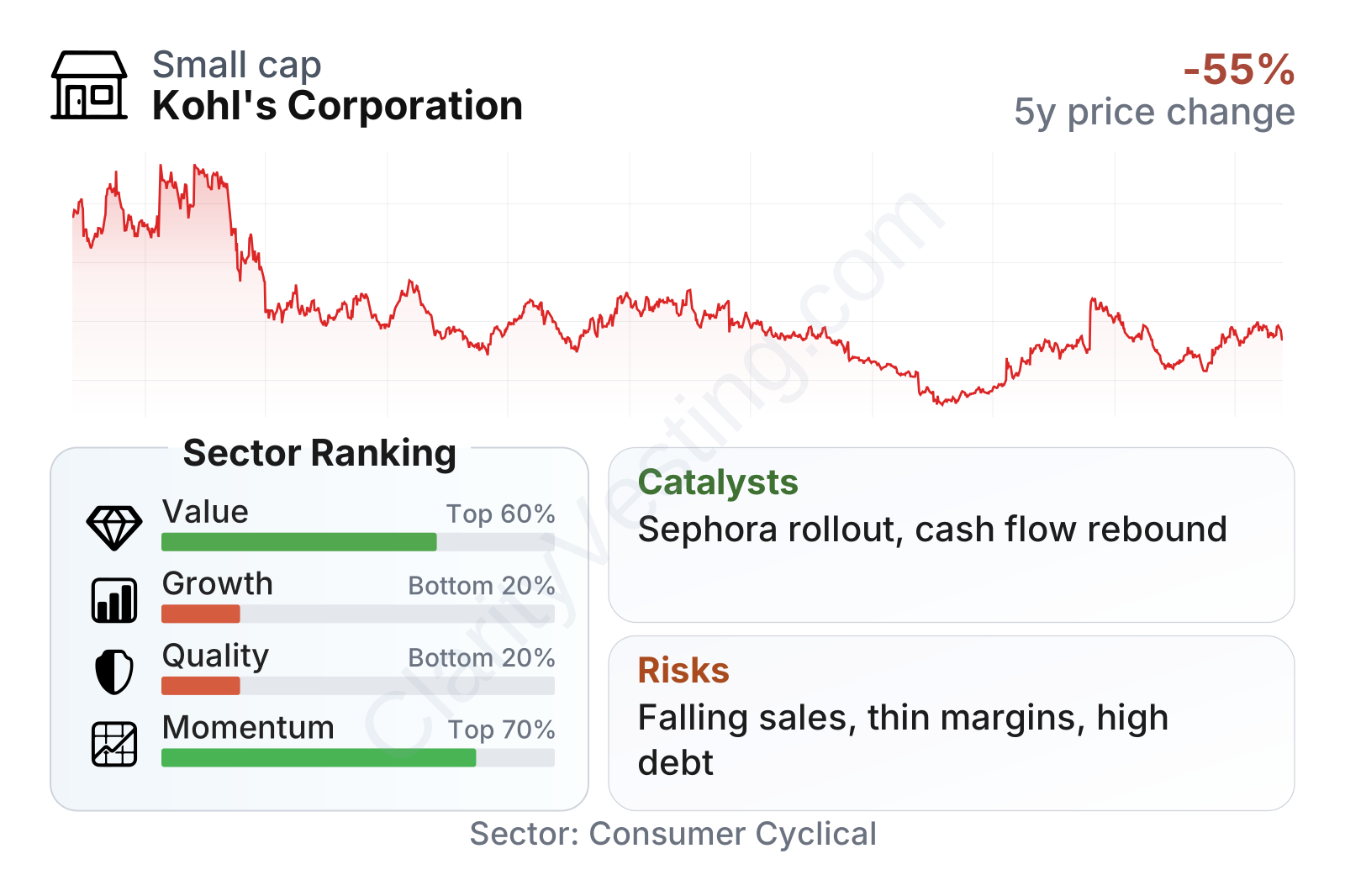
Kohl’s currently screens as inexpensive on headline valuation metrics, with a P/E ratio well below the sector median and a very high free cash flow yield. However, those cheaper multiples come alongside weak growth and below-average quality indicators. Profitability remains thin, leverage is elevated, and the company’s growth profile ranks near the bottom of its sector. In short, the market is not valuing Kohl’s like a healthy retailer with expanding earnings; it is valuing a smaller, more challenged company that is still producing cash but has not yet proved a durable return to stronger fundamentals.
The stock chart also reflects that tension. The shares have been volatile, with a deep multiyear decline followed by a sharp rebound over the last 12 months before another pullback. That pattern usually signals that sentiment around the turnaround remains fragile and highly sensitive to each earnings update.
Growth
Kohl’s operates in a mature part of retail rather than a naturally high-growth segment. Department stores have been losing share for years to off-price chains, e-commerce specialists, big-box retailers, and brand-direct digital channels. That means growth for Kohl’s is less about industry tailwinds and more about execution: improving assortment, lifting store productivity, strengthening digital engagement, and winning repeat visits from existing customers.
The company’s current strategy is sensible in that context. Management has emphasized categories where Kohl’s believes it can still matter to customers, including beauty, impulse purchases, gifting, and family apparel basics. The Sephora partnership remains one of the clearest traffic drivers because it gives Kohl’s exposure to a faster-growing beauty category that is more resilient than much of traditional department store merchandise. Kohl’s has also continued focusing on inventory discipline, expense control, and store productivity rather than aggressive expansion.
The problem is that reported sales trends still show contraction. Year-over-year revenue declines have persisted for an extended period, although the latest reading suggests the pace of decline has moderated to around 1%. That is a clear improvement from the steeper drops seen in prior years, but it is still not the same as returning to sustained growth. For a long-term case to strengthen, Kohl’s would likely need to show that beauty gains, loyalty engagement, and merchandising changes can do more than simply slow the decline.
Cash generation is a more constructive part of the picture. Free cash flow has been volatile, including a negative period in 2023, but it rebounded strongly and most recently reached a level above $1 billion on a trailing basis. That kind of recovery matters because it supports debt management, capital flexibility, and the ability to absorb operational pressure. For Kohl’s, improving cash flow is one of the more important signs that the business still has economic value even without top-line growth.
Recent company updates in 2026 have continued to emphasize turnaround priorities rather than major new growth initiatives. The significant opportunity, if it develops, is not a new market opening up; it is Kohl’s proving that store traffic can stabilize and that partnerships such as Sephora can lift sales productivity enough to support better margins over time.
Risks
This article is for informational purposes only and does not constitute financial advice. Some content is AI-generated. See Disclaimer