Stock Analysis · Kainos Group plc (KNNNF)
Overview
Kainos Group plc is a UK-based software and digital services company that helps large organizations modernize how they work. Its business is centered on two main activities: building and running digital platforms for customers, and selling software products that improve human resources and workforce processes. The company is especially well known for its long-standing work with governments and public-sector agencies in the United Kingdom, while also serving healthcare, commercial, and international clients.
Its operations are generally presented through two main divisions. Digital Services covers consulting, design, engineering, cloud migration, and managed services, often for complex public-sector transformation programs. Workday Services includes implementation and support work around Workday’s enterprise software, while Workday Products includes Kainos’s own software tools built to extend Workday’s capabilities. In practice, that means Kainos earns money both from people-based project work and from recurring software-related revenue.
Based on the company’s recent annual reporting structure, revenue is mainly driven by the following areas, with the broad ranking below reflecting the usual size of each stream:
- Digital Services – the largest contributor, roughly around half of group revenue in recent years.
- Workday Services – typically the second-largest stream, often around one-third of revenue.
- Workday Products – the smallest segment, but strategically important because it is more software-led and can carry attractive economics; often around the mid-teens as a share of revenue.
This mix matters for long-term analysis. Digital Services gives Kainos scale, credibility, and access to major multi-year programs, while the Workday-related business gives it exposure to a global enterprise software ecosystem. The company’s financial flow over the last several years shows a business that has expanded revenue meaningfully, although profit conversion has been less smooth than sales growth.
Revenue has moved up strongly over the past five years, recovering well in the latest fiscal year after a softer 2025. The broad picture is encouraging: sales have climbed from just above £300 million equivalent levels in fiscal 2022 to more than £430 million in fiscal 2026, while operating profit and net income also improved from the prior year. At the same time, costs have risen with expansion, so the company’s margin profile has not advanced as consistently as top-line growth.
Key Figures
| Metric | Value | Sector ⓘ |
|---|---|---|
| Date | Sep 12, 2026 | |
| Context | ||
| Sector | Technology | |
| Industry | Software - Application | |
| Market Cap ⓘ | $1.69B | |
| Beta ⓘ | 0.87 | |
Value (Cheapness) | ||
| P/E Ratio ⓘ | 31.17 | 29.51 |
| FCF Yield ⓘ | 6.49% | 4.25% |
| EBIT / EV ⓘ | 7.20% | 2.85% |
| PEG ⓘ | N/A | |
Growth (Business expansion) | ||
| Revenue Growth ⓘ | 27.60% | 15.40% |
| RPS Growth (5Y CAGR) ⓘ | 10.26% | 8.56% |
| EPS Growth (5Y CAGR) ⓘ | -7.13% | -11.88% |
| Margin Growth (5Y Trend) ⓘ | -3.70% | 0.46% |
| FCF Growth (5Y CAGR) ⓘ | 8.05% | 9.80% |
Quality (Business durability) | ||
| ROIC (Latest) ⓘ | N/A | 9.44% |
| ROIC (5Y Median) ⓘ | 34.10% | 8.30% |
| Net Debt / EBIT (Latest) ⓘ | -0.94 | 0.54 |
| Net Debt / EBIT (5Y Median) ⓘ | -1.59 | 0.44 |
| Operating Margin (Latest) ⓘ | 11.50% | 9.58% |
| Operating Margin (5Y Median) ⓘ | 13.39% | 8.25% |
| Debt to Equity (Latest) ⓘ | 6.11% | 33.33% |
| Profit Margin (Latest) ⓘ | 9.86% | 7.14% |
| Free Cash Flow (Latest) ⓘ | $109.62M | |
Momentum (Price trend) | ||
| 3Y Return ⓘ | -28.49% | +45.48% |
| 12M Return (excl. last month) ⓘ | +5.43% | +23.48% |
| 6M Return ⓘ | +67.70% | +20.93% |
| Price vs. 200-Day MA ⓘ | +43.32% | +7.43% |
Kainos looks financially solid for its size. With a market value around $1.7 billion and a beta below 1, it sits in the mid-cap range and has shown somewhat lower share-price volatility than many technology names. The quality profile stands out most: profitability is above many software peers, leverage is very low, and the balance sheet appears comfortably positioned with net cash rather than balance-sheet strain.
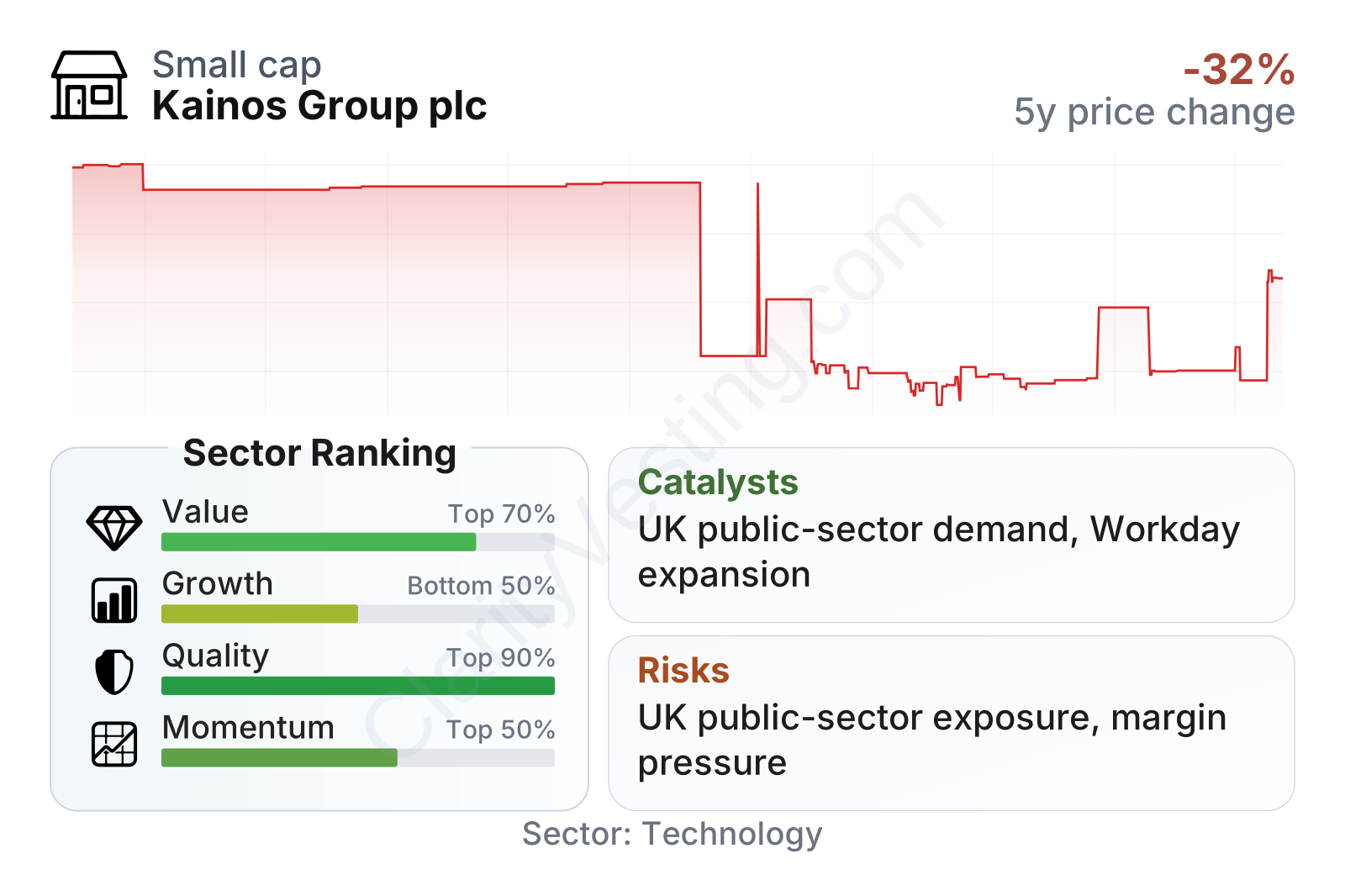
The broader factor picture is mixed in a useful way. Quality metrics rank very strongly against the sector, and value metrics are also respectable because cash generation is healthy relative to enterprise value. Growth is around the middle of the pack: recent revenue growth has been strong, but longer-term earnings progression has been less impressive because margins have come under pressure. Momentum is the weakest area, reflecting the stock’s poor share-price performance over recent years despite an operational rebound.
Growth
Kainos operates in parts of technology that still have room to expand over the long run. Digital transformation in government, healthcare, and regulated industries remains a durable theme because large organizations continue replacing legacy systems, moving workloads to the cloud, and automating internal processes. The company also benefits from demand tied to Workday, which remains an important platform for finance and human capital management. That gives Kainos exposure to two structural trends at once: modernization of public services and ongoing adoption of cloud enterprise software.
The strategy is coherent. Kainos has built a reputation in difficult, high-trust projects where execution matters more than flashy branding. In Digital Services, that means deep relationships, domain knowledge, security credentials, and delivery capability. In Workday, it means combining implementation services with proprietary products, which can deepen customer relationships and potentially create more repeatable revenue over time. That combination is sensible because services can win customer access, while products can strengthen margins and reduce dependence on pure billable hours.
The latest growth picture is clearly better than the prior year. Recent year-over-year revenue growth is well above the sector median, and the fiscal 2026 results suggest the company regained momentum after the slowdown seen in fiscal 2025. Over a five-year view, revenue per share growth has also remained ahead of the typical software peer, even though earnings growth has been more uneven.
Cash generation adds credibility to the growth profile. Free cash flow over the trailing twelve months is solid for a company of this size, and free cash flow yield compares favorably with much of the software sector. That matters because it suggests expansion is not being funded by heavy borrowing or persistent cash burn. A company can go through temporary margin pressure more comfortably when it still converts a meaningful share of revenue into cash.
A notable near-term catalyst is the recovery in annual revenue and profit in fiscal 2026 after the prior year’s decline. Another is the continued digitization agenda in the UK public sector, where Kainos has a strong established position. The company’s role in the Workday ecosystem also remains important: as customers upgrade systems, broaden deployments, or look for industry-specific tools, Kainos has a pathway to sell implementation work, support, and add-on products. These are not speculative opportunities; they are extensions of activities the company already performs successfully.
Risks
This article is for informational purposes only and does not constitute financial advice. Some content is AI-generated. See Disclaimer


