Stock Analysis · CarMax Inc (KMX)
Overview
CarMax Inc is the largest used-vehicle retailer in the United States. The company sells used cars through a nationwide store network and digital channels, buys cars directly from consumers, arranges financing for many of its retail customers, and offers related protection products. Its model is built around a simple customer proposition: large selection, fixed pricing, appraisal and trade-in services, and an increasingly omnichannel buying process that combines online shopping with in-store pickup or delivery.
Revenue is heavily concentrated in vehicle sales, while profitability is influenced by both retail margins and financing-related income. Based on recent annual filings, CarMax’s main revenue sources can be summarized approximately as follows:
- Used vehicle sales: roughly 80% to 85% of total revenue, by far the largest contributor.
- Wholesale vehicle sales: roughly 10% to 15%, mainly vehicles sold through dealer auctions after appraisal and trade-in activity.
- Other sales and revenues: roughly 3% to 5%, including service plans and related products.
- CarMax Auto Finance income: an important earnings contributor, although it represents a much smaller share of total reported revenue than vehicle sales.
That mix matters because CarMax is not just a dealer. It is also a scaled sourcing platform for used cars and a financing ecosystem. The company’s size gives it broad inventory access, national brand recognition, and operating data that smaller independent dealers generally do not have.
The business picture over the past several years shows a company with very large revenue but thin margins. Cost of sales consumes most of each dollar brought in, and interest expense has become a much larger burden than it was a few years ago. Gross profit has stayed in the multibillion-dollar range, but the path from gross profit to net income has tightened as financing costs and operating expenses have absorbed more of the economics.
This operating profile helps explain why even moderate shifts in used-car prices, loan performance, or borrowing costs can have an outsized effect on earnings.
Key Figures
| Metric | Value | Sector ⓘ |
|---|---|---|
| Date | Sep 12, 2026 | |
| Context | ||
| Sector | Consumer Cyclical | |
| Industry | Auto & Truck Dealerships | |
| Market Cap ⓘ | $8.70B | |
| Beta ⓘ | 1.17 | |
Value (Cheapness) | ||
| P/E Ratio ⓘ | 37.62 | 17.10 |
| FCF Yield ⓘ | 11.43% | 8.53% |
| EBIT / EV ⓘ | 2.84% | 6.46% |
| PEG ⓘ | 0.61 | |
Growth (Business expansion) | ||
| Revenue Growth ⓘ | 5.50% | 5.75% |
| RPS Growth (5Y CAGR) ⓘ | -2.39% | 9.14% |
| EPS Growth (5Y CAGR) ⓘ | -21.28% | -18.21% |
| Margin Growth (5Y Trend) ⓘ | -0.81% | -0.23% |
| FCF Growth (5Y CAGR) ⓘ | N/A | 4.91% |
Quality (Business durability) | ||
| ROIC (Latest) ⓘ | 2.39% | 12.61% |
| ROIC (5Y Median) ⓘ | 4.30% | 10.72% |
| Net Debt / EBIT (Latest) ⓘ | 24.07 | 2.10 |
| Net Debt / EBIT (5Y Median) ⓘ | 13.34 | 2.32 |
| Operating Margin (Latest) ⓘ | 2.92% | 9.25% |
| Operating Margin (5Y Median) ⓘ | 5.29% | 9.64% |
| Debt to Equity (Latest) ⓘ | 304.69% | 75.78% |
| Profit Margin (Latest) ⓘ | 0.79% | 5.33% |
| Free Cash Flow (Latest) ⓘ | $994.30M | |
Momentum (Price trend) | ||
| 3Y Return ⓘ | -24.82% | +14.53% |
| 12M Return (excl. last month) ⓘ | +3.62% | +3.08% |
| 6M Return ⓘ | +49.56% | +0.55% |
| Price vs. 200-Day MA ⓘ | +31.00% | -0.54% |
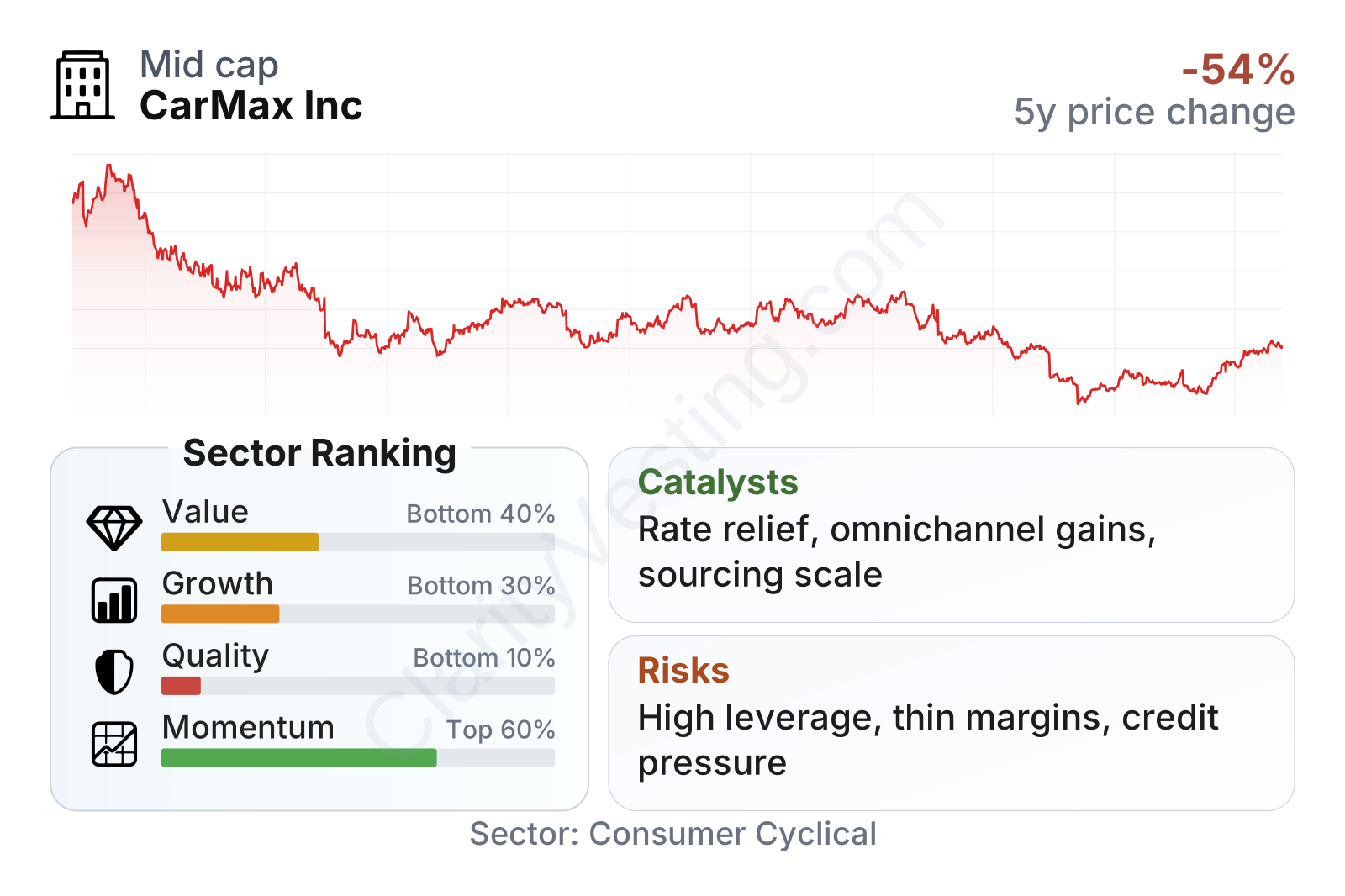
CarMax currently sits in a mixed position. Its market value is in the mid-single-digit billions, making it a meaningful player in auto retail, and its recent share-price behavior has been volatile. The factor view points to a company that screens weak on quality and below average on long-term growth, while appearing stronger on free-cash-flow generation than the headline earnings multiple alone would suggest.
The table also suggests an important contrast. On one hand, free cash flow has improved sharply and the PEG ratio looks modest relative to the current earnings multiple. On the other hand, profitability, returns on capital, and leverage compare poorly with the broader consumer cyclical group. In simple terms, CarMax looks operationally large and financially active, but not especially efficient right now.
Growth
CarMax operates in a large and durable market. The used-car sector benefits from a simple long-term reality: most households cannot regularly afford new vehicles, and the average age of cars on U.S. roads remains high. That creates ongoing replacement demand. Over time, consumers have also become more comfortable shopping for vehicles online, which supports CarMax’s strategy of blending e-commerce with stores, appraisals, logistics, and financing.
The company’s strategy for future growth is logical. It is trying to increase unit volume through better digital shopping tools, broader sourcing of vehicles from consumers, and improved conversion across online and store channels. The more cars CarMax can source directly from the public, the more control it has over inventory flow and wholesale output. Its financing arm also strengthens the model by supporting sales and capturing economics beyond the initial transaction.
Recent revenue growth has been uneven rather than consistently strong. CarMax moved from very strong post-pandemic comparisons into a period of declines, then returned to low-single-digit growth. That pattern suggests demand is present, but affordability pressures and used-vehicle pricing swings are still shaping results. Growth today looks more like a recovery phase than a clean expansion cycle.
Free cash flow is a more encouraging part of the picture. After large swings earlier in the cycle, recent trailing twelve-month cash generation has turned strongly positive. That improvement can give CarMax more flexibility around operations, technology spending, and balance-sheet management. For a business with thin margins, cash conversion matters a great deal.
A meaningful catalyst is the eventual normalization of auto finance conditions. If borrowing costs ease and credit availability improves, monthly payments become more manageable and used-vehicle demand can respond quickly. CarMax could also benefit if consumers keep shifting toward trusted national retailers rather than fragmented local lots, especially when affordability and transparency are major concerns. Recent company communications have also emphasized efficiency initiatives, omnichannel execution, and vehicle appraisal growth, all of which could support better unit economics if demand stabilizes.
Risks
This article is for informational purposes only and does not constitute financial advice. Some content is AI-generated. See Disclaimer


