Stock Analysis · Kulicke and Soffa Industries Inc (KLIC)
Overview
Kulicke and Soffa Industries is a semiconductor equipment company. In simple terms, it sells machines and tools used to assemble and connect semiconductor devices after the chips themselves have been manufactured. These systems are essential in the final stages of production for products such as memory chips, logic devices, power semiconductors, automotive electronics, sensors, and advanced packaging used in artificial intelligence and high-performance computing.
The company’s business is concentrated in semiconductor assembly equipment, with additional revenue from aftermarket support and a smaller electronics assembly activity. Based on recent company filings, the main sources of revenue can be summarized as follows:
- Capital equipment for semiconductor assembly: about 75% to 85%. This includes ball bonding systems, wedge bonding systems, thermocompression and hybrid bonding-related equipment, and advanced packaging tools used by chip manufacturers and outsourced assembly providers.
- Aftermarket products and services: about 15% to 20%. This includes spare parts, tools, service contracts, upgrades, and consumables that support the installed base of machines.
- Electronics assembly and other: less than 10%. This includes selected solutions outside core semiconductor packaging, depending on product mix and period.
Kulicke and Soffa has historically been best known for wire bonding, a mature but still very large market in semiconductor packaging, especially in automotive, industrial, and power devices. Over time, management has tried to broaden the company into faster-growing areas such as advanced packaging, thermocompression, and hybrid bonding, where demand is tied more directly to leading-edge computing and AI infrastructure.
The business mix also has an important geographic angle: a large part of sales is generated in Asia, where most semiconductor assembly capacity is located. That creates access to the industry’s main customers, but it also means results can move sharply with changes in the global chip cycle and capital spending plans.
The company’s earnings profile has become much more volatile than its revenue base alone suggests. Revenue stayed above $1.5 billion in fiscal 2021 and 2022, then fell to roughly $740 million in 2023 and about $700 million in 2024 before slipping further in 2025. During that downturn, operating expenses remained comparatively high, especially in research and development and selling costs, which compressed profitability. That helps explain why recent recovery in sales matters so much for margins.
Key Figures
| Metric | Value | Sector ⓘ |
|---|---|---|
| Date | Sep 12, 2026 | |
| Context | ||
| Sector | Technology | |
| Industry | Semiconductor Equipment & Materials | |
| Market Cap ⓘ | $4.51B | |
| Beta ⓘ | 1.62 | |
Value (Cheapness) | ||
| P/E Ratio ⓘ | 39.51 | 29.51 |
| FCF Yield ⓘ | 0.89% | 4.25% |
| EBIT / EV ⓘ | 3.74% | 2.85% |
| PEG ⓘ | 2.38 | |
Growth (Business expansion) | ||
| Revenue Growth ⓘ | 122.60% | 15.40% |
| RPS Growth (5Y CAGR) ⓘ | -15.30% | 8.56% |
| EPS Growth (5Y CAGR) ⓘ | -26.67% | -11.88% |
| Margin Growth (5Y Trend) ⓘ | -24.18% | 0.46% |
| FCF Growth (5Y CAGR) ⓘ | -23.22% | 9.80% |
Quality (Business durability) | ||
| ROIC (Latest) ⓘ | 13.57% | 9.44% |
| ROIC (5Y Median) ⓘ | 4.83% | 8.30% |
| Net Debt / EBIT (Latest) ⓘ | -2.28 | 0.54 |
| Net Debt / EBIT (5Y Median) ⓘ | -3.86 | 0.44 |
| Operating Margin (Latest) ⓘ | 15.22% | 9.58% |
| Operating Margin (5Y Median) ⓘ | 9.74% | 8.25% |
| Debt to Equity (Latest) ⓘ | 4.18% | 33.33% |
| Profit Margin (Latest) ⓘ | 12.18% | 7.14% |
| Free Cash Flow (Latest) ⓘ | $39.97M | |
Momentum (Price trend) | ||
| 3Y Return ⓘ | +91.05% | +45.48% |
| 12M Return (excl. last month) ⓘ | +159.83% | +23.48% |
| 6M Return ⓘ | +36.54% | +20.93% |
| Price vs. 200-Day MA ⓘ | +7.98% | +7.43% |
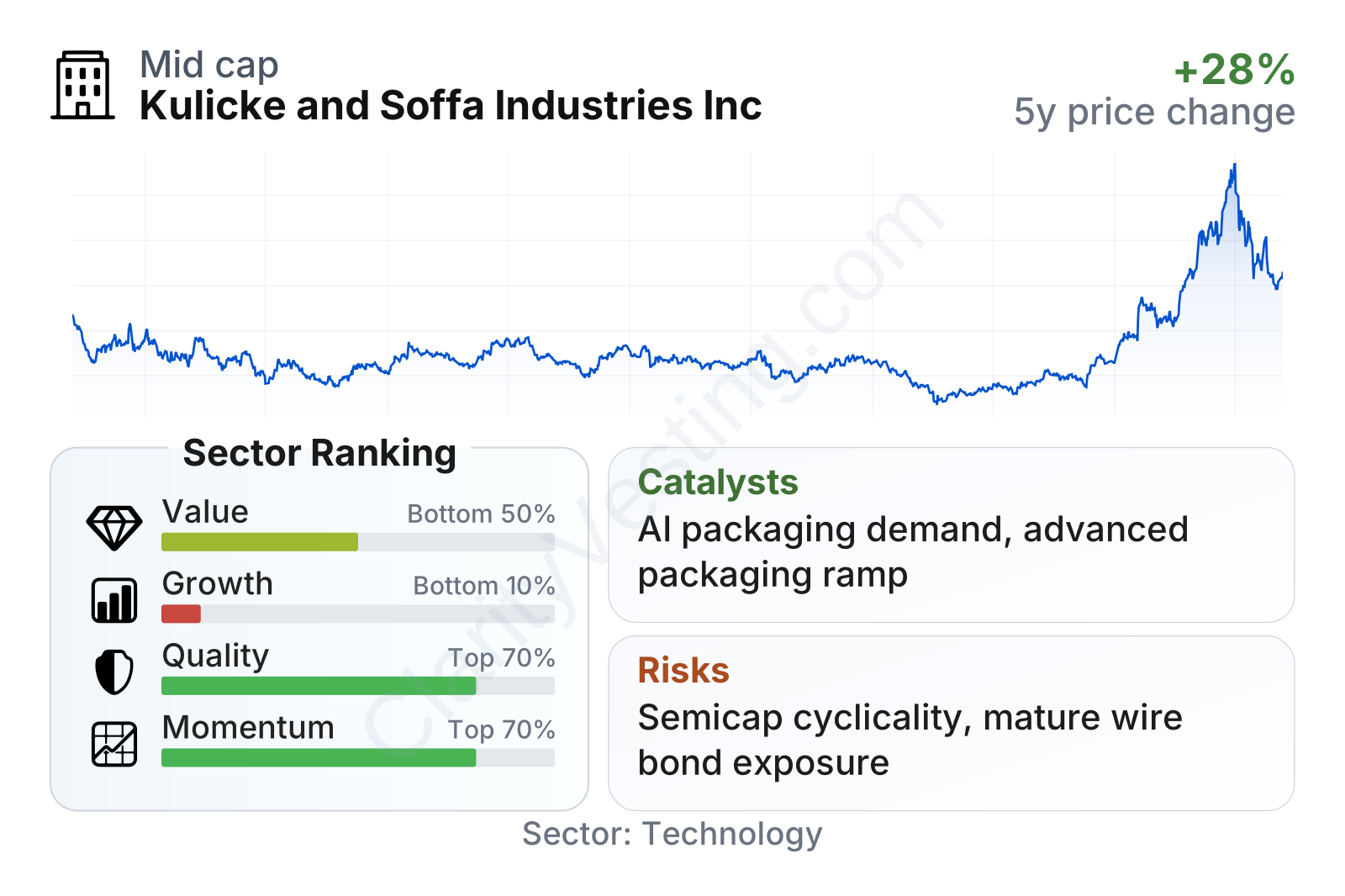
Kulicke and Soffa sits in the mid-cap range and shows a mixed profile. Balance-sheet quality stands out: debt is very low, net cash is meaningful, and operating margin is currently above the sector median. Momentum has also been strong, with the stock well ahead of many technology peers over the last year. The weaker points are valuation and long-term growth consistency. The current earnings multiple is above the sector median, while five-year trends for revenue per share, earnings, margins, and free cash flow remain notably weaker than many peers despite the recent rebound.
The share-price history reflects that cyclicality clearly. The stock spent several years moving through a wide range, then surged sharply in early 2026 as the market started to price in a stronger recovery and greater exposure to advanced packaging opportunities.
Growth
Kulicke and Soffa operates in a sector with attractive long-term demand drivers. Semiconductor content keeps rising in cars, industrial systems, consumer devices, data centers, and AI hardware. Even more important, the back-end of chip manufacturing is becoming more advanced. As chips become harder to improve through traditional scaling alone, packaging technologies that connect, stack, and integrate chips more efficiently are becoming more valuable. That broad industry direction supports the company’s strategic push beyond traditional wire bonding.
The company’s strategy is logical on paper. Its legacy franchise in wire bonding gives it customer relationships, a large installed base, and recurring aftermarket revenue. Management has been using that position to expand into advanced packaging and related assembly technologies. If that shift works, Kulicke and Soffa could participate in both resilient mature markets and faster-growing packaging segments linked to AI and high-performance computing.
Recent revenue momentum has turned sharply upward after a prolonged downturn. The company went through multiple quarters of contraction from late 2022 through most of 2025, which is typical of semiconductor equipment cycles, but the latest year-over-year growth rate shows a very strong rebound. That is encouraging, although it also needs to be viewed in context: comparisons had become relatively easy after a weak base, so one or two strong quarters alone do not fully settle the longer-term growth question.
Cash generation tells a more cautious version of the same story. Free cash flow was very strong a few years ago, then fell sharply during the downturn and has remained uneven. That matters because long-term value creation in equipment businesses depends not only on cyclical order recoveries, but also on the ability to turn those recoveries into durable cash generation after research spending and working-capital needs.
A meaningful catalyst is the company’s exposure to advanced packaging and thermocompression applications. These technologies are increasingly relevant in chiplet architectures, high-bandwidth memory integration, and other packaging methods used in AI systems. Recent company communications in 2026 have also pointed to improving demand conditions and customer engagement in these areas. Another helpful factor is the company’s large cash position, which gives it flexibility to keep investing through the cycle, pursue acquisitions, and continue shareholder returns without stressing the balance sheet.
Risks
This article is for informational purposes only and does not constitute financial advice. Some content is AI-generated. See Disclaimer


