Stock Analysis · Keysight Technologies Inc (KEYS)
Overview
Keysight Technologies is a measurement and test equipment company. In simple terms, it builds the tools that engineers use to design, validate, and monitor advanced electronic systems. Its products help customers test wireless networks, semiconductors, data center links, aerospace and defense systems, industrial electronics, automotive electronics, and connected devices. The company also sells software that supports simulation, design, and network visibility, which makes its business broader than traditional lab instruments alone.
Keysight’s revenue mix is mainly organized by end market in its annual reporting. Based on its latest annual filing and investor materials, the business is concentrated in a few large areas:
- Commercial communications: approximately 38% of revenue. This includes wireless, wireline, data center, and service provider testing, where customers need to validate faster and more complex networks.
- Electronic industrial solutions: approximately 35% of revenue. This covers semiconductor, automotive, energy, consumer electronics, and general electronics applications.
- Aerospace, defense, and government: approximately 27% of revenue. This area includes radar, satellite, electronic warfare, secure communications, and related government programs.
The company also reports revenue by geography. The Americas, Europe, and Asia-Pacific all matter, but Asia is especially important because of semiconductor and electronics manufacturing concentration. In business model terms, Keysight generates sales from hardware instruments, software licenses and subscriptions, and services such as support, calibration, and maintenance. Software and services typically add stability because they can carry recurring or repeatable revenue characteristics.
The broad picture is that Keysight sits at a critical point in the technology supply chain: before a chip, device, network, or defense system is deployed, it usually has to be tested. That position can make the company less visible to the public than consumer tech brands, but highly relevant to long-term technology spending.
Over the last several years, revenue has moved through a cycle, but the business has remained structurally profitable. Gross profit has stayed strong, and the company continues to spend heavily on research and development, which is consistent with a business that competes on technical performance rather than low pricing.
Key Figures
| Metric | Value | Sector ⓘ |
|---|---|---|
| Date | Sep 12, 2026 | |
| Context | ||
| Sector | Technology | |
| Industry | Scientific & Technical Instruments | |
| Market Cap ⓘ | $55.44B | |
| Beta ⓘ | 1.21 | |
Value (Cheapness) | ||
| P/E Ratio ⓘ | 44.86 | 29.51 |
| FCF Yield ⓘ | 2.65% | 4.25% |
| EBIT / EV ⓘ | 2.60% | 2.85% |
| PEG ⓘ | 0.66 | |
Growth (Business expansion) | ||
| Revenue Growth ⓘ | 36.50% | 15.40% |
| RPS Growth (5Y CAGR) ⓘ | 4.13% | 8.56% |
| EPS Growth (5Y CAGR) ⓘ | 0.80% | -11.88% |
| Margin Growth (5Y Trend) ⓘ | -0.64% | 0.46% |
| FCF Growth (5Y CAGR) ⓘ | 2.78% | 9.80% |
Quality (Business durability) | ||
| ROIC (Latest) ⓘ | 15.29% | 9.44% |
| ROIC (5Y Median) ⓘ | 16.71% | 8.30% |
| Net Debt / EBIT (Latest) ⓘ | 0.10 | 0.54 |
| Net Debt / EBIT (5Y Median) ⓘ | -0.02 | 0.44 |
| Operating Margin (Latest) ⓘ | 22.33% | 9.58% |
| Operating Margin (5Y Median) ⓘ | 21.40% | 8.25% |
| Debt to Equity (Latest) ⓘ | 41.79% | 33.33% |
| Profit Margin (Latest) ⓘ | 19.14% | 7.14% |
| Free Cash Flow (Latest) ⓘ | $1.47B | |
Momentum (Price trend) | ||
| 3Y Return ⓘ | +157.23% | +45.48% |
| 12M Return (excl. last month) ⓘ | +112.16% | +23.48% |
| 6M Return ⓘ | +19.75% | +20.93% |
| Price vs. 200-Day MA ⓘ | +16.09% | +7.43% |
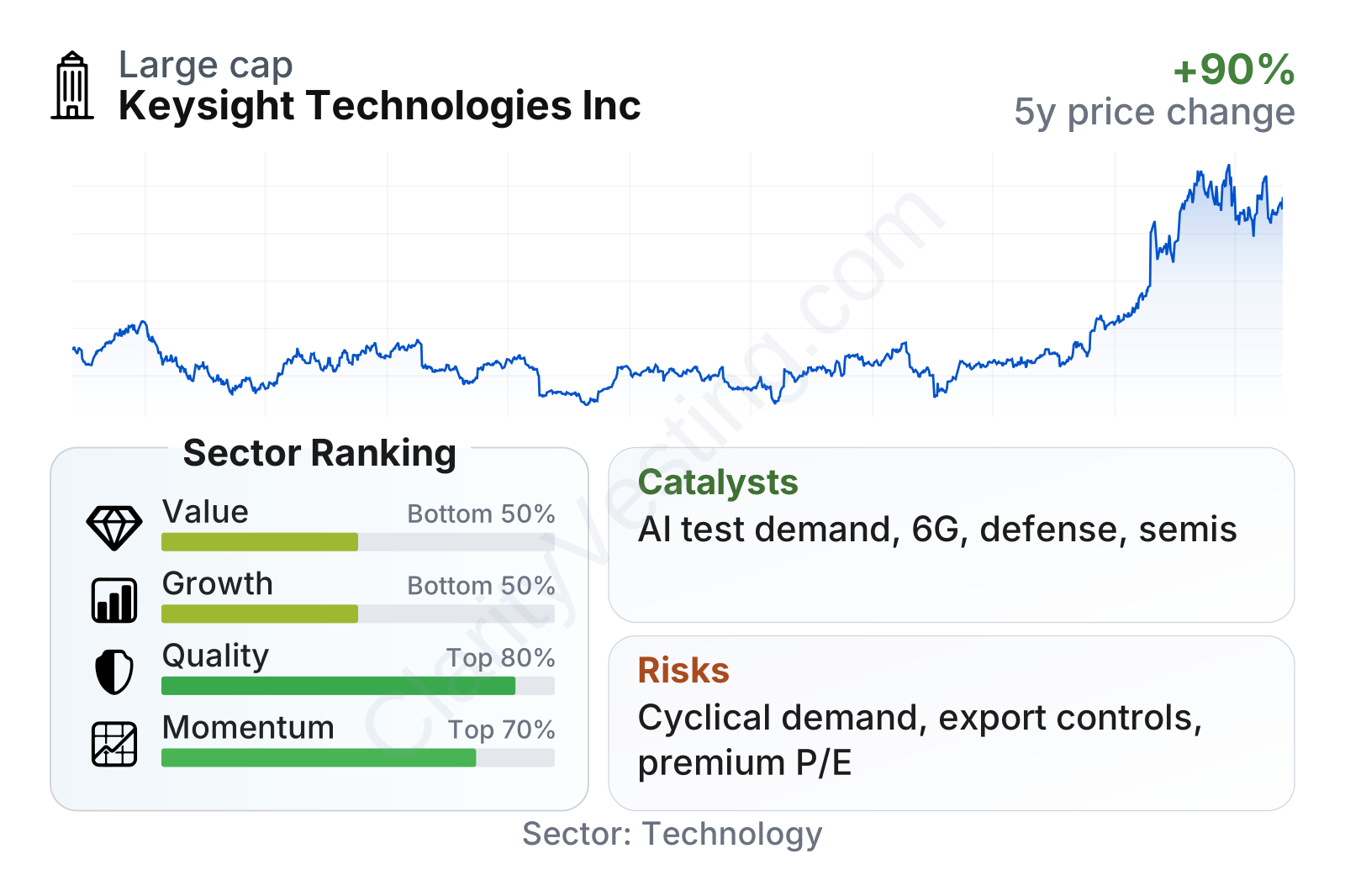
Keysight stands out more for business quality than for headline cheapness. Profitability and returns on invested capital are clearly above the sector median, and leverage remains low relative to operating earnings. Growth metrics look mixed over a five-year view because the company went through a downcycle before re-accelerating sharply more recently. On valuation, the shares trade above the sector median on earnings and below the sector median on free-cash-flow yield, which points to a market already recognizing the company’s quality and current recovery.
In size terms, Keysight is a large company within scientific and technical instruments, and its stock has shown above-market volatility with a beta a little above 1. The share price history also shows that the market has been willing to re-rate the company when growth expectations improve.
Growth
Keysight operates in markets that are supported by long-duration technology trends. Wireless networks continue to advance, with 5G expansion still ongoing and early 6G research progressing. Semiconductor complexity keeps increasing as chipmakers move to more advanced nodes, higher-speed interfaces, and more demanding power and signal requirements. Data centers and artificial intelligence infrastructure are also becoming more demanding to test because faster interconnects and more complex system architectures create more points of failure. In defense, modern electronic systems require extensive simulation and validation. All of this supports the need for more sophisticated test and measurement tools.
Its strategy is logical for future growth because it combines high-performance instruments with software, services, and workflow tools. That matters because customers increasingly want integrated platforms that reduce development time, not just standalone hardware boxes. The company has also expanded through acquisitions in areas such as design engineering software and network testing, which strengthens its role earlier in the customer development cycle and can deepen relationships.
The recent growth pattern looks notably stronger than the earlier downturn. Revenue growth turned negative during the industry slowdown, but the company has since moved back into expansion and the latest year-over-year pace is well above the sector median. That suggests Keysight is benefiting both from improved demand and from exposure to areas where customers are increasing spending again.
Cash generation also improved after a softer period. Trailing free cash flow has rebounded to roughly the mid-$1 billion range, which is important because it gives the company room to keep investing in research, support acquisitions, and return capital to shareholders without leaning heavily on debt.
A meaningful recent opportunity is the surge in AI-related infrastructure spending. Keysight has been positioning around high-speed digital, data center interconnect, and advanced semiconductor validation, all of which become more important as AI servers and networking equipment push performance limits. The company has also highlighted opportunities tied to next-generation wireless research, aerospace and defense modernization, and more software-led solutions. These are not short-lived trends; they are linked to the increasing complexity of electronic systems.
Risks
This article is for informational purposes only and does not constitute financial advice. Some content is AI-generated. See Disclaimer


