Stock Analysis · Bitfarms Ltd (KEEL)
Overview
Bitfarms Ltd is a Bitcoin infrastructure company. In simple terms, it operates large computing facilities filled with specialized machines that process the Bitcoin network and, in return, earn Bitcoin. The company owns and runs data-center-style sites, secures power contracts, manages mining equipment, and then either holds or sells part of the Bitcoin it produces. Its operations have historically been concentrated in the Americas, with a strong focus on energy access and site development.
For most practical purposes, Bitfarms is still a single-business company. Its economic results depend mainly on how much Bitcoin it can mine, what Bitcoin is worth when it sells, how efficient its machines are, and how much electricity and hosting infrastructure cost.
The main sources of revenue are therefore highly concentrated:
- Bitcoin mining revenue: approximately 95% to 100% of total revenue in recent periods. This comes from block rewards and transaction-fee income earned through participation in the Bitcoin network.
- Other revenue: approximately 0% to 5% when present. This can include items tied to energy optimization, equipment-related arrangements, or other operational activities, but these have not been a major driver of the business.
That concentration makes Bitfarms easy to understand: revenue is mostly a function of Bitcoin production and Bitcoin prices. It also means the business has less diversification than many technology companies.
The longer-term operating pattern has been mixed. Revenue has risen from 2023 through 2025, but costs have grown faster, and gross profit turned negative in several recent years. The business has therefore expanded its operating footprint without yet converting that scale into stable profitability.
The financial flow over the last several years shows a clear tension: revenue has improved from the 2022 downturn, but cost of revenue has remained above sales in recent annual periods. Administrative costs have also stayed meaningful, so growth in activity has not yet translated into durable operating earnings.
Key Figures
| Metric | Value | Sector ⓘ |
|---|---|---|
| Date | Sep 12, 2026 | |
| Context | ||
| Sector | Technology | |
| Industry | Information Technology Services | |
| Market Cap ⓘ | $2.12B | |
| Beta ⓘ | 4.07 | |
Value (Cheapness) | ||
| P/E Ratio ⓘ | N/A | 29.51 |
| FCF Yield ⓘ | -16.86% | 4.25% |
| EBIT / EV ⓘ | -6.56% | 2.85% |
| PEG ⓘ | N/A | |
Growth (Business expansion) | ||
| Revenue Growth ⓘ | -50.00% | 15.40% |
| RPS Growth (5Y CAGR) ⓘ | -19.72% | 8.56% |
| EPS Growth (5Y CAGR) ⓘ | -12.32% | -11.88% |
| Margin Growth (5Y Trend) ⓘ | N/A | 0.46% |
| FCF Growth (5Y CAGR) ⓘ | N/A | 9.80% |
Quality (Business durability) | ||
| ROIC (Latest) ⓘ | -14.99% | 9.44% |
| ROIC (5Y Median) ⓘ | N/A | 8.30% |
| Net Debt / EBIT (Latest) ⓘ | N/A | 0.54 |
| Net Debt / EBIT (5Y Median) ⓘ | N/A | 0.44 |
| Operating Margin (Latest) ⓘ | -86.82% | 9.58% |
| Operating Margin (5Y Median) ⓘ | -42.41% | 8.25% |
| Debt to Equity (Latest) ⓘ | 315.88% | 33.33% |
| Profit Margin (Latest) ⓘ | -230.59% | 7.14% |
| Free Cash Flow (Latest) ⓘ | -$358.14M | |
Momentum (Price trend) | ||
| 3Y Return ⓘ | +210.43% | +45.48% |
| 12M Return (excl. last month) ⓘ | +178.74% | +23.48% |
| 6M Return ⓘ | +60.81% | +20.93% |
| Price vs. 200-Day MA ⓘ | +5.16% | +7.43% |
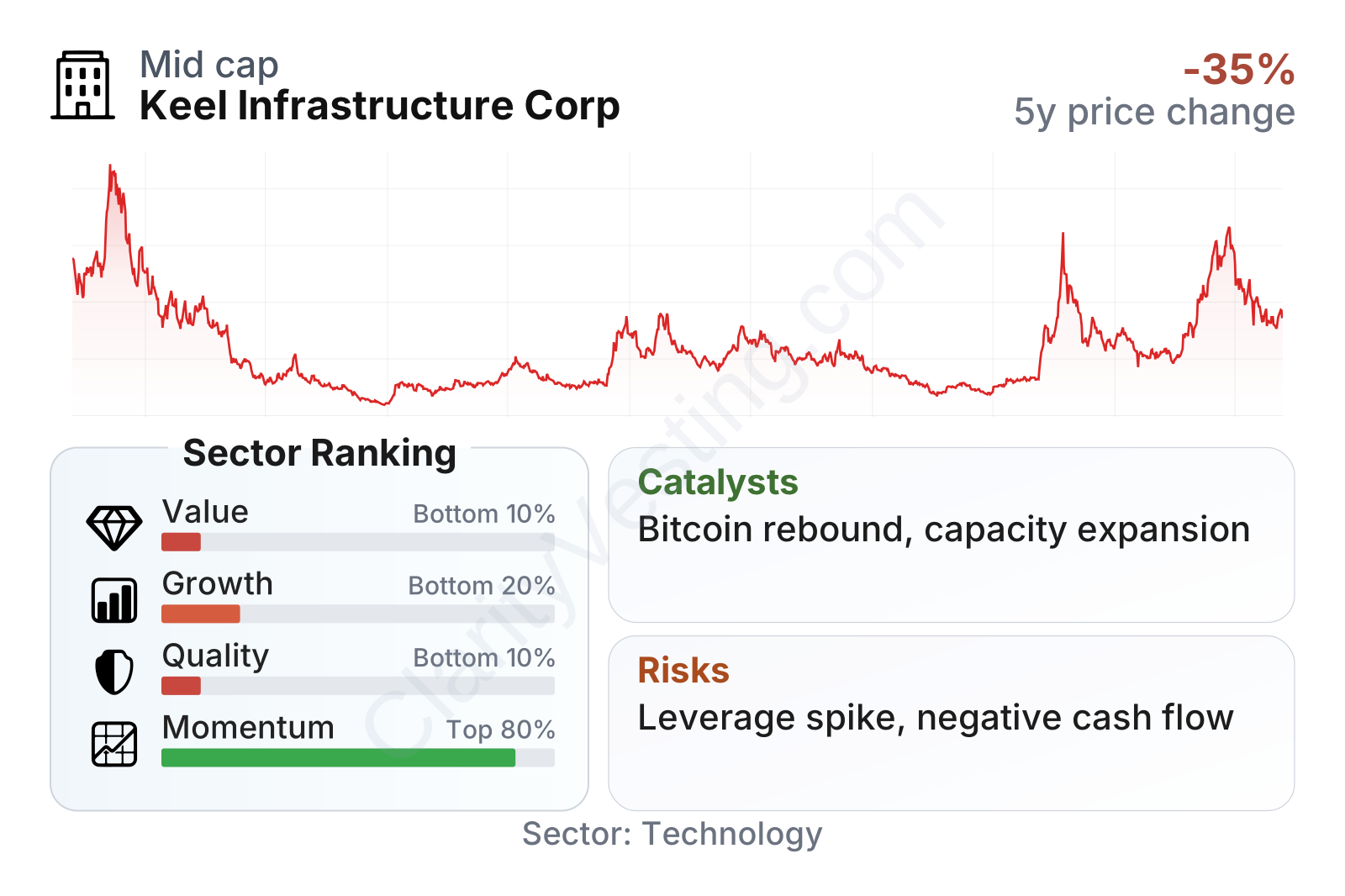
Bitfarms is now a mid-sized public company by market value, but it behaves much more like a high-volatility commodity-linked operator than a typical software or services stock. The share price history has been extremely unstable, with very large swings over the last few years. That volatility is also visible in the beta above 4, which implies the stock has moved much more sharply than the broader market.
The summary metrics point to a weak current fundamental profile versus the wider technology sector. On value, growth, and quality, the company ranks near the bottom of the sector, while momentum has been better thanks to strong price moves over parts of the last 12 months and 3 years. In other words, market performance has at times improved much faster than the operating profile.
Growth
Bitfarms operates in a sector that still has structural growth potential, but it is not a normal technology growth market. Bitcoin mining can expand when the Bitcoin price rises, when miners secure lower-cost power, or when operators upgrade equipment to improve output per unit of electricity. Demand for Bitcoin infrastructure also tends to increase around strong crypto market cycles. That gives the company exposure to a large and still developing digital-asset ecosystem.
Its strategy generally makes sense within that industry. The company has focused on expanding energized capacity, improving fleet efficiency, and growing its North American presence. In Bitcoin mining, access to electricity at attractive prices is one of the most important advantages, so site development and power sourcing are central to future economics. If Bitfarms can keep adding capacity while modernizing its mining fleet, it may be able to raise production even in a more competitive network environment.
Recent revenue growth has been highly uneven. Bitfarms posted strong rebounds during parts of 2024 and 2025, but the more recent year-over-year readings have turned sharply negative again, with declines of roughly 45% to 60% in the latest quarters shown. That pattern suggests growth is being driven less by steady business expansion and more by the timing of Bitcoin-market conditions, network difficulty, and operational transitions.
Cash generation remains the bigger obstacle to the growth case. Free cash flow has stayed deeply negative over time, including a trailing twelve-month deficit in the hundreds of millions of dollars. That indicates expansion has required substantial capital spending and that internally generated cash has not been enough to fund the buildout. For a mining company, that matters because hardware ages quickly and must be upgraded regularly to remain competitive.
A meaningful catalyst is the company’s exposure to any sustained rise in Bitcoin prices. Because revenue is tied so directly to Bitcoin economics, stronger digital-asset markets can improve mined-coin values, balance-sheet flexibility, and the economics of adding new machines. Another important catalyst is execution on new sites and power capacity, because a larger and more efficient fleet can lift production without requiring the Bitcoin price alone to do all the work.
Recent company developments have also pointed to a broader infrastructure ambition rather than a narrow “mine-and-sell” model. Bitfarms has highlighted expansion efforts in energy and compute capacity, which can matter if the company is able to position some of its infrastructure for adjacent high-performance computing uses over time. That is still more of an emerging opportunity than a proven revenue pillar, but it gives the market another lens through which to view the asset base.
Risks
This article is for informational purposes only and does not constitute financial advice. Some content is AI-generated. See Disclaimer


