Stock Analysis · Kodiak AI Inc (KDK)
Overview
Kodiak AI Inc is an autonomous driving company focused mainly on self-driving technology for trucks. Its core product is an artificial intelligence system that helps heavy commercial vehicles drive with limited human input, with the broader goal of improving freight efficiency and safety. The company has also developed related tools such as mapping, simulation, sensor integration, and fleet support software that help its autonomous platform operate in real-world logistics environments.
For a long-term stock analysis, the key point is that Kodiak is still in an early commercial stage. It is not yet a mature software company with recurring profits. Instead, it is closer to a development-stage transportation technology business trying to turn years of engineering work into scalable commercial contracts.
Based on public filings and company disclosures, revenue appears to come from a small number of activity buckets, though detailed segment percentages are limited. The available information suggests the revenue mix is concentrated and still evolving.
- Autonomous trucking and related commercial services: likely the largest source of revenue. This includes work tied to Kodiak’s self-driving trucking platform, pilot programs, and services connected to deployment with logistics or freight partners.
- Government and defense-related autonomous vehicle work: a smaller but potentially meaningful source. Kodiak has publicly discussed defense applications of its autonomous technology, which may include development, testing, or contracted vehicle programs.
- Engineering, platform integration, and other revenue: a limited source that can include technical services, customization, and partner-related development work.
The financial flow currently shows a business with modest revenue compared with very high operating costs. Research and development remains the dominant expense line, which is typical for an autonomous driving company, but it also shows how far Kodiak still is from self-funding operations. Another notable shift is that revenue weakened sharply in 2025 while losses expanded significantly, indicating that commercialization has not yet become stable.
Key Figures
| Metric | Value | Sector ⓘ |
|---|---|---|
| Date | Sep 12, 2026 | |
| Context | ||
| Sector | Technology | |
| Industry | Software - Infrastructure | |
| Market Cap ⓘ | $880.71M | |
| Beta ⓘ | 0.45 | |
Value (Cheapness) | ||
| P/E Ratio ⓘ | N/A | 29.51 |
| FCF Yield ⓘ | -21.29% | 4.25% |
| EBIT / EV ⓘ | -44.62% | 2.85% |
| PEG ⓘ | N/A | |
Growth (Business expansion) | ||
| Revenue Growth ⓘ | 595.60% | 15.40% |
| RPS Growth (5Y CAGR) ⓘ | -33.27% | 8.56% |
| EPS Growth (5Y CAGR) ⓘ | N/A | -11.88% |
| Margin Growth (5Y Trend) ⓘ | N/A | 0.46% |
| FCF Growth (5Y CAGR) ⓘ | N/A | 9.80% |
Quality (Business durability) | ||
| ROIC (Latest) ⓘ | N/A | 9.44% |
| ROIC (5Y Median) ⓘ | N/A | 8.30% |
| Net Debt / EBIT (Latest) ⓘ | N/A | 0.54 |
| Net Debt / EBIT (5Y Median) ⓘ | N/A | 0.44 |
| Operating Margin (Latest) ⓘ | -10277.26% | 9.58% |
| Operating Margin (5Y Median) ⓘ | -431.98% | 8.25% |
| Debt to Equity (Latest) ⓘ | 139.50% | 33.33% |
| Profit Margin (Latest) ⓘ | N/A | 7.14% |
| Free Cash Flow (Latest) ⓘ | -$187.48M | |
Momentum (Price trend) | ||
| 3Y Return ⓘ | -56.96% | +45.48% |
| 12M Return (excl. last month) ⓘ | -57.22% | +23.48% |
| 6M Return ⓘ | -52.02% | +20.93% |
| Price vs. 200-Day MA ⓘ | -42.04% | +7.43% |
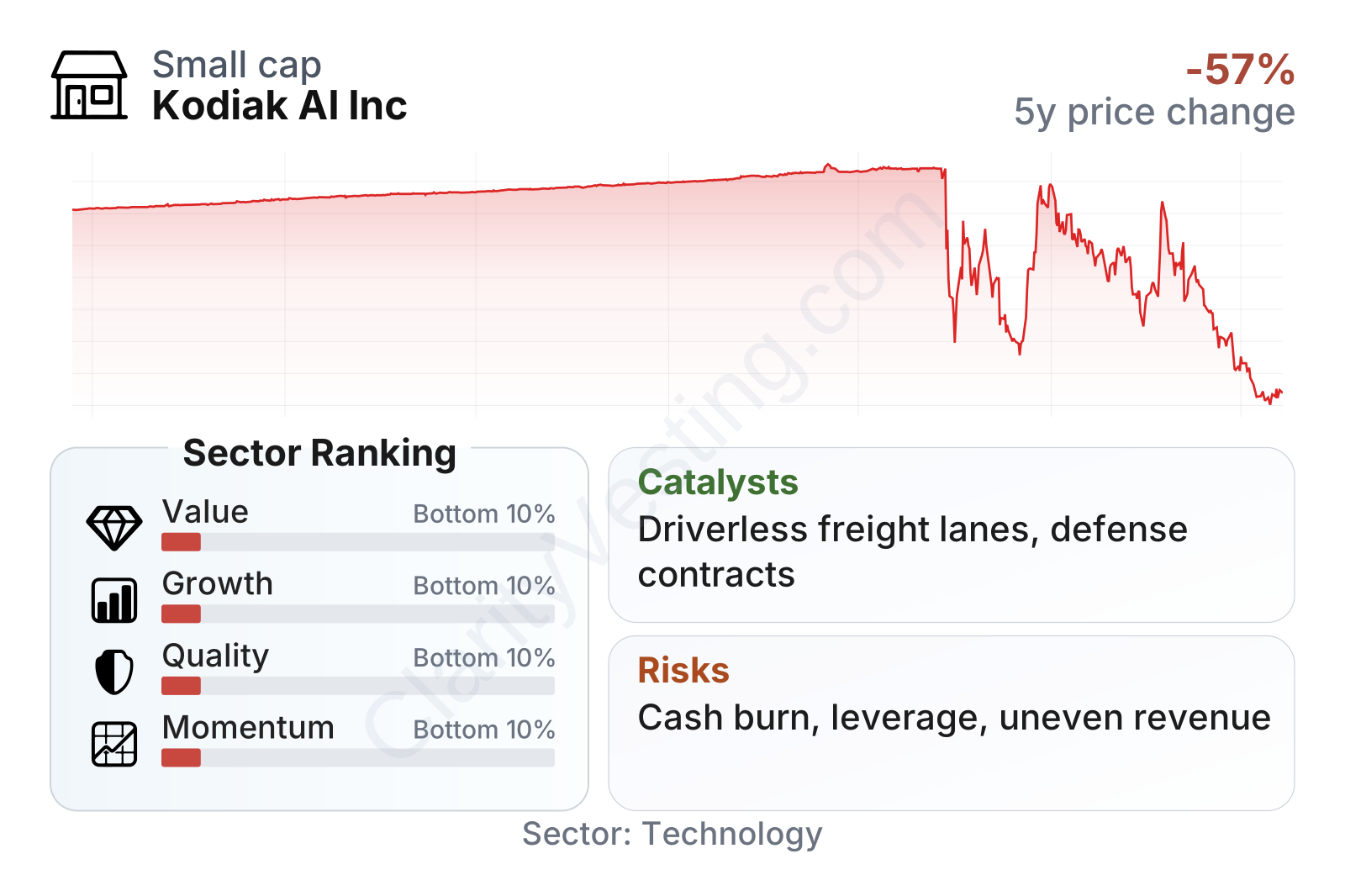
Kodiak is a small-cap technology company with a market value under $1 billion and a relatively low beta near 0.45, although that low beta should be read carefully because the stock’s own trading history has still been very weak. The stock price was fairly stable through much of 2023 to mid-2025, then dropped sharply and remained under pressure in 2026.
The broader picture from the metrics table is difficult: Kodiak ranks in the bottom 10% of its sector on value, growth, quality, and momentum. The one bright spot is recent year-over-year revenue acceleration, but that improvement sits next to deeply negative margins, negative free cash flow, and weak long-term per-share growth. In simple terms, the company has signs of activity picking up, but the underlying financial profile remains fragile.
Growth
Autonomous trucking is part of a large and potentially expanding market. Long-haul freight has labor shortages, pressure to reduce delivery costs, and a strong economic incentive to improve vehicle utilization. If self-driving trucks reach reliable commercial deployment, the addressable opportunity could be substantial because trucking is a major part of supply chains across the United States. That gives Kodiak exposure to a sector with real long-term potential rather than a purely speculative consumer concept.
Kodiak’s strategy also makes sense on paper. The company is not trying to solve every driving use case at once. It has emphasized freight corridors and commercial routes where operating conditions can be more structured than dense urban passenger driving. That narrower focus can improve the odds of practical deployment and may help the company build a clearer path to revenue through partnerships with carriers, logistics groups, and government users.
Recent revenue growth has become highly volatile. After a sharp decline in parts of 2025, growth turned positive again in early 2026 and then accelerated dramatically by mid-2026. That kind of rebound can matter because it may indicate contract timing, program launches, or progress in commercialization. Still, one strong growth period does not yet prove a durable trend, especially for a company coming from a very small revenue base.
Cash generation remains a major obstacle. Free cash flow has become much more negative over time, reaching roughly negative $187 million on a trailing basis. That means growth is currently expensive: Kodiak is spending heavily to support technology development and operations, while cash inflows remain too small to offset those outlays. For long-term analysis, the central growth question is not whether autonomous trucking is attractive, but whether Kodiak can convert technical progress into repeatable, better-funded commercial scaling.
A meaningful catalyst is the company’s continued push into real-world deployments and strategic partnerships. Public company communications have highlighted collaborations in trucking and defense-related autonomy, and those areas are important because they can validate the technology in demanding operating conditions. Any expansion of driverless freight lanes, additional contract wins, or deeper relationships with fleet operators would be more important than headline technology claims alone.
Risks
This article is for informational purposes only and does not constitute financial advice. Some content is AI-generated. See Disclaimer


