Stock Analysis · Kyndryl Holdings Inc (KD)
Overview
Kyndryl Holdings is a large information technology services company focused on designing, building, managing, and modernizing critical technology systems for enterprises and public-sector clients. It was created from IBM’s managed infrastructure services business and now operates as an independent company. In simple terms, Kyndryl helps large organizations keep their core IT running while also moving those systems toward newer cloud-based and digital environments.
Its business is centered on long-term service relationships. Customers typically rely on Kyndryl for essential operations such as managing data centers, networks, cloud environments, workplace technology, security, and mainframe systems. That gives the company a recurring-revenue profile, but it also means growth depends on retaining big contracts, improving margins, and expanding into newer higher-value services rather than just maintaining older infrastructure.
Based on company reporting, revenue is mainly organized by geography rather than by product line. The latest annual filing shows a broad global footprint, with revenue spread across major regions as follows:
- United States: about 32% of revenue.
- Japan: about 17%.
- Principal European markets: about 30% combined, including countries such as Germany, the United Kingdom, France, Italy, and Spain.
- Other countries and regions: about 21%.
The company also describes its activities across several service areas. Precise revenue shares for these categories are not consistently broken out in the latest filing, but the main activities include:
- Cloud services: helping clients run and manage workloads across private, public, and hybrid cloud environments.
- Core enterprise and zCloud services: supporting mission-critical systems, including mainframes and related infrastructure.
- Applications, data, and AI services: modernizing software environments and improving the use of enterprise data.
- Digital workplace services: managing employee devices, support, and collaboration technology.
- Network and edge services: operating connectivity, branch, and edge infrastructure.
- Security and resiliency services: helping customers protect and recover critical systems.
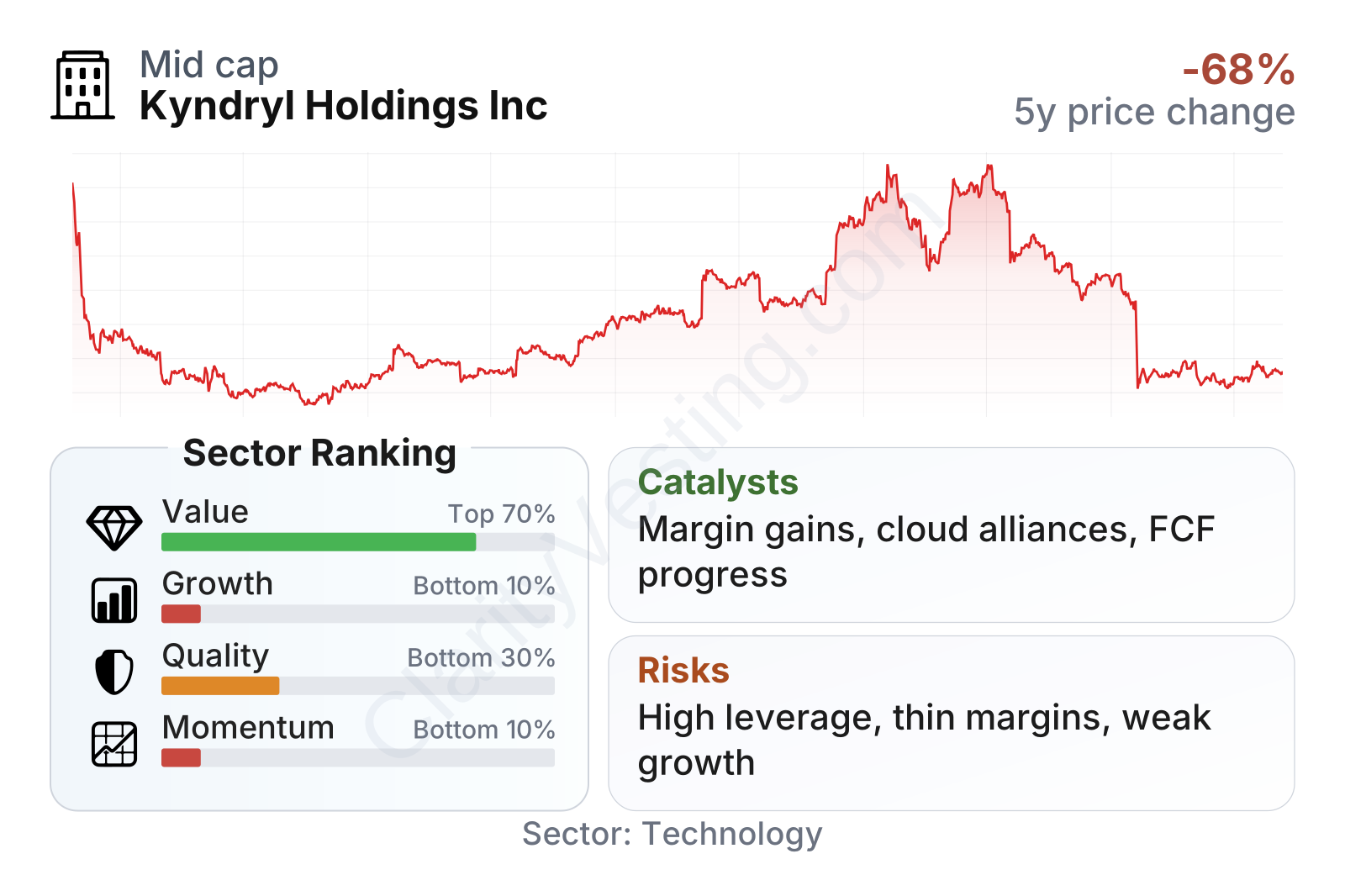
Kyndryl’s financial profile has been changing in an important way: revenue has contracted since the spin-off, but the mix has been gradually improving. Gross profit has expanded while losses turned into modest profitability, showing that lower-quality contracts have been reduced and operational discipline has improved.
Key Figures
| Metric | Value | Sector ⓘ |
|---|---|---|
| Date | Sep 12, 2026 | |
| Context | ||
| Sector | Technology | |
| Industry | Information Technology Services | |
| Market Cap ⓘ | $2.76B | |
| Beta ⓘ | 1.71 | |
Value (Cheapness) | ||
| P/E Ratio ⓘ | 35.22 | 29.51 |
| FCF Yield ⓘ | 5.36% | 4.25% |
| EBIT / EV ⓘ | 9.53% | 2.85% |
| PEG ⓘ | N/A | |
Growth (Business expansion) | ||
| Revenue Growth ⓘ | -3.30% | 15.40% |
| RPS Growth (5Y CAGR) ⓘ | -6.16% | 8.56% |
| EPS Growth (5Y CAGR) ⓘ | -58.26% | -11.88% |
| Margin Growth (5Y Trend) ⓘ | N/A | 0.46% |
| FCF Growth (5Y CAGR) ⓘ | N/A | 9.80% |
Quality (Business durability) | ||
| ROIC (Latest) ⓘ | 5.31% | 9.44% |
| ROIC (5Y Median) ⓘ | -0.81% | 8.30% |
| Net Debt / EBIT (Latest) ⓘ | 4.61 | 0.54 |
| Net Debt / EBIT (5Y Median) ⓘ | N/A | 0.44 |
| Operating Margin (Latest) ⓘ | 3.35% | 9.58% |
| Operating Margin (5Y Median) ⓘ | -0.29% | 8.25% |
| Debt to Equity (Latest) ⓘ | 460.75% | 33.33% |
| Profit Margin (Latest) ⓘ | 0.58% | 7.14% |
| Free Cash Flow (Latest) ⓘ | $148.00M | |
Momentum (Price trend) | ||
| 3Y Return ⓘ | -20.21% | +45.48% |
| 12M Return (excl. last month) ⓘ | -55.81% | +23.48% |
| 6M Return ⓘ | +4.70% | +20.93% |
| Price vs. 200-Day MA ⓘ | -17.53% | +7.43% |
Kyndryl is a mid-sized technology services company with a stock that has been highly volatile since becoming independent. The latest factor snapshot shows a mixed picture. On valuation, it screens better than much of the sector on cash-flow and enterprise-value measures, even though its headline earnings multiple is not especially low. On growth, quality, and momentum, it ranks near the bottom of the technology sector, reflecting weak historical sales trends, thin margins, heavy leverage, and a sharp share-price decline over recent months.
That combination matters for long-term analysis: the company is no longer in the deep-loss phase seen after the separation from IBM, but it still has a fragile financial profile compared with stronger technology peers.
Growth
Kyndryl operates in a sector with durable long-term demand. Large enterprises still need outside partners to run complex infrastructure, protect systems, manage hybrid cloud environments, and modernize legacy technology. Those needs are not disappearing. In fact, the spread of AI, stricter cyber requirements, and the need to connect older systems to newer cloud platforms can create more demand for companies that understand complex enterprise environments.
The main question is not whether the sector itself has growth. It does. The question is whether Kyndryl can capture enough of that growth while offsetting the decline of older infrastructure work. Management’s strategy has been to move the company away from low-margin legacy contracts and toward services tied to cloud, applications, data, security, and consulting-led modernization. Strategically, that direction makes sense because customers increasingly want integrated support rather than simple infrastructure outsourcing.
Revenue trends still show the difficulty of that transition. Over the last several years, sales were mostly negative year over year, although the declines became much smaller and occasional quarters returned to flat or positive growth. That is a sign that the business may be nearing stabilization, but it is not yet strong evidence of sustained expansion. One unusually large growth reading in the recent series appears inconsistent with the broader pattern and should be treated cautiously until confirmed by subsequent filings.
A more encouraging sign is cash generation. Kyndryl has moved from negative free cash flow in earlier years to positive free cash flow more recently. That shift is important because it suggests operational improvements are becoming real in cash terms, not just accounting results.
The trend in free cash flow points to one of Kyndryl’s clearest catalysts: if revenue can merely stabilize while margins continue to improve, the earnings and cash profile could look materially different from the post-spin period. The company has also emphasized alliances with major technology vendors such as Microsoft, Amazon Web Services, Google Cloud, VMware, and others. Those partnerships can help Kyndryl win modernization work without having to build every technology platform itself.
Recent company communications have continued to highlight signings, cloud-related projects, and progress in its “Accounts” and “Practices” model, where industry-focused client coverage is paired with specialized service capabilities. The opportunity here is practical rather than flashy: Kyndryl already has access to large enterprise customers running critical systems, and cross-selling newer services into that installed base could support gradual improvement over time.
Risks
This article is for informational purposes only and does not constitute financial advice. Some content is AI-generated. See Disclaimer


