Stock Analysis · KB Home (KBH)
Overview
KB Home is a U.S. homebuilder that designs, builds, and sells single-family homes, townhomes, and some condominium projects, primarily for first-time, first move-up, and active adult buyers. The company operates across several large housing markets, with a focus on the West Coast, the Southwest, and parts of the Southeast. A major part of its identity is offering buyers the ability to personalize floor plans and finishes, which helps differentiate it from builders that rely more heavily on standardized models.
Its business is straightforward: it acquires land, develops communities, builds homes, and then sells those homes to individual buyers. Because of that model, results are heavily influenced by housing demand, mortgage rates, affordability, and the company’s ability to control land and construction costs.
Revenue comes overwhelmingly from home sales, while financial services play a much smaller supporting role through mortgage, title, and insurance-related activities tied to its homebuyers. Based on recent annual reporting, the mix is approximately:
- Homebuilding: roughly 98% to 99% of revenue
- Financial services: roughly 1% to 2% of revenue
Geographically, revenue is spread across U.S. regions rather than across business lines. California remains especially important, making KB Home more concentrated than some larger national builders, but also giving it strong exposure to markets with persistent housing shortages.
The financial flow over the last several years shows a cyclical pattern rather than a straight line. Revenue and profits improved strongly during the housing upcycle, peaked around 2022 to 2024 depending on the measure, and then moderated as affordability pressure and higher financing costs weighed on demand. Even so, the company has remained profitable through that slowdown.
Key Figures
| Metric | Value | Sector ⓘ |
|---|---|---|
| Date | Sep 12, 2026 | |
| Context | ||
| Sector | Consumer Cyclical | |
| Industry | Residential Construction | |
| Market Cap ⓘ | $3.01B | |
| Beta ⓘ | 1.34 | |
Value (Cheapness) | ||
| P/E Ratio ⓘ | 11.96 | 17.10 |
| FCF Yield ⓘ | 12.03% | 8.53% |
| EBIT / EV ⓘ | 7.30% | 6.46% |
| PEG ⓘ | 5.97 | |
Growth (Business expansion) | ||
| Revenue Growth ⓘ | -27.30% | 5.75% |
| RPS Growth (5Y CAGR) ⓘ | 10.15% | 9.14% |
| EPS Growth (5Y CAGR) ⓘ | -45.36% | -18.21% |
| Margin Growth (5Y Trend) ⓘ | -2.92% | -0.23% |
| FCF Growth (5Y CAGR) ⓘ | N/A | 4.91% |
Quality (Business durability) | ||
| ROIC (Latest) ⓘ | 4.67% | 12.61% |
| ROIC (5Y Median) ⓘ | 18.01% | 10.72% |
| Net Debt / EBIT (Latest) ⓘ | 5.22 | 2.10 |
| Net Debt / EBIT (5Y Median) ⓘ | 1.91 | 2.32 |
| Operating Margin (Latest) ⓘ | 6.26% | 9.25% |
| Operating Margin (5Y Median) ⓘ | 11.81% | 9.64% |
| Debt to Equity (Latest) ⓘ | 52.64% | 75.78% |
| Profit Margin (Latest) ⓘ | 4.94% | 5.33% |
| Free Cash Flow (Latest) ⓘ | $362.50M | |
Momentum (Price trend) | ||
| 3Y Return ⓘ | +3.97% | +14.53% |
| 12M Return (excl. last month) ⓘ | -7.37% | +3.08% |
| 6M Return ⓘ | -6.63% | +0.55% |
| Price vs. 200-Day MA ⓘ | -11.97% | -0.54% |
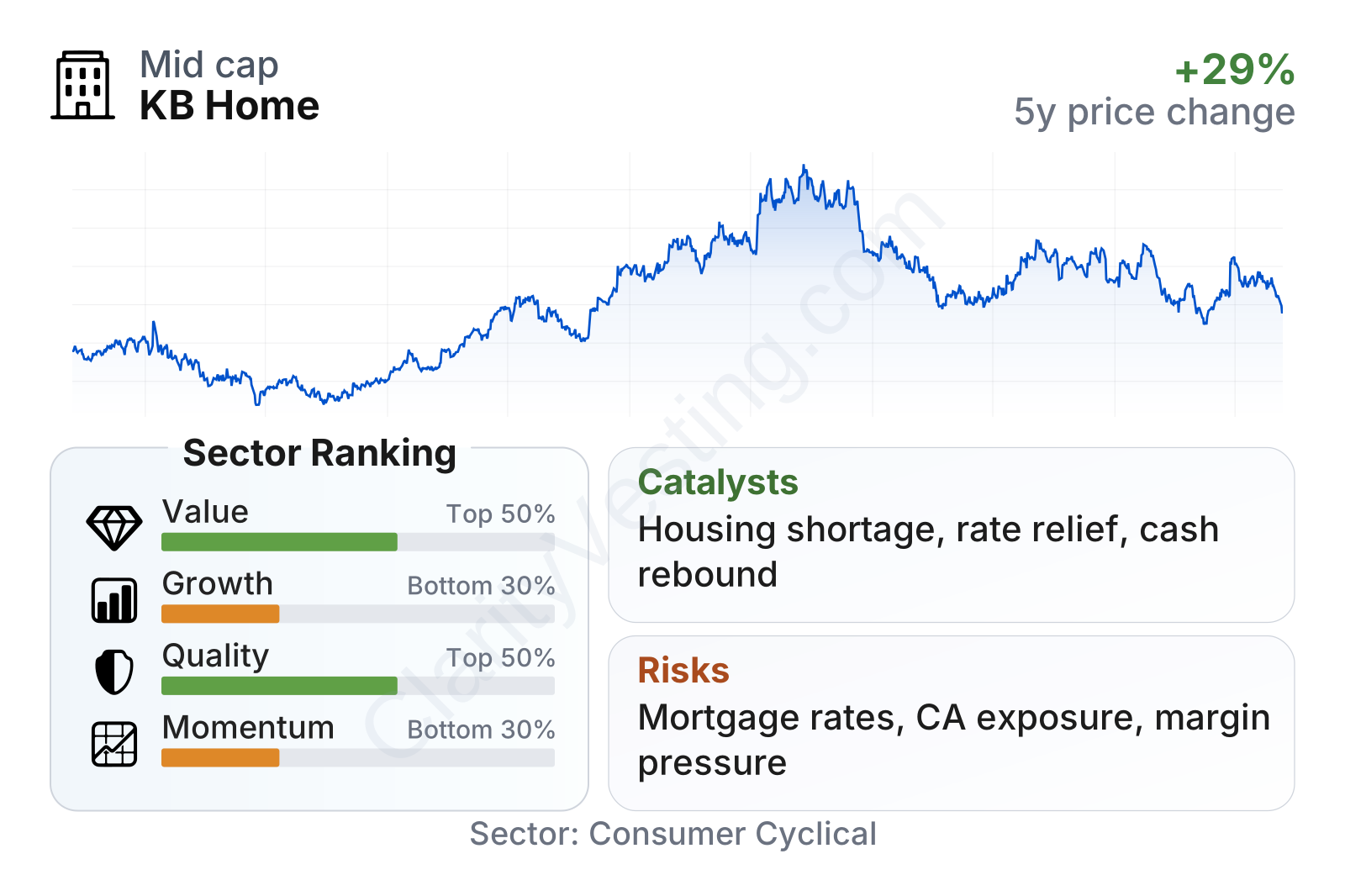
KB Home sits in the mid-cap range, with a market value of about $3.8 billion, and the shares have shown above-average volatility, which is common for homebuilders. The overall metrics profile is mixed: valuation looks moderate relative to much of the sector, free cash flow generation is currently solid, and leverage appears controlled by industry standards. On the other hand, recent growth metrics are weak, profitability has cooled from prior highs, and current returns on capital are below the stronger parts of the homebuilding group.
The stock-price history also reflects the industry’s cyclical nature. Shares climbed sharply from 2022 lows into 2024, then gave back part of those gains as the market reassessed the pace of housing demand and earnings durability.
Growth
Residential construction remains a structurally important sector in the United States because the country still faces a meaningful housing supply gap in many markets. That long-term backdrop supports demand for new homes, especially in areas with population growth and limited resale inventory. In that sense, KB Home operates in a sector that still has room to expand over time, even though short-term conditions can swing sharply.
KB Home’s strategy makes practical sense for this environment. The company focuses on built-to-order homes, energy efficiency, and product customization, which can appeal to buyers who want a new home tailored to their budget and preferences. It also tends to emphasize lot discipline and community positioning rather than chasing growth at any price. That approach can help preserve profitability when the market is less favorable.
Still, near-term momentum has clearly slowed. Revenue growth has turned negative after earlier years of strong expansion, showing how sensitive homebuilders are to affordability pressure and mortgage costs. The more encouraging point is that longer-term growth over a five-year view is better than the recent trend suggests, indicating that the current slowdown looks more cyclical than structural.
Cash generation has also been uneven, which is normal in homebuilding because land spending, development timing, and home deliveries can move cash flow sharply from one period to another. KB Home has returned to positive trailing free cash flow after a weak patch, which matters because it gives the company more flexibility for land investment, debt management, and shareholder returns without relying entirely on external financing.
A meaningful catalyst for future growth is the persistent shortage of affordable and entry-level housing in many U.S. markets. If mortgage rates stabilize or ease, builders with an existing community base and a product aimed at affordability could see better order activity. Another support is the limited supply of existing homes for sale, which can push buyers toward new construction when resale options remain scarce.
Recent company updates have also pointed to the continued use of incentives, pricing adjustments, and product positioning to keep absorption moving in a difficult market. That is not as powerful as a broad housing rebound, but it shows management is adapting rather than waiting passively for conditions to improve.
Risks
This article is for informational purposes only and does not constitute financial advice. Some content is AI-generated. See Disclaimer


