Stock Analysis · Jumbo SA (JUMSY)
Overview
Jumbo S.A. is a large specialty retailer based in Greece that focuses on value-oriented consumer goods. The company is best known for toys, baby products, seasonal items, home goods, school supplies, and decoration products sold at relatively low price points. Its business model is built around broad product variety, high inventory turnover, direct sourcing, and a store network that serves families and everyday discretionary spending.
The group operates mainly in Greece, Cyprus, Bulgaria, and Romania, while also reaching some additional markets through partnerships. Revenue comes primarily from physical retail stores, supported by e-commerce operations in the countries where it has direct presence. The company’s product mix is diversified, but public reporting tends to emphasize geography more clearly than exact category splits.
Based on recent company reporting, Jumbo’s revenue sources are best understood by market exposure rather than by product category.
- Greece: approximately 65% to 70% of sales. This is the core market and includes the company’s densest store base and strongest brand recognition.
- Romania: approximately 15% to 20% of sales. This has become the main external growth market as the network expands.
- Bulgaria: approximately 7% to 10% of sales.
- Cyprus: approximately 5% to 7% of sales.
- Other activities: a small remaining share from e-commerce and partner-operated international arrangements.
Financially, the company has turned revenue growth into unusually strong profitability for a retailer. Over the last several years, sales have climbed steadily from roughly €0.8 billion equivalent in 2021 to nearly €1.2 billion in 2025, while net income remained very high for the sector. The overall picture is that of a discount-focused retailer with a strong local market position and an unusually efficient cost structure.
The profit flow shows a notable feature: revenue has expanded materially over the past few years while operating income and net income stayed exceptionally strong. Even with some pressure in 2025, profitability remains far above what is typical in specialty retail, which helps explain why Jumbo stands out financially despite operating in a generally competitive consumer business.
Key Figures
| Metric | Value | Sector ⓘ |
|---|---|---|
| Date | Sep 12, 2026 | |
| Context | ||
| Sector | Consumer Cyclical | |
| Industry | Specialty Retail | |
| Market Cap ⓘ | $4.15B | |
| Beta ⓘ | 0.32 | |
Value (Cheapness) | ||
| P/E Ratio ⓘ | 11.15 | 17.10 |
| FCF Yield ⓘ | 8.86% | 8.53% |
| EBIT / EV ⓘ | N/A | 6.46% |
| PEG ⓘ | N/A | |
Growth (Business expansion) | ||
| Revenue Growth ⓘ | 6.70% | 5.75% |
| RPS Growth (5Y CAGR) ⓘ | 9.57% | 9.14% |
| EPS Growth (5Y CAGR) ⓘ | 10.59% | -18.21% |
| Margin Growth (5Y Trend) ⓘ | -3.19% | -0.23% |
| FCF Growth (5Y CAGR) ⓘ | -2.94% | 4.91% |
Quality (Business durability) | ||
| ROIC (Latest) ⓘ | N/A | 12.61% |
| ROIC (5Y Median) ⓘ | 19.39% | 10.72% |
| Net Debt / EBIT (Latest) ⓘ | -0.79 | 2.10 |
| Net Debt / EBIT (5Y Median) ⓘ | -1.06 | 2.32 |
| Operating Margin (Latest) ⓘ | 31.93% | 9.25% |
| Operating Margin (5Y Median) ⓘ | 32.53% | 9.64% |
| Debt to Equity (Latest) ⓘ | 4.22% | 75.78% |
| Profit Margin (Latest) ⓘ | 25.98% | 5.33% |
| Free Cash Flow (Latest) ⓘ | $367.66M | |
Momentum (Price trend) | ||
| 3Y Return ⓘ | +26.60% | +14.53% |
| 12M Return (excl. last month) ⓘ | -21.77% | +3.08% |
| 6M Return ⓘ | +19.12% | +0.55% |
| Price vs. 200-Day MA ⓘ | +8.22% | -0.54% |
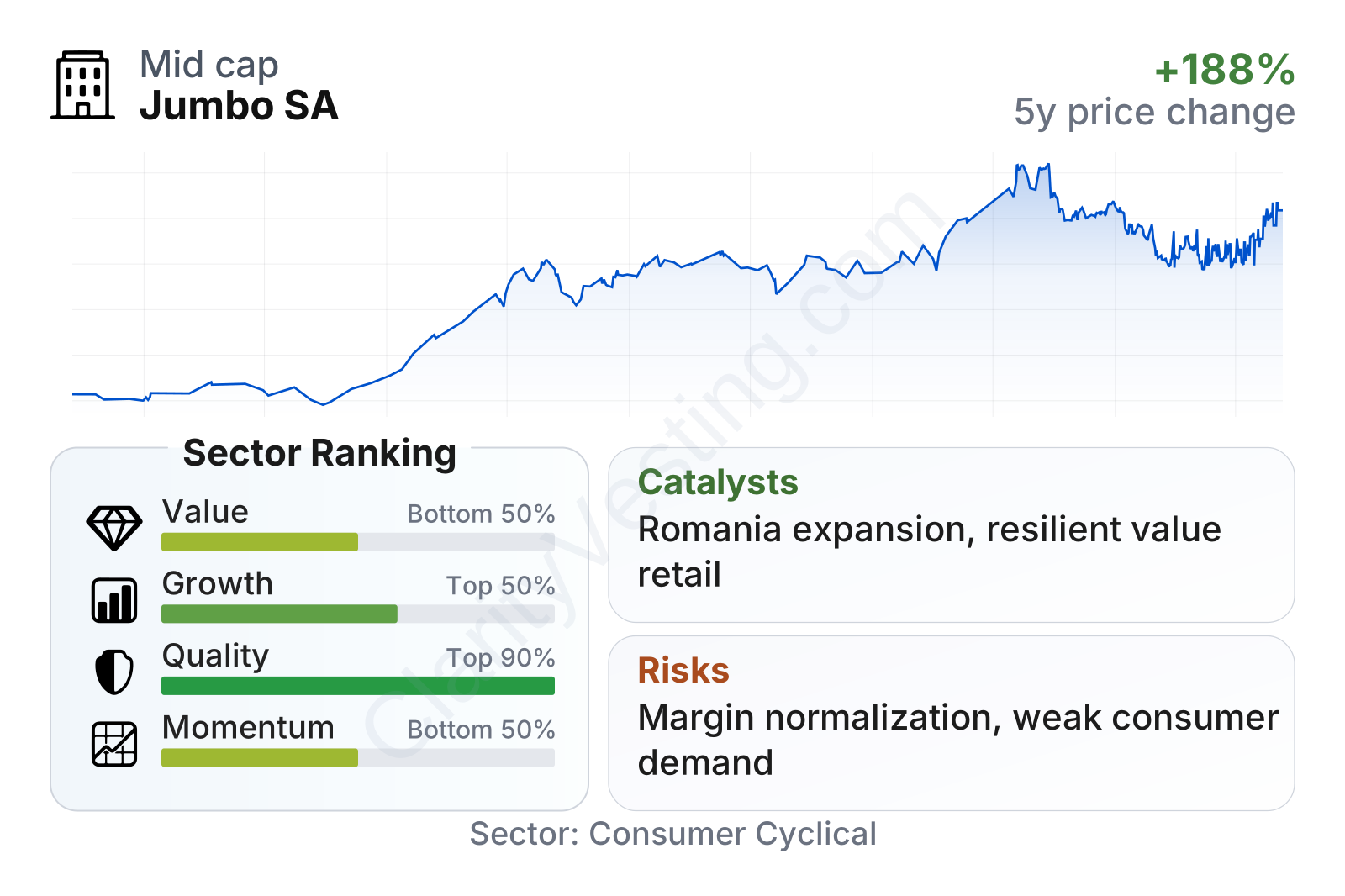
Jumbo is a mid-sized listed retailer with a market value around $4 billion and a low share price volatility profile, reflected in a beta close to 0.3. The factor breakdown is mixed but interesting. On value, the stock screens below the sector median on earnings multiple, with a P/E around 11 versus roughly 17.5 for the sector median, while free cash flow yield is slightly better than the median. On growth, the company ranks in the top half of the sector, helped by revenue growth of about 7% and solid five-year expansion in revenue per share and earnings per share. On quality, it is much stronger, ranking in the top 10% of the sector thanks to high returns on capital, very low leverage, and margins that are far above typical retail levels. Momentum is weaker over the last year, even though the longer-term share performance remains positive.
Growth
Jumbo operates in a part of retail that is mature, but still capable of growth when a company combines low prices, strong merchandising, and disciplined expansion. Toys alone are not a high-growth industry, yet Jumbo is broader than a toy chain. Its exposure to seasonal goods, household items, baby products, school supplies, and low-ticket discretionary purchases gives it a wider addressable market and helps smooth demand across the year.
The company’s strategy for future growth appears coherent. It continues to expand in Southeastern Europe, especially Romania, where organized retail still offers room for store rollout and scale benefits. This matters because Jumbo’s model depends on purchasing efficiency and operating leverage: once a market reaches sufficient scale, margins can remain attractive even in a value-focused retail format.
Recent growth has been respectable rather than explosive. The latest year-over-year revenue growth is around 7%, slightly above the sector median, while five-year revenue-per-share growth is close to 10% annually. That points to a business still expanding at a healthy pace, although not at the rate of an early-stage retailer. Importantly, earnings growth over the last five years has also held up well, suggesting that growth has not come at the expense of profitability.
Cash generation remains one of the more attractive parts of the picture. Free cash flow has stayed solid in absolute terms, although the shorter-term trend has softened from earlier peaks. That moderation deserves attention, but it does not currently undermine the broader impression of a retailer that converts a meaningful share of earnings into cash.
A practical catalyst for the business is continued store development in Romania and the possibility of gaining share from smaller or less efficient local competitors. Another support factor is consumer behavior during uncertain economic periods: a value retailer with a broad non-food assortment can sometimes benefit when households trade down from higher-priced alternatives. The company has also maintained a conservative balance sheet, which gives it flexibility to keep investing even when competitors become more cautious.
Risks
This article is for informational purposes only and does not constitute financial advice. Some content is AI-generated. See Disclaimer