Stock Analysis · JOYY Inc (JOYY)
Overview
JOYY Inc is a social media and online entertainment company focused on live-streaming and real-time interactive platforms. Its best-known business today is BIGO, a global portfolio that includes Bigo Live for live streaming, Likee for short-form video, and imo for communication and social interaction. The company also operates audio-based social products in certain markets. JOYY used to have a larger China-focused live-streaming presence, but its current profile is much more centered on international users and overseas monetization.
The business model is relatively simple: JOYY attracts users onto its apps, keeps them engaged through creator content and social interaction, and then turns engagement into revenue mainly through virtual gifts, premium features, and other paid services inside the apps. Advertising exists, but it is not the core driver.
Based on recent company reporting, JOYY’s revenue mix is heavily concentrated in live-streaming and social entertainment. A practical way to think about its sources of revenue is:
- Live-streaming revenue: about 90% to 95% of total revenue. This mainly comes from users buying virtual gifts and other in-app paid items on platforms such as Bigo Live and similar social entertainment products.
- Advertising and other revenue: about 5% to 10% of total revenue. This includes ads, platform-related services, and smaller monetization streams outside core gifting.
Within that, the international segment has become the key economic engine. That matters because JOYY is no longer mainly a China domestic platform story; it is increasingly an overseas digital entertainment company with exposure to Southeast Asia, the Middle East, and other international markets.
The longer revenue trend shows a company that has been reshaping itself rather than simply expanding every year. Sales have declined from earlier peaks, but costs have also come down materially. Research and development spending has stayed meaningful, while selling and administrative expense has been reduced from 2021 levels. That shift helps explain why profitability and cash generation have improved even without a steady top-line climb.
The operating profile has become leaner over time: revenue is below 2021 levels, but the expense base is much lighter, interest burden is minimal, and recent periods show that JOYY can still convert its platform scale into earnings and cash when monetization improves.
Key Figures
| Metric | Value | Sector ⓘ |
|---|---|---|
| Date | Sep 12, 2026 | |
| Context | ||
| Sector | Communication Services | |
| Industry | Internet Content & Information | |
| Market Cap ⓘ | $3.78B | |
| Beta ⓘ | 0.47 | |
Value (Cheapness) | ||
| P/E Ratio ⓘ | 17.72 | 18.61 |
| FCF Yield ⓘ | 8.70% | 13.68% |
| EBIT / EV ⓘ | 4.59% | 4.54% |
| PEG ⓘ | 0.86 | |
Growth (Business expansion) | ||
| Revenue Growth ⓘ | 16.30% | 5.40% |
| RPS Growth (5Y CAGR) ⓘ | 4.43% | 4.62% |
| EPS Growth (5Y CAGR) ⓘ | -6.34% | -18.01% |
| Margin Growth (5Y Trend) ⓘ | 12.61% | 1.10% |
| FCF Growth (5Y CAGR) ⓘ | 57.94% | 5.88% |
Quality (Business durability) | ||
| ROIC (Latest) ⓘ | 1.53% | 8.38% |
| ROIC (5Y Median) ⓘ | N/A | 8.32% |
| Net Debt / EBIT (Latest) ⓘ | -2.75 | 1.99 |
| Net Debt / EBIT (5Y Median) ⓘ | -1.68 | 2.94 |
| Operating Margin (Latest) ⓘ | 4.76% | 14.89% |
| Operating Margin (5Y Median) ⓘ | 10.20% | 12.96% |
| Debt to Equity (Latest) ⓘ | 1.08% | 59.59% |
| Profit Margin (Latest) ⓘ | 9.58% | 8.77% |
| Free Cash Flow (Latest) ⓘ | $329.05M | |
Momentum (Price trend) | ||
| 3Y Return ⓘ | +130.67% | +46.64% |
| 12M Return (excl. last month) ⓘ | +58.66% | +2.16% |
| 6M Return ⓘ | +32.11% | +5.05% |
| Price vs. 200-Day MA ⓘ | +21.42% | +2.88% |
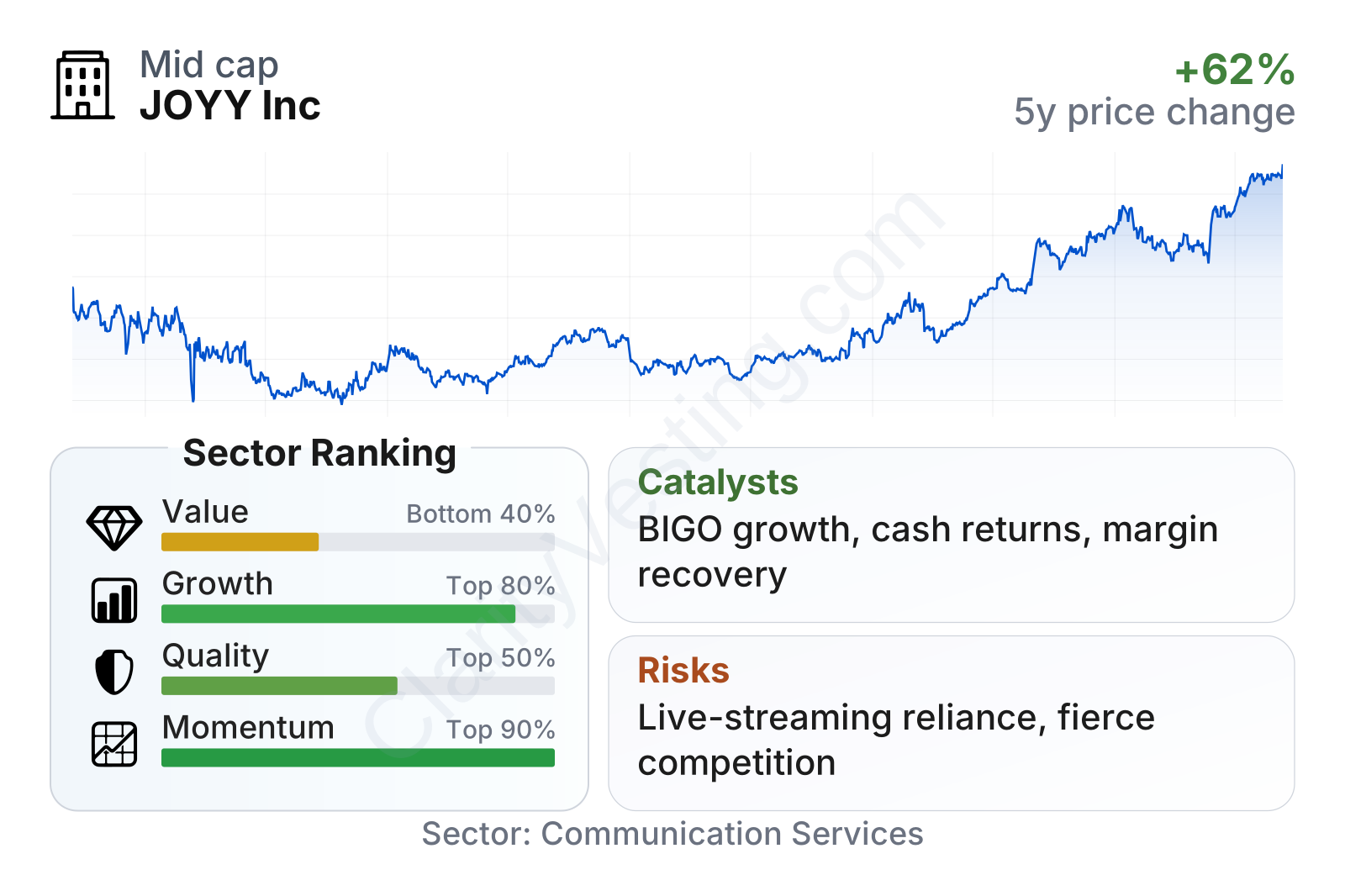
JOYY is a mid-sized internet platform company with a market value in the low single-digit billions of dollars. Its share-price behavior has been notably less volatile than many internet peers, with a beta well below 1. In the factor table, the strongest areas are momentum and recent growth improvement, while quality is mixed and value looks roughly around the sector range rather than deeply discounted. Revenue growth has recently moved well above the sector median, and free cash flow growth over five years has been especially strong, but returns on invested capital and operating margin remain below stronger peers in the broader communication services group.
Growth
JOYY operates in a sector that still has room for expansion over the long run. Live-streaming, creator-led digital entertainment, and social interaction apps continue to benefit from mobile usage, digital payments, and the growing acceptance of online tipping and virtual gifting. These are real structural tailwinds, especially in emerging markets where smartphone adoption and mobile-first entertainment remain on the rise.
What makes JOYY’s growth case more nuanced is that the company is not a pure early-stage expansion name anymore. It is better viewed as a platform owner trying to balance user growth, monetization, and efficiency. That strategy makes sense for the current stage of the business. Instead of chasing revenue at any cost, management has focused on improving monetization quality, controlling expenses, and supporting products with stronger international traction.
The recent revenue trend is encouraging. After a long stretch of contraction, year-over-year growth turned positive again and accelerated into the mid-teens by the latest period. That is a meaningful change because it suggests JOYY may be moving out of its restructuring phase and back into a more stable growth pattern. Relative to the sector, recent sales growth is clearly stronger than average.
Cash generation is another important support. Even with only a partial historical view here, free cash flow has improved materially from earlier levels, and the broader metric set points to very strong multi-year free cash flow growth. For a social platform business, that matters because cash can be used for product development, acquisitions, share repurchases, and balance-sheet resilience during weaker demand periods.
Several catalysts could matter over the next few years. First, continued expansion of BIGO products in overseas markets could lift paying-user activity. Second, better cost discipline can have an outsized effect because a digital platform has meaningful operating leverage once engagement improves. Third, JOYY has historically returned capital to shareholders through repurchases and dividends, which can reshape per-share results if cash generation remains solid. Finally, any sustained improvement in monetization at Bigo Live or Likee would likely be more important than simple user-count growth.
Recent company updates have generally reinforced this direction: management has continued to emphasize global social entertainment, efficiency, and shareholder returns rather than expensive reinvention. That does not guarantee stronger growth, but it does create a clearer strategic identity than JOYY had several years ago.
Risks
This article is for informational purposes only and does not constitute financial advice. Some content is AI-generated. See Disclaimer