Stock Analysis · Jack Henry & Associates Inc (JKHY)
Overview
Jack Henry & Associates is a financial technology company that provides software, payment processing, and technology services mainly to banks and credit unions in the United States. Its products help financial institutions run core account systems, process transactions, move money, manage digital banking, detect fraud, and meet compliance requirements. In simple terms, Jack Henry sells the digital infrastructure that many community and regional financial institutions use every day.
The business is built around long-term customer relationships and recurring revenue. Once a bank or credit union adopts a core processing platform and connects other tools around it, switching providers can be difficult, expensive, and disruptive. That gives Jack Henry a relatively sticky customer base and makes its revenue stream more predictable than that of many software companies.
Based on the company’s latest annual filing and segment disclosures, revenue comes from three main buckets.
- Services and Support: about 49% of revenue. This includes data processing, cloud and hosted services, implementation, consulting, and ongoing support tied to client operations.
- Processing: about 31% of revenue. This covers payment processing and transaction-related services such as card, ATM, ACH, bill pay, and related handling of money movement.
- License: about 20% of revenue. This includes software licenses and certain platform-related sales, though this portion has become less central over time as the company leans more on recurring and service-based activity.
That mix matters because the larger parts of the business are tied to ongoing client activity rather than one-time software sales. It also helps explain why the company has been able to maintain steady profitability even when broader technology markets have been more volatile.
The financial profile also shows a business that has expanded revenue from roughly $1.9 billion to about $2.5 billion over the last five fiscal years, while gross profit and net income also moved higher. Research and development spending has increased over that period, suggesting continued investment in products, while interest expense remains very small relative to operating income.
Over the last several years, revenue, gross profit, and net income have all trended upward, while operating costs rose more slowly than gross profit. That points to a business model with durable economics and room to keep funding product development without straining profitability.
Key Figures
| Metric | Value | Sector ⓘ |
|---|---|---|
| Date | Sep 12, 2026 | |
| Context | ||
| Sector | Technology | |
| Industry | Information Technology Services | |
| Market Cap ⓘ | $11.32B | |
| Beta ⓘ | 0.56 | |
Value (Cheapness) | ||
| P/E Ratio ⓘ | 22.70 | 29.51 |
| FCF Yield ⓘ | 6.14% | 4.25% |
| EBIT / EV ⓘ | 5.83% | 2.85% |
| PEG ⓘ | 1.93 | |
Growth (Business expansion) | ||
| Revenue Growth ⓘ | 4.70% | 15.40% |
| RPS Growth (5Y CAGR) ⓘ | 7.00% | 8.56% |
| EPS Growth (5Y CAGR) ⓘ | 7.71% | -11.88% |
| Margin Growth (5Y Trend) ⓘ | -0.15% | 0.46% |
| FCF Growth (5Y CAGR) ⓘ | 22.04% | 9.80% |
Quality (Business durability) | ||
| ROIC (Latest) ⓘ | 22.89% | 9.44% |
| ROIC (5Y Median) ⓘ | 22.38% | 8.30% |
| Net Debt / EBIT (Latest) ⓘ | 0.04 | 0.54 |
| Net Debt / EBIT (5Y Median) ⓘ | 0.05 | 0.44 |
| Operating Margin (Latest) ⓘ | 25.62% | 9.58% |
| Operating Margin (5Y Median) ⓘ | 24.29% | 8.25% |
| Debt to Equity (Latest) ⓘ | 1.95% | 33.33% |
| Profit Margin (Latest) ⓘ | 19.76% | 7.14% |
| Free Cash Flow (Latest) ⓘ | $694.86M | |
Momentum (Price trend) | ||
| 3Y Return ⓘ | +9.75% | +45.48% |
| 12M Return (excl. last month) ⓘ | -3.24% | +23.48% |
| 6M Return ⓘ | -2.35% | +20.93% |
| Price vs. 200-Day MA ⓘ | +1.63% | +7.43% |
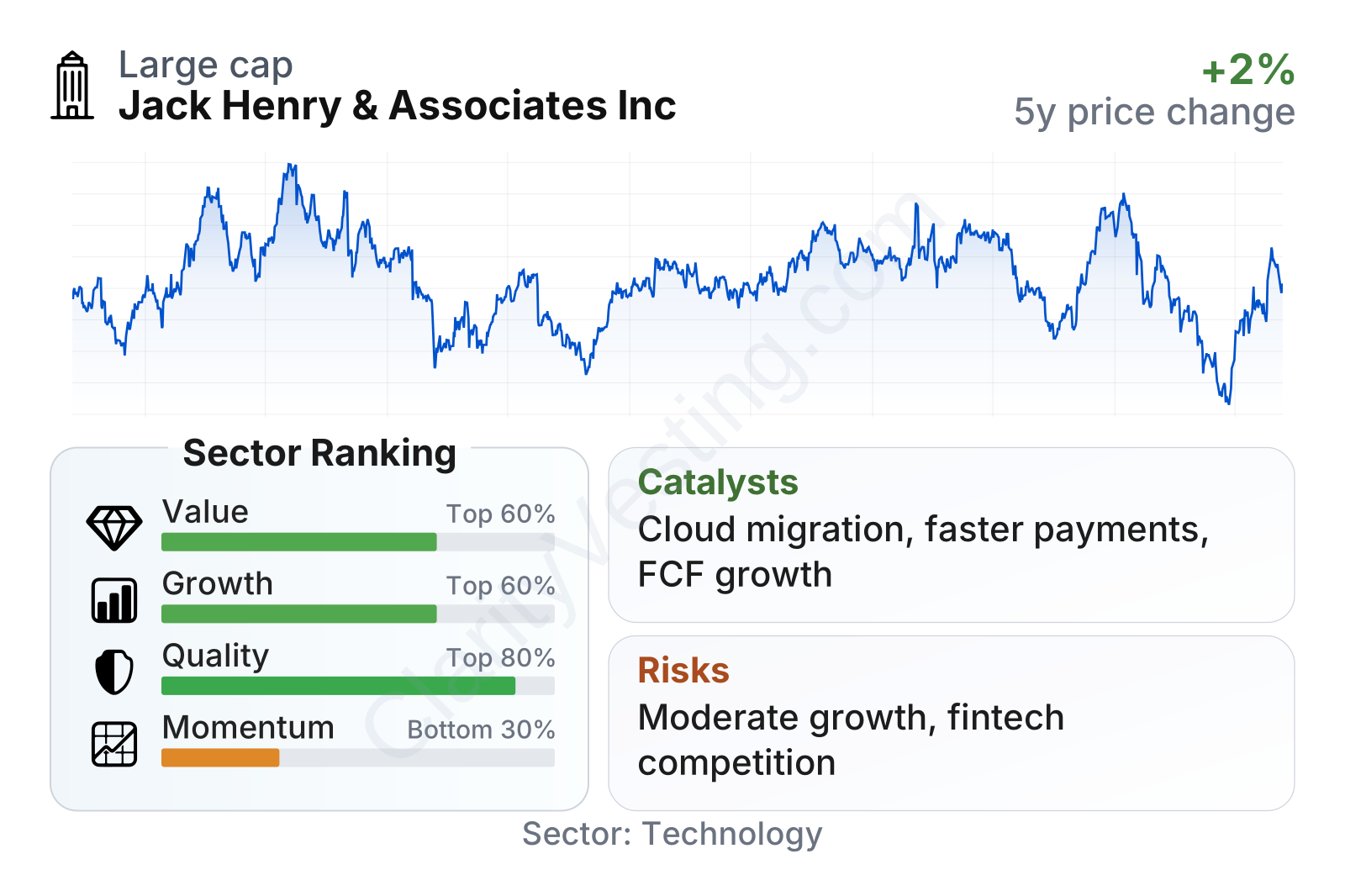
Jack Henry stands out more for business quality than for fast headline growth. Profitability is clearly above much of the technology services group, with operating margin around the mid-20% range and net profit margin near 20%. Returns on invested capital are also strong, and balance-sheet leverage is exceptionally low. On valuation, the shares trade below the sector median on earnings while cash-flow-based measures also look solid. The weaker area is market momentum: the stock has lagged the broader technology sector over the last year and over the last three years.
Growth
Jack Henry operates in a part of technology that still has long-term growth drivers. Banks and credit unions continue to modernize their systems, upgrade digital customer experiences, strengthen fraud controls, and adapt to faster payment networks. These are not optional trends. Financial institutions need to keep investing in technology even in slower economic periods, because reliability, compliance, and customer expectations all keep rising.
The company’s strategy is aligned with that environment. It focuses on community and regional financial institutions, a large market that often lacks the internal resources of the biggest national banks. Jack Henry’s value proposition is not just software, but an integrated operating platform with payments, digital banking, and outsourced processing layered on top. That can deepen customer relationships and gradually increase revenue per client over time.
Revenue growth has not been explosive, but it has been fairly consistent. Recent year-over-year revenue increases have generally stayed in the mid-single-digit to high-single-digit range, with the latest reading closer to 5%. That is slower than the typical technology company, but it is more stable than many cyclical software businesses. Over five years, revenue per share growth has been respectable, and earnings per share growth has also been positive.
Free cash flow is one of the more encouraging signals. It has climbed sharply over the past few years and is now well above earlier levels, reaching roughly $700 million on a trailing basis. That matters because free cash flow supports dividends, buybacks, acquisitions, and internal investment. It also shows that accounting profits are turning into real cash.
Recent company updates have also pointed to ongoing demand in areas such as cloud migration, digital capabilities, and payment-related services. Faster payments infrastructure in the U.S., including instant payment adoption, can create additional opportunities for vendors that already sit close to transaction flows. Jack Henry’s existing client relationships could help it capture that demand without needing to build an entirely new customer base.
Risks
This article is for informational purposes only and does not constitute financial advice. Some content is AI-generated. See Disclaimer


