Stock Analysis · Jabil Circuit Inc (JBL)
Overview
Jabil Circuit Inc., usually known as Jabil, is a large manufacturing services company that helps other businesses design, build, and manage electronic products and supply chains. In simple terms, many well-known brands rely on Jabil to turn product ideas into finished devices or components at global scale. Its work ranges from circuit boards and industrial equipment to healthcare devices, cloud infrastructure hardware, automotive electronics, and packaging solutions.
Jabil’s business is broad, but its revenue mainly comes from manufacturing and engineering services for customers in a handful of end markets. Based on recent company reporting, the largest revenue sources are approximately:
- Capital Equipment – roughly a quarter of revenue, including cloud, data center, and industrial infrastructure programs.
- Digital Commerce – about one-fifth of revenue, tied to connected devices, consumer-oriented products, and related electronics manufacturing.
- Regulated Industries – roughly one-fifth of revenue, including healthcare and certain highly controlled product categories.
- Automotive and Transportation – low-to-mid teens as a share of revenue, supported by vehicle electronics and electrification programs.
- Connected Living and Energy – around low teens combined, covering areas such as networking, home-related electronics, and energy infrastructure.
- Packaging and smaller programs – a smaller but still meaningful portion through specialized packaging and other services.
This mix matters because Jabil is no longer just a low-margin electronics assembler. Management has been shifting the portfolio toward more complex and sticky programs in areas such as healthcare, automotive, cloud infrastructure, and capital equipment, where customer relationships can be deeper and product life cycles longer.
The company’s financial structure also shows the basic economics of contract manufacturing: revenue is very large, but most of it is absorbed by production costs. What stands out is that Jabil has improved operating income over time even when sales have moved around, suggesting better mix and tighter execution rather than simple volume growth alone.
Over the past several years, revenue has been volatile, but the more important trend is that operating profit expanded faster than sales during stronger periods. That points to a business increasingly focused on higher-value projects instead of only chasing scale.
Key Figures
| Metric | Value | Sector ⓘ |
|---|---|---|
| Date | Sep 12, 2026 | |
| Context | ||
| Sector | Technology | |
| Industry | Electronic Components | |
| Market Cap ⓘ | $33.33B | |
| Beta ⓘ | 1.29 | |
Value (Cheapness) | ||
| P/E Ratio ⓘ | 37.87 | 29.51 |
| FCF Yield ⓘ | 4.51% | 4.25% |
| EBIT / EV ⓘ | 4.16% | 2.85% |
| PEG ⓘ | 0.82 | |
Growth (Business expansion) | ||
| Revenue Growth ⓘ | 11.80% | 15.40% |
| RPS Growth (5Y CAGR) ⓘ | 8.69% | 8.56% |
| EPS Growth (5Y CAGR) ⓘ | 3.23% | -11.88% |
| Margin Growth (5Y Trend) ⓘ | 0.16% | 0.46% |
| FCF Growth (5Y CAGR) ⓘ | 43.81% | 9.80% |
Quality (Business durability) | ||
| ROIC (Latest) ⓘ | 22.78% | 9.44% |
| ROIC (5Y Median) ⓘ | 18.56% | 8.30% |
| Net Debt / EBIT (Latest) ⓘ | 1.78 | 0.54 |
| Net Debt / EBIT (5Y Median) ⓘ | 1.26 | 0.44 |
| Operating Margin (Latest) ⓘ | 4.25% | 9.58% |
| Operating Margin (5Y Median) ⓘ | 4.11% | 8.25% |
| Debt to Equity (Latest) ⓘ | 294.18% | 33.33% |
| Profit Margin (Latest) ⓘ | 2.57% | 7.14% |
| Free Cash Flow (Latest) ⓘ | $1.50B | |
Momentum (Price trend) | ||
| 3Y Return ⓘ | +198.40% | +45.48% |
| 12M Return (excl. last month) ⓘ | +59.19% | +23.48% |
| 6M Return ⓘ | +26.21% | +20.93% |
| Price vs. 200-Day MA ⓘ | +7.83% | +7.43% |
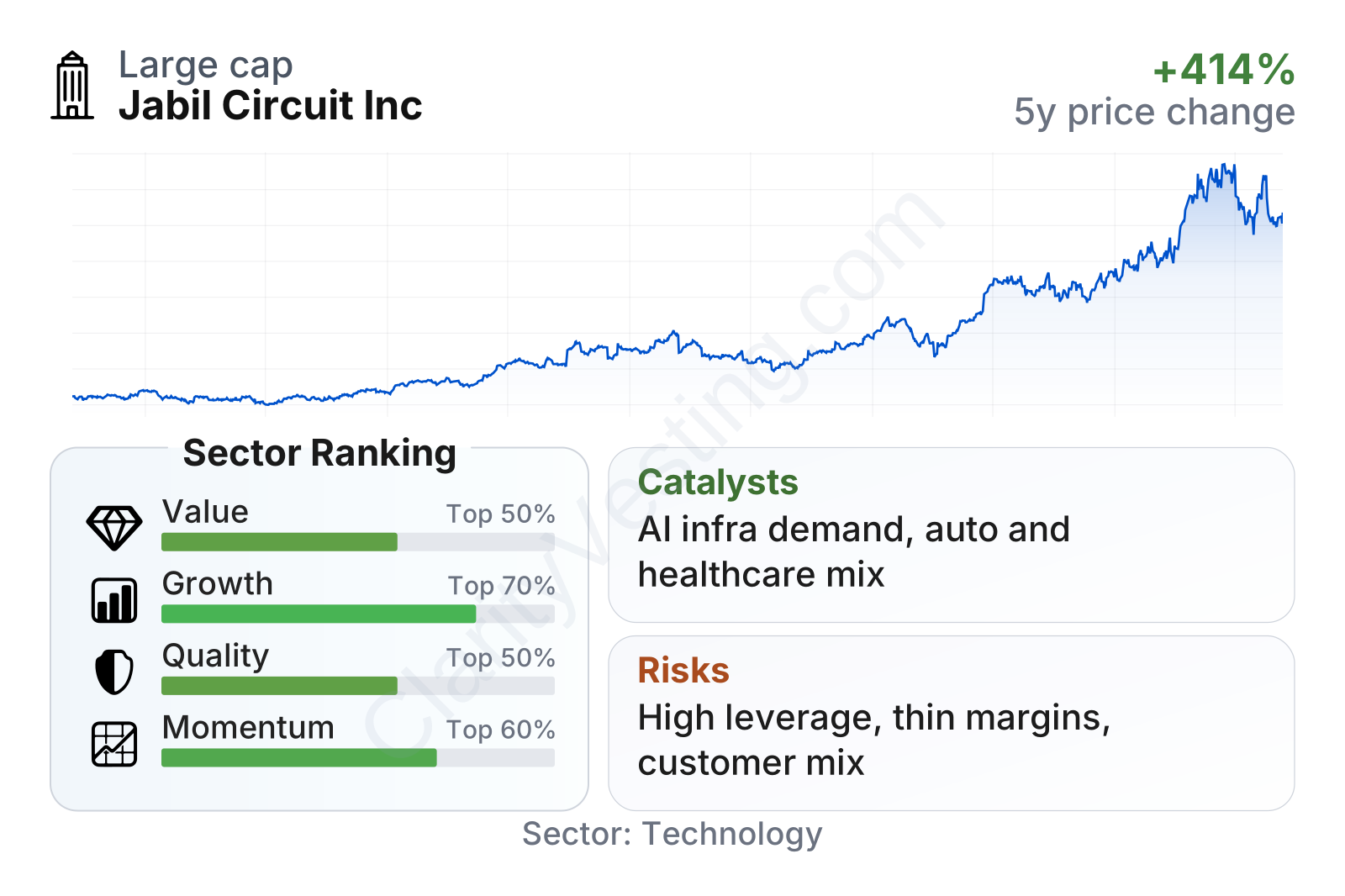
Jabil’s profile is unusual inside the technology sector. Its market value is now large, and its share price performance has been exceptionally strong over the last one, three, and even shorter time periods. Growth and momentum metrics sit above much of the sector, while quality looks decent overall because returns on invested capital have been solid over time and cash generation has improved sharply. On the other hand, classic value measures look less favorable after the stock’s rerating, and balance-sheet leverage is much higher than the typical technology peer.
The table also highlights the core trade-off in Jabil’s model: strong free cash flow and respectable long-term capital efficiency, but lower margins and heavier debt than many software or semiconductor names in the same broad sector classification. That makes it important to judge the company more like a manufacturing platform than a typical high-margin tech business.
Growth
Jabil operates in several areas that still have meaningful long-term demand drivers. These include data center and cloud hardware, healthcare devices, automotive electronics, industrial automation, and power-related infrastructure. Those are not all fast-growing every year, but they benefit from durable structural trends: more electronics in vehicles, rising compute needs, increasing medical device complexity, and the continued outsourcing of manufacturing by large global brands.
Jabil’s strategy for future expansion is fairly logical. Instead of depending too much on short-cycle consumer demand, it has been emphasizing business lines where engineering know-how, quality control, and global execution matter more. That can make customer relationships harder to replace and may reduce some of the volatility that comes with lower-value consumer assembly work.
Recent revenue trends show why Jabil needs this strategy. Sales went through a period of contraction after a stronger cycle, then returned to double-digit year-over-year growth. That pattern is typical for an exposed manufacturing company, but the rebound suggests that demand in several targeted markets has strengthened again rather than the company simply stabilizing at a lower level.
Cash generation is one of the more encouraging parts of the story. Free cash flow has climbed markedly over the last few years, moving from a few hundred million dollars to roughly $1.5 billion on a trailing basis. For a manufacturing business, that is a meaningful sign of discipline in working capital, capital spending, and program selection. It also gives the company more room to support acquisitions, debt management, and shareholder returns.
A notable catalyst is Jabil’s positioning in AI-related infrastructure and data center hardware through its capital equipment and cloud-linked programs. The company has discussed strength in areas tied to next-generation computing and advanced infrastructure, which could support additional demand if hyperscale and enterprise spending remains healthy. Automotive electronics and healthcare manufacturing also remain important medium-term growth pillars because both markets increasingly require sophisticated outsourced production.
Recent company updates have also pointed to continued portfolio shaping, with management focusing resources on businesses where complexity and reliability are more important than pure volume. That approach does not guarantee smooth growth, but it is a sensible way to pursue better economics over time.
Risks
This article is for informational purposes only and does not constitute financial advice. Some content is AI-generated. See Disclaimer