Stock Analysis · Ituran Location and Control Ltd (ITRN)
Overview
Ituran Location and Control Ltd is an Israel-based company that provides connected vehicle services. In simple terms, it installs and supports systems that help track vehicles, recover stolen cars, manage fleets, monitor driver behavior, and support usage-based insurance programs. The business combines hardware installed in vehicles with recurring service subscriptions, which is important because it creates an ongoing revenue stream rather than relying only on one-time product sales.
The company operates mainly in Israel, Brazil, and other Latin American markets, with Brazil and Israel standing out as its largest territories in recent company reporting. Its model is built around a large subscriber base: once a device is installed and a customer is connected to the service network, the relationship can continue for years through monthly fees, service upgrades, and related add-on offerings.
Based on company filings, Ituran’s revenue is primarily split between service income and product income, with service revenue clearly representing the larger portion. A practical breakdown is:
- Subscription and service revenue: about 65% to 75% of total revenue. This includes stolen vehicle recovery services, connected car services, fleet management, telematics, and insurance-related service programs.
- Product revenue: about 25% to 35% of total revenue. This includes the sale and installation of tracking and telematics devices, in-vehicle communication units, and related hardware.
Within those categories, the most attractive economic engine is the recurring service side. Hardware sales help bring customers into the ecosystem, but subscription revenue tends to be steadier and usually carries better visibility over time. Another notable point is that the business has shown a gradual expansion in gross profit and net income over recent years, suggesting that revenue growth has not come at the expense of profitability.
The company’s revenue base has expanded steadily over the past several years, while operating profit and net income have also moved higher. Costs have grown, but gross profit has widened enough to support continued margin strength, which is a healthy sign for a subscription-heavy business.
Key Figures
| Metric | Value | Sector ⓘ |
|---|---|---|
| Date | Sep 12, 2026 | |
| Context | ||
| Sector | Technology | |
| Industry | Scientific & Technical Instruments | |
| Market Cap ⓘ | $1.04B | |
| Beta ⓘ | 0.79 | |
Value (Cheapness) | ||
| P/E Ratio ⓘ | 16.06 | 29.51 |
| FCF Yield ⓘ | 7.99% | 4.25% |
| EBIT / EV ⓘ | 9.31% | 2.85% |
| PEG ⓘ | 3.41 | |
Growth (Business expansion) | ||
| Revenue Growth ⓘ | 20.70% | 15.40% |
| RPS Growth (5Y CAGR) ⓘ | 8.48% | 8.56% |
| EPS Growth (5Y CAGR) ⓘ | -1.44% | -11.88% |
| Margin Growth (5Y Trend) ⓘ | 2.47% | 0.46% |
| FCF Growth (5Y CAGR) ⓘ | 14.28% | 9.80% |
Quality (Business durability) | ||
| ROIC (Latest) ⓘ | 31.77% | 9.44% |
| ROIC (5Y Median) ⓘ | 30.52% | 8.30% |
| Net Debt / EBIT (Latest) ⓘ | -1.16 | 0.54 |
| Net Debt / EBIT (5Y Median) ⓘ | -0.68 | 0.44 |
| Operating Margin (Latest) ⓘ | 21.91% | 9.58% |
| Operating Margin (5Y Median) ⓘ | 20.72% | 8.25% |
| Debt to Equity (Latest) ⓘ | 1.90% | 33.33% |
| Profit Margin (Latest) ⓘ | 16.28% | 7.14% |
| Free Cash Flow (Latest) ⓘ | $83.25M | |
Momentum (Price trend) | ||
| 3Y Return ⓘ | +110.83% | +45.48% |
| 12M Return (excl. last month) ⓘ | +35.34% | +23.48% |
| 6M Return ⓘ | +10.68% | +20.93% |
| Price vs. 200-Day MA ⓘ | +3.07% | +7.43% |
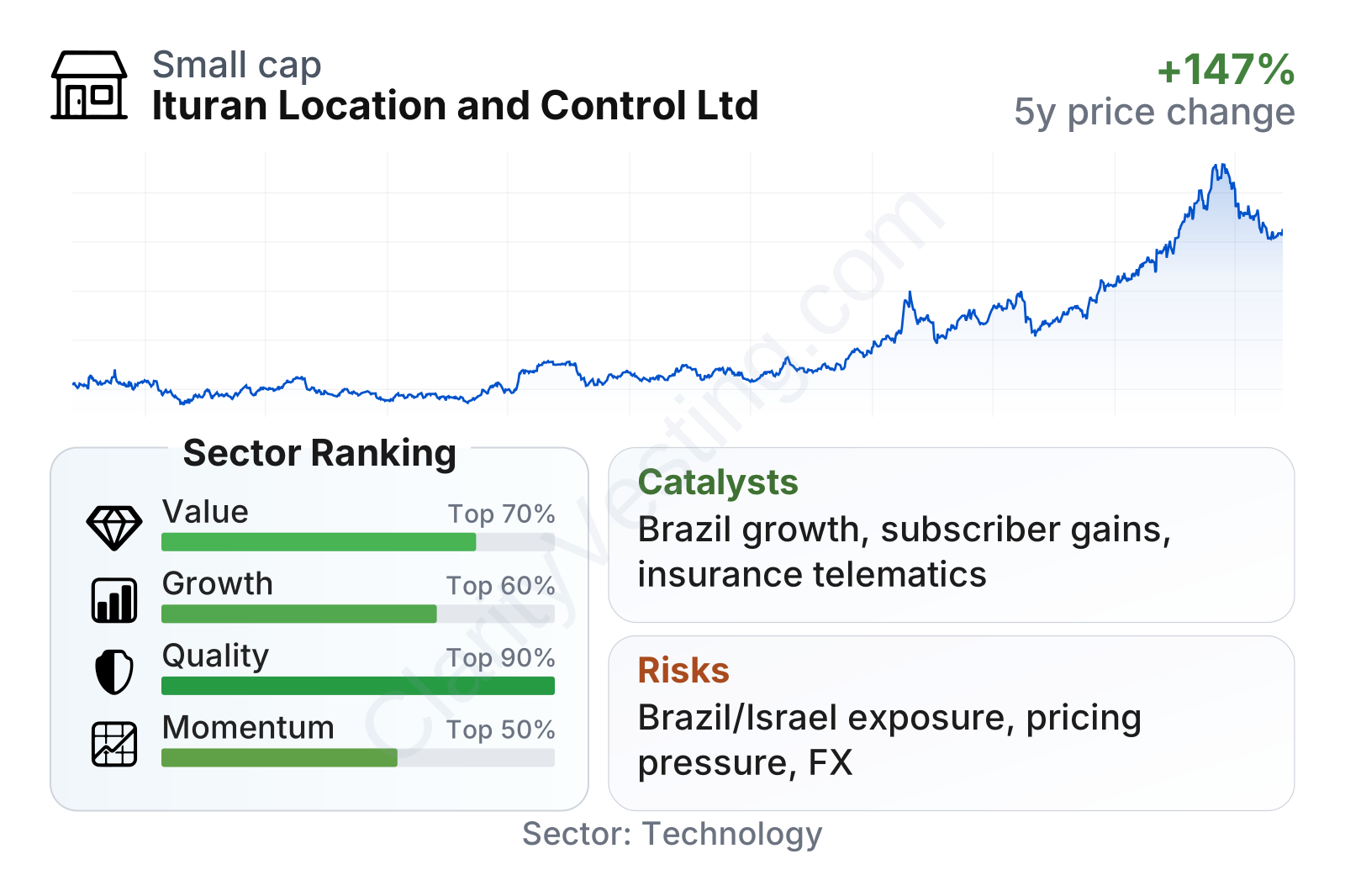
Ituran stands out most on quality and balance sheet strength. Returns on invested capital are far above the sector median, operating margins are well above typical peers, and the company is effectively in a net cash position with very low leverage. On valuation, the earnings multiple remains below the sector median even after a strong share price run. Growth metrics are solid rather than spectacular over a five-year view, but recent year-over-year revenue acceleration has improved the picture.
The stock’s longer-term share performance has been strong, with the price more than doubling over roughly three years, although the move has not been perfectly smooth. More recently, momentum has cooled compared with some sector names, which may simply reflect consolidation after a sharp rally.
Growth
Ituran operates in a part of the market that benefits from several durable trends: more connected vehicles, more demand for fleet efficiency, rising use of telematics in insurance, and continued need for vehicle security and recovery solutions in regions where theft remains a meaningful issue. These are not niche themes tied to a single product cycle. They are broader operating needs for drivers, insurers, and commercial fleet owners.
The company’s strategy also makes sense for long-term expansion because it is not just selling devices. It is building recurring relationships through subscription services. That gives it a better foundation than a hardware-only model, since each installation can become a multi-year stream of service revenue. This structure can also make growth more resilient if hardware demand becomes uneven in a given quarter.
Revenue growth had slowed at points in 2024 and early 2025, but the more recent pattern shows a clear reacceleration, reaching around 20% year over year by mid-2026. That is notably stronger than the sector median and suggests the business has entered a better operating phase, whether from subscriber additions, stronger activity in Brazil, pricing, product mix, or some combination of these factors.
Cash generation has also improved meaningfully. Free cash flow has climbed sharply from the lower levels seen in 2023 to much stronger levels more recently. That matters because free cash flow is what gives a company flexibility to invest in expansion, support dividends, pursue acquisitions, or absorb cyclical pressure without straining the balance sheet.
A key catalyst for future growth is Ituran’s exposure to insurance and fleet telematics. Insurers increasingly use driver and vehicle data to price risk more accurately, while commercial fleets want lower theft losses, better routing, improved fuel efficiency, and more oversight of assets and drivers. These needs can support both subscriber growth and higher-value service packages. In addition, the company has historically emphasized subscriber additions as a core operating target, which fits well with a long-duration compounding model if customer retention remains healthy.
Recent company communications have also pointed to continued business expansion and subscriber growth, especially in Latin America. For a company of Ituran’s size, sustained execution in these markets can have a noticeable impact on overall results because the installed base compounds over time.
Risks
This article is for informational purposes only and does not constitute financial advice. Some content is AI-generated. See Disclaimer


