Stock Analysis · Itron Inc (ITRI)
Overview
Itron Inc develops technology used by electric, gas, and water utilities to measure usage, connect field devices, and manage energy and water networks more efficiently. In simple terms, the company helps utilities know how much customers are consuming, detect problems on the grid or in water systems, and increasingly turn those networks into more connected, software-driven systems. Its products include smart meters, communication modules, network infrastructure, software platforms, and related services.
The business is tied to long replacement cycles and large utility projects rather than consumer demand. That gives Itron a more specialized position than many technology companies. Its customers are typically utilities and municipalities, which often sign multiyear deployments and service agreements. This can create good visibility, although project timing can make results uneven from one quarter to another.
Based on the company’s recent reporting structure, revenue mainly comes from three operating segments.
- Device Solutions: about 46% of revenue in 2025. This segment includes smart meters and related endpoints for electric, gas, water, heat, and industrial measurement applications.
- Outcomes: about 32% of revenue in 2025. This includes software, networked solutions, analytics, managed services, and recurring or usage-based offerings that help utilities operate distributed energy, demand response, and intelligent networks.
- Networked Solutions: about 22% of revenue in 2025. This segment includes communications modules, routers, and infrastructure that connect field devices and support utility networking.
This revenue mix matters because it shows Itron is no longer only a meter manufacturer. Hardware remains the largest piece, but the company has been building a larger layer of software, networking, and services around its installed base. That shift can support better margins and deeper customer relationships over time.
From a broader financial flow perspective, the company has moved from losses in 2021 and 2022 to much healthier profitability in 2023 through 2025. Revenue rose from roughly $1.8 billion in 2022 to about $2.4 billion in 2024, while gross profit and operating income expanded faster than sales. That suggests the recent improvement has not come only from growth, but also from better execution and product mix.
The financial profile has clearly improved: sales have grown meaningfully since 2022, while gross profit, operating income, and net income have expanded at a faster pace. Costs have not risen as quickly as revenue, which points to stronger mix and operating discipline rather than growth at any price.
Key Figures
| Metric | Value | Sector ⓘ |
|---|---|---|
| Date | Sep 12, 2026 | |
| Context | ||
| Sector | Technology | |
| Industry | Scientific & Technical Instruments | |
| Market Cap ⓘ | $4.10B | |
| Beta ⓘ | 1.32 | |
Value (Cheapness) | ||
| P/E Ratio ⓘ | 15.64 | 29.51 |
| FCF Yield ⓘ | 9.36% | 4.25% |
| EBIT / EV ⓘ | 6.80% | 2.85% |
| PEG ⓘ | 0.72 | |
Growth (Business expansion) | ||
| Revenue Growth ⓘ | -7.20% | 15.40% |
| RPS Growth (5Y CAGR) ⓘ | 3.39% | 8.56% |
| EPS Growth (5Y CAGR) ⓘ | 33.55% | -11.88% |
| Margin Growth (5Y Trend) ⓘ | 13.55% | 0.46% |
| FCF Growth (5Y CAGR) ⓘ | 33.44% | 9.80% |
Quality (Business durability) | ||
| ROIC (Latest) ⓘ | 10.61% | 9.44% |
| ROIC (5Y Median) ⓘ | 7.80% | 8.30% |
| Net Debt / EBIT (Latest) ⓘ | -1.77 | 0.54 |
| Net Debt / EBIT (5Y Median) ⓘ | 1.17 | 0.44 |
| Operating Margin (Latest) ⓘ | 14.62% | 9.58% |
| Operating Margin (5Y Median) ⓘ | 7.87% | 8.25% |
| Debt to Equity (Latest) ⓘ | 9.13% | 33.33% |
| Profit Margin (Latest) ⓘ | 11.90% | 7.14% |
| Free Cash Flow (Latest) ⓘ | $383.34M | |
Momentum (Price trend) | ||
| 3Y Return ⓘ | +48.78% | +45.48% |
| 12M Return (excl. last month) ⓘ | -18.62% | +23.48% |
| 6M Return ⓘ | +3.23% | +20.93% |
| Price vs. 200-Day MA ⓘ | +1.31% | +7.43% |
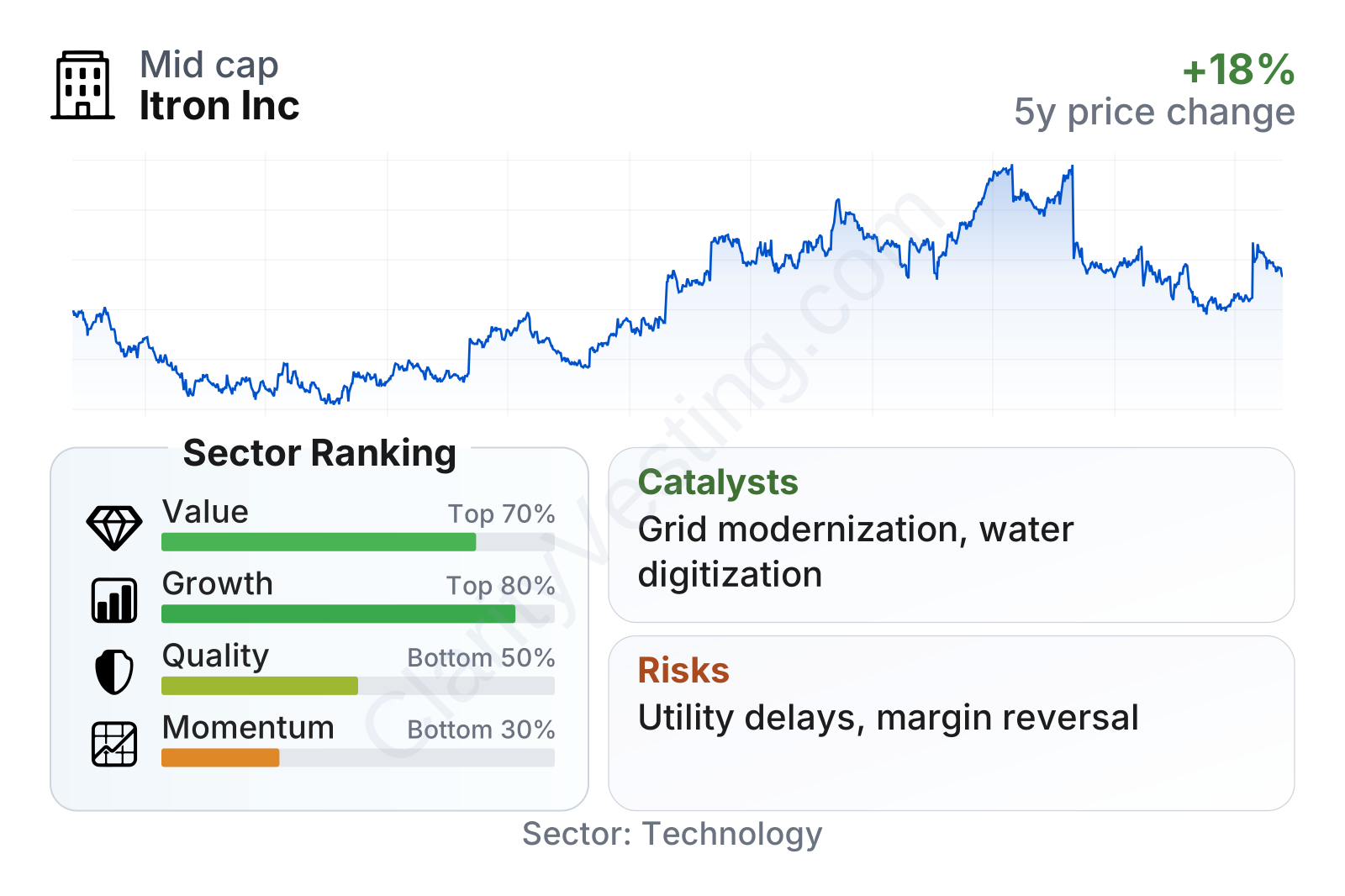
Itron currently looks stronger on profitability, cash generation, and balance sheet quality than on recent sales growth or stock momentum. Compared with the sector median, valuation measures are relatively modest, free cash flow generation is notably strong, and debt is very low. The weaker area is near-term revenue growth, which has recently turned negative after a strong expansion phase, while share-price performance has cooled over the last year.
The stock history also shows that this is not a smooth compounding name. The shares fell sharply in 2021 and 2022, recovered strongly through 2023 and 2024, and then pulled back again in 2026. That pattern fits a company whose market perception is heavily influenced by utility project timing, margin improvement, and confidence in the durability of earnings.
Growth
Itron operates in a market with favorable long-term drivers. Utilities around the world are modernizing power, water, and gas infrastructure; adding smart metering; improving outage visibility; integrating distributed energy resources; and trying to reduce waste, theft, and operating costs. These are durable needs, not short-lived technology trends. Water scarcity, grid resilience, electrification, and the need for better data all support ongoing investment in the kinds of systems Itron provides.
The company’s strategy also makes sense for future growth because it builds on an installed base that many utilities already rely on. A utility that starts with metering hardware can later add connectivity, software applications, data analytics, distributed intelligence, and managed services. That creates cross-selling potential and may increase switching costs over time. It also means Itron can gradually shift part of the business toward more recurring and higher-value revenue streams instead of depending only on unit shipments.
Recent revenue growth has clearly cooled. After a strong rebound in 2023 and much of 2024, year-over-year growth moved close to flat and then turned negative in 2025 and 2026. That does not automatically mean the long-term thesis is broken, but it does show that the business is still exposed to project timing, customer ordering patterns, and a tougher comparison after a period of strong recovery.
One encouraging point is that cash generation has continued to improve even as revenue growth slowed. Free cash flow has risen sharply from relatively modest levels in 2022 to a much stronger run rate by 2026. That is important because it suggests the company is not merely booking accounting profits; it is also converting more of its business activity into real cash.
A meaningful catalyst is the broader move toward grid edge intelligence. Utilities increasingly need to manage electric vehicles, distributed solar, battery storage, and load flexibility closer to the customer. Itron’s combination of meters, communication networks, and software platforms gives it a practical role in that transition. Another catalyst is ongoing utility investment in water efficiency and leak detection, where connected devices and analytics can help reduce non-revenue water and improve system planning.
Recent company updates have also emphasized partnerships and deployments related to distributed intelligence, grid management, and utility digitalization. Those developments reinforce the idea that Itron is trying to position itself as a platform provider for connected utility operations, not just an equipment supplier.
Risks
This article is for informational purposes only and does not constitute financial advice. Some content is AI-generated. See Disclaimer