Stock Analysis · Gartner Inc (IT)
Overview
Gartner is a research, advisory, and events company focused on helping large organizations make decisions about technology, management, and business operations. Its best-known activity is selling subscription-based research and access to analysts who advise executives on areas such as software, cloud, cybersecurity, data, artificial intelligence, and digital transformation. The company also runs conferences and provides consulting services.
Its business model is attractive because a large part of revenue comes from recurring contracts. Gartner serves chief information officers, technology vendors, finance leaders, HR leaders, supply chain teams, and other corporate decision-makers. That makes it less dependent on a single industry niche than many specialized research firms.
Based on recent company reporting, Gartner’s revenue mix is led by its Research segment, followed by Conferences and then Consulting.
- Research: about 84% of revenue — subscription research, benchmark tools, and analyst access sold mainly to enterprises and technology vendors.
- Conferences: about 10% of revenue — in-person and virtual events, sponsorships, and attendance fees tied to executive and technology themes.
- Consulting: about 6% of revenue — project-based advisory work, often tied to technology cost optimization, sourcing, and execution support.
The broad picture is that Gartner is not primarily a software company; it is a knowledge and advisory platform with a strong reputation in enterprise technology decision-making. Over the last several years, revenue expanded steadily from roughly $4.7 billion in 2021 to about $6.5 billion in 2025, while gross profit remained very high, reflecting the economics of research subscriptions.
What stands out in the cost structure is that selling and administrative expenses absorb a large share of revenue, which is typical for a subscription advisory business that relies on sales capacity and client service. Even so, the company has historically converted a meaningful portion of revenue into operating income and cash flow.
The long-term pattern shows a business with rising revenue and high gross profit, but 2025 also appears less clean than 2024 because profitability fell noticeably despite higher sales. That suggests the current debate is less about whether Gartner has a viable model and more about whether recent pressure is temporary or structural.
Key Figures
| Metric | Value | Sector ⓘ |
|---|---|---|
| Date | Sep 12, 2026 | |
| Context | ||
| Sector | Technology | |
| Industry | Information Technology Services | |
| Market Cap ⓘ | $11.34B | |
| Beta ⓘ | 0.95 | |
Value (Cheapness) | ||
| P/E Ratio ⓘ | 16.15 | 29.51 |
| FCF Yield ⓘ | 11.37% | 4.25% |
| EBIT / EV ⓘ | 8.90% | 2.85% |
| PEG ⓘ | 0.68 | |
Growth (Business expansion) | ||
| Revenue Growth ⓘ | -0.60% | 15.40% |
| RPS Growth (5Y CAGR) ⓘ | 13.17% | 8.56% |
| EPS Growth (5Y CAGR) ⓘ | -10.40% | -11.88% |
| Margin Growth (5Y Trend) ⓘ | -7.16% | 0.46% |
| FCF Growth (5Y CAGR) ⓘ | -1.58% | 9.80% |
Quality (Business durability) | ||
| ROIC (Latest) ⓘ | 27.44% | 9.44% |
| ROIC (5Y Median) ⓘ | 32.85% | 8.30% |
| Net Debt / EBIT (Latest) ⓘ | 1.34 | 0.54 |
| Net Debt / EBIT (5Y Median) ⓘ | 1.84 | 0.44 |
| Operating Margin (Latest) ⓘ | 17.24% | 9.58% |
| Operating Margin (5Y Median) ⓘ | 21.67% | 8.25% |
| Debt to Equity (Latest) ⓘ | -1780.32% | 33.33% |
| Profit Margin (Latest) ⓘ | 12.00% | 7.14% |
| Free Cash Flow (Latest) ⓘ | $1.29B | |
Momentum (Price trend) | ||
| 3Y Return ⓘ | -48.73% | +45.48% |
| 12M Return (excl. last month) ⓘ | -21.77% | +23.48% |
| 6M Return ⓘ | +11.83% | +20.93% |
| Price vs. 200-Day MA ⓘ | +1.75% | +7.43% |
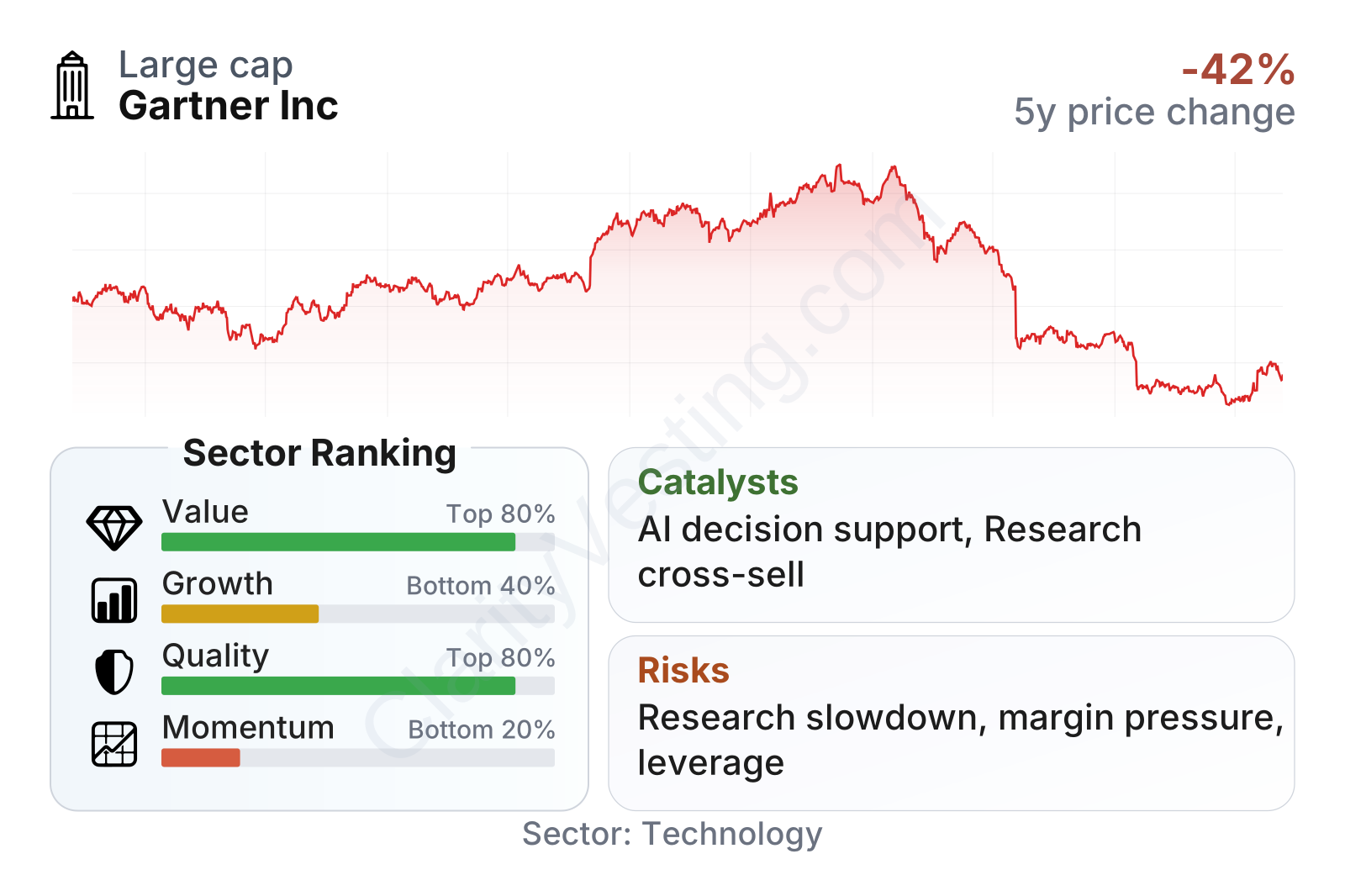
Gartner currently sits in a mixed position. On valuation and business quality, it compares well with much of the technology services sector: earnings multiple is below the sector median, cash flow yield is strong, and returns on invested capital are well above average. On the other hand, recent growth and market momentum are weak, with revenue slightly down year over year and the stock still far behind its sector over the last one to three years despite some stabilization in the last six months.
The company is mid-sized by public market standards, with below-market volatility and a beta just under 1. That usually points to a business that is more stable than many technology names, even if the share price has recently been under pressure.
Growth
Gartner operates in a sector that still has durable long-term demand. Companies continue to spend heavily on cloud migration, cybersecurity, AI adoption, software selection, vendor management, and productivity improvement. In that environment, independent research and executive guidance remain relevant, especially when businesses want to avoid costly mistakes in technology spending.
Its strategy also makes sense for long-term expansion. The core Research business is subscription-based, scales well, and tends to benefit from cross-selling into additional executive roles. Gartner is no longer only serving IT leaders; it has been broadening its reach across finance, HR, legal, supply chain, and other corporate functions. That widens the addressable market and reduces reliance on any one budget line.
That said, the recent revenue trend has clearly cooled. Growth was running in the mid-teens in 2021 and 2022, then slowed through 2023 and 2024, and turned slightly negative most recently. For a long-term view, that matters because Gartner’s premium characteristics are easier to defend when contract growth and conference demand are moving in the right direction. The current slowdown likely reflects tougher enterprise spending decisions rather than a collapse in the underlying need for Gartner’s services, but it does show that this is not a business completely insulated from macro pressure.
Cash generation remains one of the strongest parts of the case. Free cash flow has generally stayed around or above the $1.0 billion level in recent years, with a peak well above that before moderating again. That level of cash generation gives the company room for debt service, buybacks, and selective reinvestment even during softer growth periods.
A major catalyst is the rising complexity of enterprise technology decisions. Artificial intelligence adds a new layer to that trend: boards and executives need help deciding where to spend, which vendors to trust, how to measure return, and how to manage risk. Gartner’s research franchise is well positioned to benefit if AI spending continues to force organizations to seek third-party validation and planning support.
Another potential opportunity comes from normalization after a difficult stock and growth period. If contract activity, conference attendance, or wallet share per client improves from current subdued levels, the business may look materially stronger without needing extraordinary revenue acceleration.
Risks
This article is for informational purposes only and does not constitute financial advice. Some content is AI-generated. See Disclaimer