Stock Analysis · Iridium Communications Inc (IRDM)
Overview
Iridium Communications Inc. operates a global satellite network that provides voice and data connectivity in places where traditional wireless networks are weak, unavailable, or impractical. Its service is designed for customers that need coverage across oceans, polar regions, deserts, remote industrial sites, aviation routes, and military environments. That makes Iridium less dependent on city-based consumer telecom demand and more exposed to specialized, mission-critical communications.
The company makes money mainly by selling satellite services and, to a smaller extent, equipment used to access those services. Based on recent annual reporting, revenue is centered on recurring service subscriptions and usage rather than one-time hardware sales.
- Commercial service revenue: about 56% of total revenue. This includes voice and data plans for maritime, land mobile, aviation, Internet of Things devices, and hosted payload/data services used by commercial customers.
- U.S. government service revenue: about 19%. This mainly covers airtime, network access, and related satellite communications services provided under government relationships, including defense-oriented uses.
- Subscriber equipment: about 15%. This includes satellite phones, terminals, modules, and other devices that connect users or machines to the network.
- Engineering and support / other revenue: about 10%. This category includes contract work, integration support, and other non-core or less recurring items.
One of the important features of Iridium’s model is that much of its revenue comes from subscriptions and long-duration customer relationships. That tends to make revenue more predictable than a hardware-led business. Another key point is that the company already owns and operates a completed satellite constellation, so growth increasingly depends on filling network capacity with higher-value services rather than building an entirely new system from scratch.
The financial flow over the last several years shows a meaningful improvement in profitability. Revenue has risen steadily, gross profit has expanded faster than sales, and operating income has improved materially. Interest expense remains a noticeable drag, but the business today converts a much larger portion of revenue into profit than it did a few years ago.
Key Figures
| Metric | Value | Sector ⓘ |
|---|---|---|
| Date | Sep 12, 2026 | |
| Context | ||
| Sector | Communication Services | |
| Industry | Telecom Services | |
| Market Cap ⓘ | $5.01B | |
| Beta ⓘ | 0.88 | |
Value (Cheapness) | ||
| P/E Ratio ⓘ | 53.75 | 18.61 |
| FCF Yield ⓘ | 5.75% | 13.68% |
| EBIT / EV ⓘ | 3.22% | 4.54% |
| PEG ⓘ | 1.84 | |
Growth (Business expansion) | ||
| Revenue Growth ⓘ | 3.80% | 5.40% |
| RPS Growth (5Y CAGR) ⓘ | 15.12% | 4.62% |
| EPS Growth (5Y CAGR) ⓘ | 63.44% | -18.01% |
| Margin Growth (5Y Trend) ⓘ | 19.09% | 1.10% |
| FCF Growth (5Y CAGR) ⓘ | 3.55% | 5.88% |
Quality (Business durability) | ||
| ROIC (Latest) ⓘ | 7.01% | 8.38% |
| ROIC (5Y Median) ⓘ | 3.05% | 8.32% |
| Net Debt / EBIT (Latest) ⓘ | 7.48 | 1.99 |
| Net Debt / EBIT (5Y Median) ⓘ | 14.65 | 2.94 |
| Operating Margin (Latest) ⓘ | 23.86% | 14.89% |
| Operating Margin (5Y Median) ⓘ | 12.34% | 12.96% |
| Debt to Equity (Latest) ⓘ | 372.87% | 59.59% |
| Profit Margin (Latest) ⓘ | 10.55% | 8.77% |
| Free Cash Flow (Latest) ⓘ | $288.32M | |
Momentum (Price trend) | ||
| 3Y Return ⓘ | +5.58% | +46.64% |
| 12M Return (excl. last month) ⓘ | +104.68% | +2.16% |
| 6M Return ⓘ | +92.65% | +5.05% |
| Price vs. 200-Day MA ⓘ | +36.78% | +2.88% |
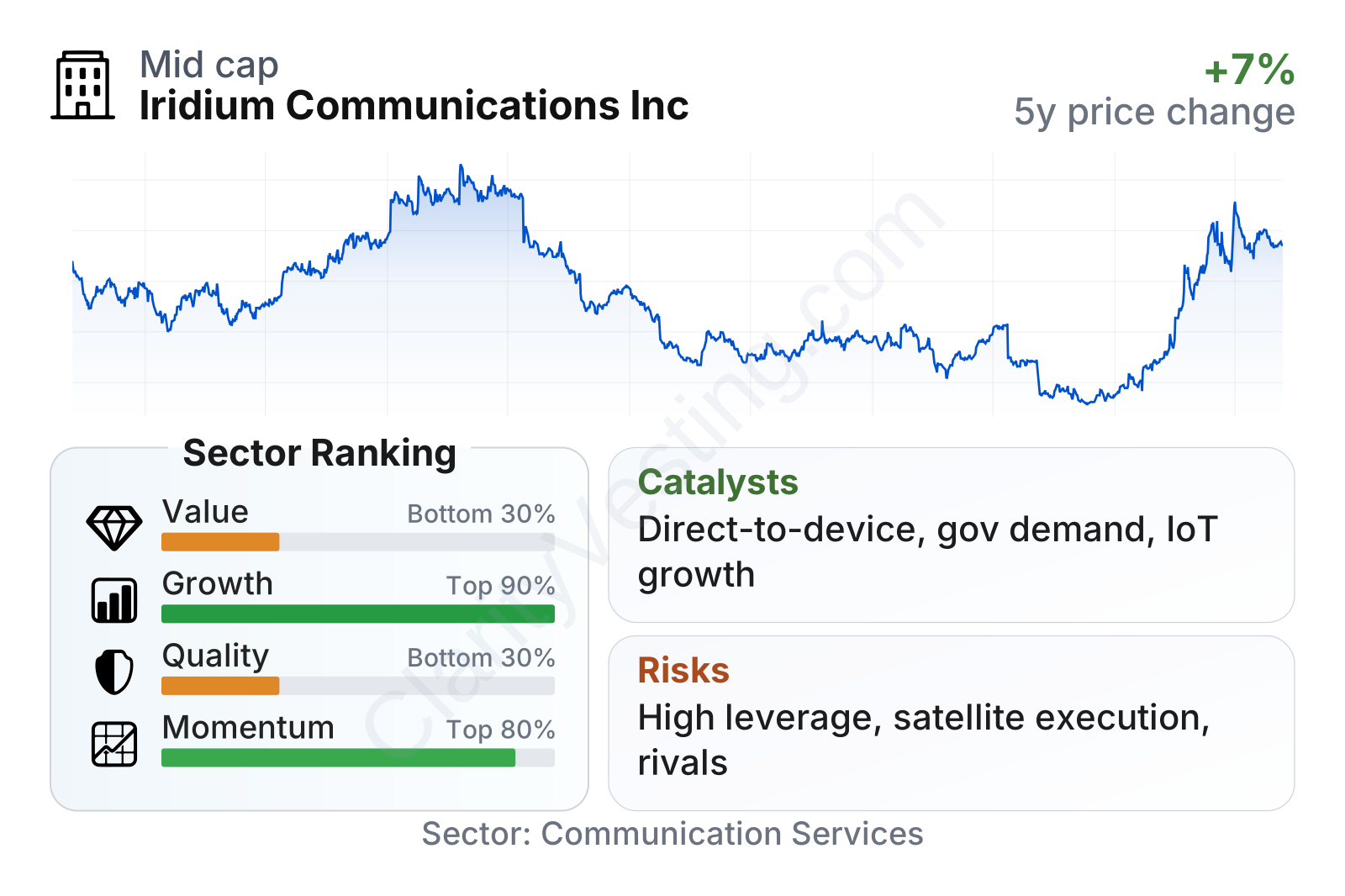
Iridium is a mid-sized telecom and satellite connectivity company with a stock that has been volatile over the past few years. The share price climbed strongly into 2023, fell sharply through 2024 and parts of 2025, and then rebounded significantly in recent months. In the latest factor snapshot, growth and momentum rank well versus the sector, while value and balance-sheet quality rank weaker. In simple terms, the market is recognizing improving business performance, but the stock is not obviously cheap and leverage remains an important constraint.
Growth
Iridium operates in a sector with durable long-term demand. Global connectivity needs are expanding beyond smartphones and cities toward ships, aircraft, autonomous assets, industrial equipment, emergency response, defense operations, and remote monitoring. This is especially relevant for satellite-based Internet of Things and direct, resilient communications services, where terrestrial networks cannot provide full geographic coverage.
The company’s strategy appears coherent for that backdrop. Iridium is focusing on higher-margin recurring service revenue, expanding connected devices, deepening government relationships, and enabling new applications on top of an existing global network. That is attractive because the network is already in orbit, so additional subscribers can improve returns without requiring the same scale of capital spending as a fresh constellation buildout.
Revenue growth has slowed from the very strong post-2021 acceleration, but it has remained positive overall, returning to low-single-digit growth most recently after periods of much faster expansion. That pattern suggests a business moving from a heavy ramp-up phase into a steadier monetization stage. Over a five-year view, revenue per share growth has still been well above the sector median, which matters more for long-term analysis than any single quarter.
Free cash flow has been solid and has trended upward overall, moving from the mid-$200 million range to around $300 million recently. That is a useful sign because it shows the company is not relying only on accounting profits; it is also generating real cash that can support debt service, technology investment, and capital returns.
A major catalyst for future growth is the company’s push into direct-to-device connectivity through its partnership with Qualcomm. The idea is to allow certain consumer smartphones to connect to satellites for messaging or emergency uses when cellular coverage is unavailable. Even if adoption is gradual, this expands Iridium’s addressable market far beyond its traditional niche of specialized satellite handsets and industrial terminals.
Another important catalyst is defense and government demand. Secure and resilient communications remain a strategic priority, and Iridium’s fully global low-Earth-orbit network is well suited for mobility and harsh environments. Growth in satellite IoT, aviation connectivity, maritime tracking, and safety services also supports the long-term case, especially because these use cases tend to be recurring and operationally important for customers.
Risks
This article is for informational purposes only and does not constitute financial advice. Some content is AI-generated. See Disclaimer


