Stock Analysis · IPG Photonics Corporation (IPGP)
Overview
IPG Photonics Corporation designs and manufactures high-performance fiber lasers and related photonics systems. In simple terms, its products generate and control very precise beams of light that manufacturers use to cut, weld, clean, mark, drill, and process materials. The company sells not only the laser source itself, but also complementary components such as optical fibers, diodes, amplifiers, beam delivery products, laser systems, and some complete solutions for industrial and specialized applications.
Its business is still centered on industrial manufacturing. Based on the company’s recent annual disclosures, revenue is mainly generated from materials processing products, with smaller contributions from newer and more specialized uses.
- Materials processing: approximately 89% of revenue in 2025. This includes lasers and systems used for cutting, welding, additive manufacturing, cleaning, drilling, and marking across factory automation and metal processing.
- Medical: approximately 5% of revenue. This covers laser products used in medical device and healthcare-related applications.
- Advanced applications and other: approximately 6% of revenue. This includes areas such as micromachining, telecom-related products, and other specialized uses.
Geographically, IPG has historically been diversified across North America, Europe, and Asia, but that diversification has not fully protected it from cyclical slowdowns in capital spending by manufacturers. The company’s model is also unusually vertically integrated for the laser industry: it makes many of its own core components instead of outsourcing them. That can support product performance and cost control when volumes are healthy, but it can also leave margins more exposed when demand weakens.
The broad financial flow over the last several years shows a clear pattern: revenue and gross profit remain meaningful, but earnings power has fallen sharply from the peak period. In 2025 the business returned to a small profit after a difficult 2024, yet profitability remained far below earlier levels.
The long-term picture is less about a broken business than a company trying to recover its former earnings strength after a deep industrial downturn and changing competitive landscape.
Key Figures
| Metric | Value | Sector ⓘ |
|---|---|---|
| Date | Sep 12, 2026 | |
| Context | ||
| Sector | Technology | |
| Industry | Semiconductor Equipment & Materials | |
| Market Cap ⓘ | $3.40B | |
| Beta ⓘ | 0.98 | |
Value (Cheapness) | ||
| P/E Ratio ⓘ | 121.20 | 29.51 |
| FCF Yield ⓘ | 0.61% | 4.25% |
| EBIT / EV ⓘ | 1.61% | 2.85% |
| PEG ⓘ | 1.83 | |
Growth (Business expansion) | ||
| Revenue Growth ⓘ | 11.10% | 15.40% |
| RPS Growth (5Y CAGR) ⓘ | -3.45% | 8.56% |
| EPS Growth (5Y CAGR) ⓘ | -38.09% | -11.88% |
| Margin Growth (5Y Trend) ⓘ | -19.65% | 0.46% |
| FCF Growth (5Y CAGR) ⓘ | N/A | 9.80% |
Quality (Business durability) | ||
| ROIC (Latest) ⓘ | 1.30% | 9.44% |
| ROIC (5Y Median) ⓘ | 5.40% | 8.30% |
| Net Debt / EBIT (Latest) ⓘ | -9.63 | 0.54 |
| Net Debt / EBIT (5Y Median) ⓘ | -2.85 | 0.44 |
| Operating Margin (Latest) ⓘ | 3.72% | 9.58% |
| Operating Margin (5Y Median) ⓘ | 16.19% | 8.25% |
| Debt to Equity (Latest) ⓘ | 0.76% | 33.33% |
| Profit Margin (Latest) ⓘ | 2.58% | 7.14% |
| Free Cash Flow (Latest) ⓘ | $20.80M | |
Momentum (Price trend) | ||
| 3Y Return ⓘ | -19.58% | +45.48% |
| 12M Return (excl. last month) ⓘ | +11.56% | +23.48% |
| 6M Return ⓘ | -27.03% | +20.93% |
| Price vs. 200-Day MA ⓘ | -21.17% | +7.43% |
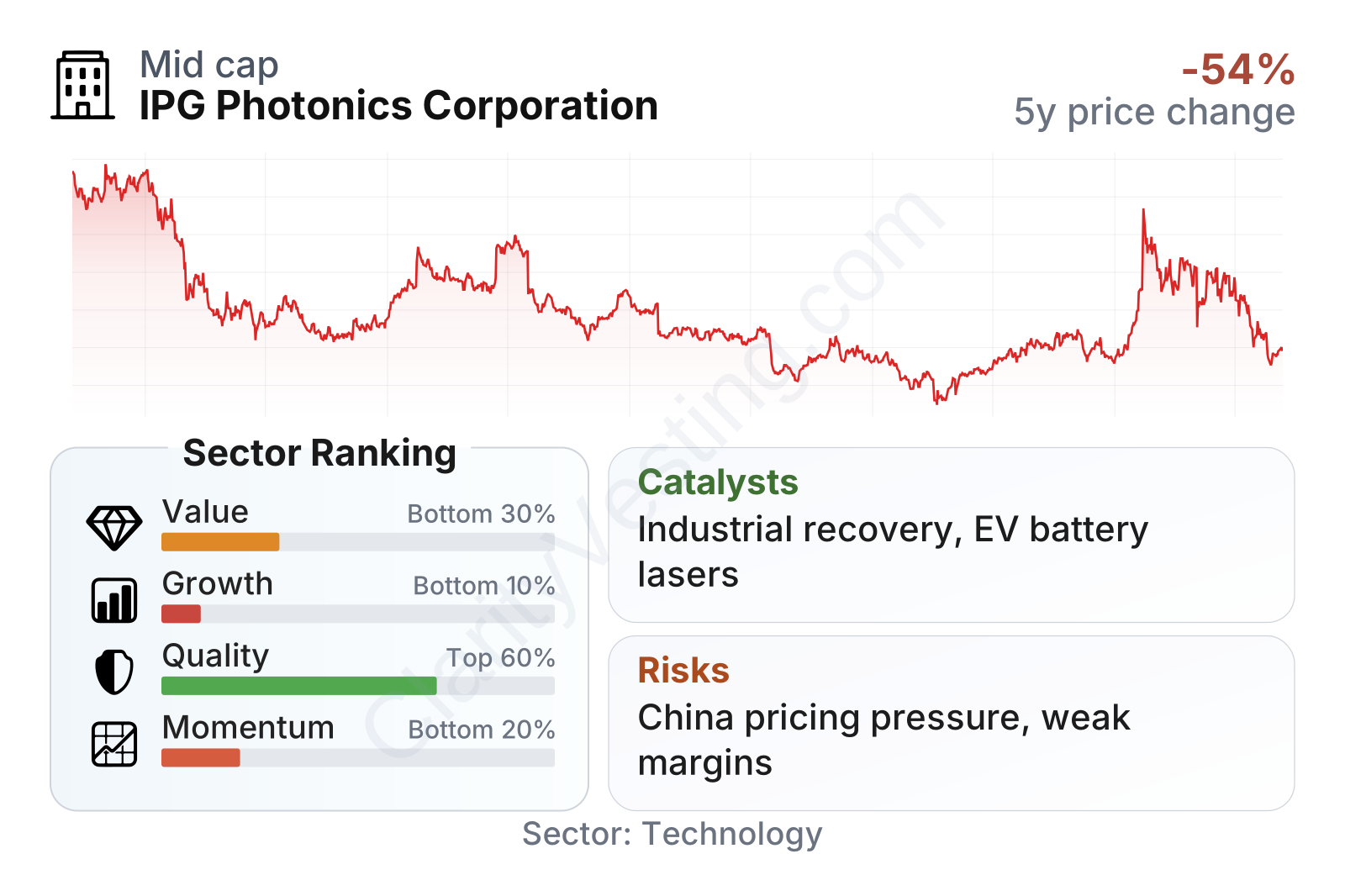
IPG sits in the mid-cap range and its share-price volatility is close to the broader market, with a beta around 1. The stock’s path over the last several years has been uneven: a major decline from 2021 highs, a sharp rebound into early 2026, and then renewed weakness. That pattern matches a business whose end markets remain cyclical and whose profit recovery is still incomplete.
The metrics table points to a mixed profile. Balance-sheet quality stands out because debt is extremely low and net cash remains a real strength. However, value and growth rankings are weak relative to the sector. The current earnings multiple is very high, not because the market is assigning an exceptional premium to strong results, but largely because present earnings are still depressed. Profitability has also reset much lower than its historical norm, which makes the company look expensive on near-term earnings even though it was once a much more profitable business.
Growth
IPG operates in a sector with credible long-term demand drivers. Laser-based manufacturing benefits from factory automation, precision production, lightweight materials, electric vehicle manufacturing, battery production, electronics miniaturization, aerospace, and cleaner industrial processes. These are attractive trends because laser tools can improve speed, precision, and waste reduction versus older manufacturing methods.
That said, the company’s actual growth record has been much weaker than the industry’s long-term promise. Revenue growth turned negative for an extended period before returning to positive territory more recently. The recent improvement suggests demand may be stabilizing, but it does not yet prove a full return to sustained expansion.
The recent revenue trend is encouraging mainly because it breaks a long stretch of declines. Even so, the latest pace is still below the sector median, and the longer five-year record remains weak. For a long-term assessment, the key question is not whether revenue can bounce after a downturn, but whether IPG can regain durable growth while protecting margins.
Management’s strategy for future growth is logical. The company continues to invest in higher-value applications such as handheld welding, cleaning, additive manufacturing, medical uses, and micromachining, while also pushing more complete solutions rather than only standalone laser components. This matters because broader system-level offerings can deepen customer relationships and reduce direct price competition. The company has also emphasized products aimed at e-mobility and battery production, both of which remain important industrial themes.
One meaningful catalyst is the possibility of a broader recovery in industrial capital spending after a weak period for manufacturing equipment demand. Another is adoption of laser applications that are still relatively underpenetrated compared with traditional methods. If customers move from testing to larger-scale deployment in areas like automated welding, cleaning, or battery manufacturing, IPG could benefit from both volume and mix.
Recent company communications have also highlighted ongoing product development in areas such as high-power lasers, welding systems, and specialized applications. None of these alone guarantees a step-change in results, but together they support the case that IPG is not simply waiting for the cycle to turn; it is trying to widen the range of markets it serves.
Cash generation, however, is the main caution inside the growth case. Free cash flow has been volatile and recently weakened sharply, even turning negative on a trailing basis before improving to only a modest positive level in the latest metrics. That does not eliminate the recovery case, but it shows that operational improvement has not yet translated into consistently strong cash output.
Risks
This article is for informational purposes only and does not constitute financial advice. Some content is AI-generated. See Disclaimer