Stock Analysis · International Paper (IP)
Overview
International Paper is one of the largest paper and packaging companies in the world. Its business is centered on fiber-based products used to protect, transport, and ship goods. In practical terms, the company makes corrugated packaging for e-commerce, food, beverage, industrial, and consumer products; containerboard that is converted into boxes; and pulp used in tissues, diapers, paper products, and other absorbent applications. The company has been reshaping itself away from lower-growth paper activities and toward packaging, which is the bigger strategic focus.
The business is now increasingly organized around packaging and pulp, with packaging clearly dominating revenue and operating focus. Based on recent company reporting, the main sources of revenue can be summarized this way:
- Industrial Packaging: approximately 75% to 80% of revenue. This includes containerboard, corrugated boxes, sheets, and related packaging solutions used by manufacturers, retailers, and e-commerce supply chains.
- Global Cellulose Fibers: approximately 20% to 25% of revenue. This segment produces fluff, market, and specialty pulps used in hygiene, tissue, and other fiber-based applications.
- Other activities: a small residual share linked to legacy or corporate items, depending on the reporting period and portfolio changes.
That revenue mix matters because packaging is generally tied to everyday goods and shipping volumes rather than to discretionary luxury demand alone. It gives International Paper a more practical and recurring end-market exposure, although pricing and volumes still move with the economic cycle. Over the last few years, the company’s revenue path has been uneven, but the broad direction of the business mix has become more packaging-heavy.
The profit flow shows a business that can generate very large gross profit in stronger periods, but whose earnings have recently been disrupted by weaker margins and sizable charges. Revenue expanded sharply in 2025, yet operating income and net income turned deeply negative, which highlights how portfolio changes and one-time items can overwhelm top-line progress.
Key Figures
| Metric | Value | Sector ⓘ |
|---|---|---|
| Date | Sep 12, 2026 | |
| Context | ||
| Sector | Consumer Cyclical | |
| Industry | Packaging & Containers | |
| Market Cap ⓘ | $18.20B | |
| Beta ⓘ | 0.88 | |
Value (Cheapness) | ||
| P/E Ratio ⓘ | N/A | 17.10 |
| FCF Yield ⓘ | 2.70% | 8.53% |
| EBIT / EV ⓘ | -11.08% | 6.46% |
| PEG ⓘ | 0.98 | |
Growth (Business expansion) | ||
| Revenue Growth ⓘ | -2.20% | 5.75% |
| RPS Growth (5Y CAGR) ⓘ | -1.13% | 9.14% |
| EPS Growth (5Y CAGR) ⓘ | -57.80% | -18.21% |
| Margin Growth (5Y Trend) ⓘ | -19.35% | -0.23% |
| FCF Growth (5Y CAGR) ⓘ | N/A | 4.91% |
Quality (Business durability) | ||
| ROIC (Latest) ⓘ | -9.39% | 12.61% |
| ROIC (5Y Median) ⓘ | 5.95% | 10.72% |
| Net Debt / EBIT (Latest) ⓘ | N/A | 2.10 |
| Net Debt / EBIT (5Y Median) ⓘ | 4.57 | 2.32 |
| Operating Margin (Latest) ⓘ | -12.41% | 9.25% |
| Operating Margin (5Y Median) ⓘ | 4.25% | 9.64% |
| Debt to Equity (Latest) ⓘ | 67.02% | 75.78% |
| Profit Margin (Latest) ⓘ | -14.21% | 5.33% |
| Free Cash Flow (Latest) ⓘ | $492.00M | |
Momentum (Price trend) | ||
| 3Y Return ⓘ | +13.73% | +14.53% |
| 12M Return (excl. last month) ⓘ | -10.86% | +3.08% |
| 6M Return ⓘ | -1.07% | +0.55% |
| Price vs. 200-Day MA ⓘ | -8.36% | -0.54% |
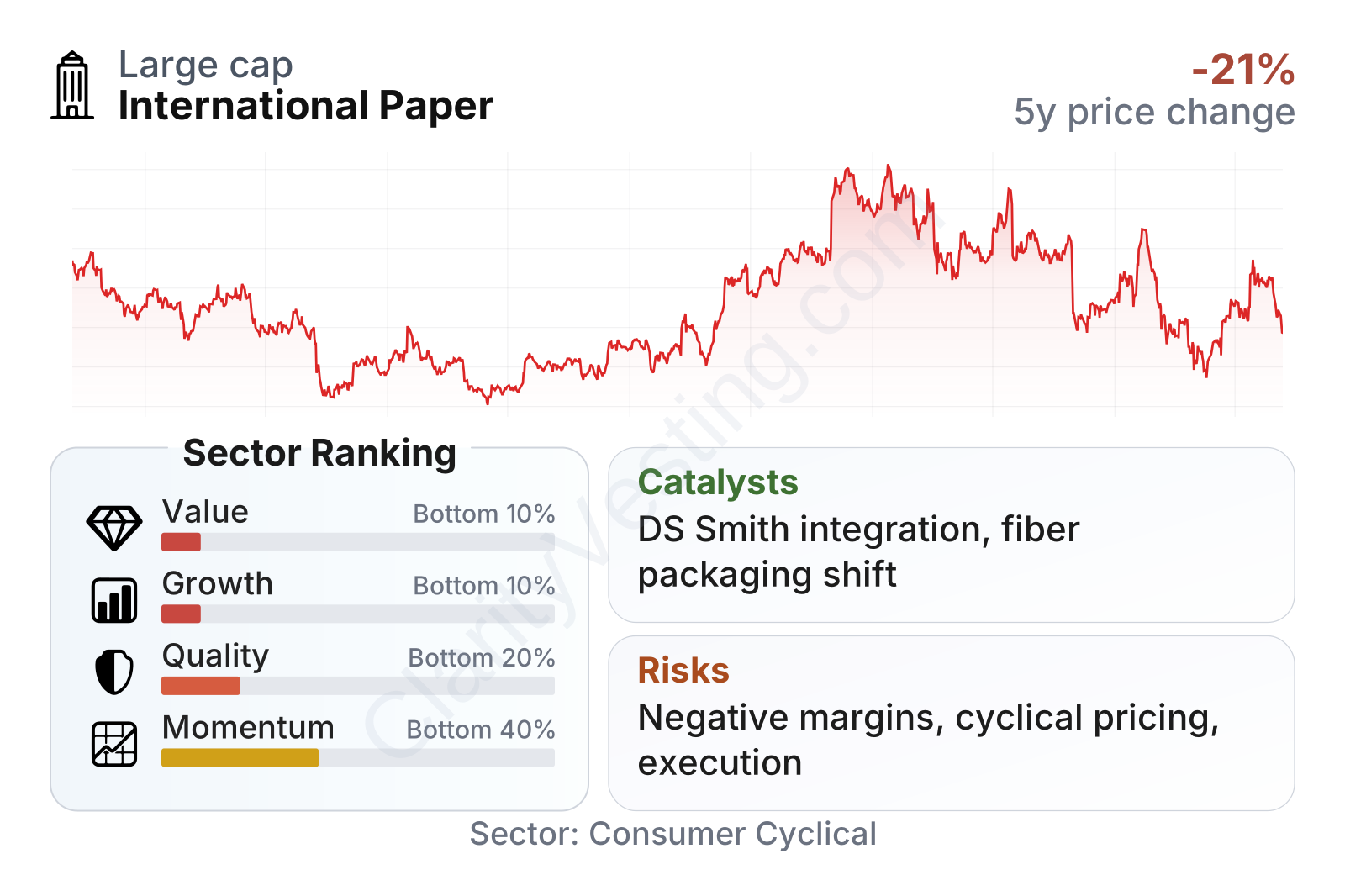
International Paper is a large-cap packaging company with below-average volatility for an industrial name, but the current financial profile looks mixed. Revenue growth has recently been stronger than the sector median, yet quality, profitability, and valuation metrics are weak relative to peers. Free cash flow remains positive, but the margin structure has deteriorated enough that headline valuation measures based on earnings are currently less useful than usual.
The stock’s multiyear path has been volatile, with a strong run-up through late 2024 followed by a meaningful pullback and continued swings in 2025 and 2026. That pattern fits a company going through both cyclical pressure and business repositioning rather than a steady compounding phase.
Growth
International Paper operates in a sector with long-term relevance rather than rapid structural expansion. Corrugated packaging benefits from enduring demand drivers such as e-commerce, food distribution, consumer staples shipping, and the replacement of some plastic-based formats with fiber-based packaging. Pulp demand is more cyclical, but hygiene and tissue end markets provide a durable base. In other words, this is not a high-growth technology market, yet it remains important and difficult to replace at scale.
The company’s strategy broadly makes sense for future growth because it is concentrating on areas where scale, mill networks, converting capacity, and customer relationships matter. International Paper has also been active in portfolio simplification and international expansion, including the announced acquisition of DS Smith, a major corrugated packaging producer focused on Europe. If integrated well, that deal could make International Paper meaningfully more global and deepen its position in fiber-based packaging across multinational customer accounts.
Recent revenue growth has been highly uneven. After a weak period in 2023 and mixed performance in 2024, growth accelerated sharply during much of 2025 before slowing again in 2026. That pattern suggests recent expansion has been influenced not only by underlying demand, but also by price changes, portfolio moves, and acquisition effects. It is better read as a transition phase than as a stable trend.
Cash generation tells a similar story. Free cash flow dropped from well above $1 billion in 2022 to much lower levels, briefly turned slightly negative in 2025, and then recovered to a positive level in 2026. For a capital-intensive manufacturer, that recovery is important because mills, box plants, and maintenance spending require steady cash support. The company still produces cash, but not with the consistency that would make the growth case especially clean.
A notable catalyst is the continued shift by customers and regulators toward recyclable, fiber-based packaging. Another is the potential benefit from integrating DS Smith, which could expand geographic reach, customer coverage, and mill-to-box system advantages. Recent company communications have also emphasized cost reduction, footprint optimization, and commercial discipline, all of which matter because even modest margin improvement can have a large effect on earnings in this kind of business.
Risks
This article is for informational purposes only and does not constitute financial advice. Some content is AI-generated. See Disclaimer