Stock Analysis · Samsara Inc (IOT)
Overview
Samsara Inc. is a software company focused on connected operations. In simple terms, it helps businesses monitor and manage physical assets and frontline work through cloud software, sensors, cameras, and connected devices. Its products are used by organizations that run fleets, heavy equipment, industrial sites, warehouses, utilities, construction operations, and field service teams. The goal is to improve safety, efficiency, maintenance, compliance, and visibility across day-to-day operations.
The company sells a connected operations platform rather than a single product. Customers typically subscribe to software applications and also purchase or deploy related hardware such as vehicle gateways, dash cameras, asset trackers, environmental sensors, and other connected devices. Samsara’s business model is largely recurring because the software is sold through subscriptions, often bundled with long-term customer relationships.
Based on company filings, Samsara generates revenue from two main sources:
- Subscription revenue: approximately 95% of total revenue in fiscal 2026. This includes access to the company’s cloud platform, applications for fleet operations, video-based safety, equipment and asset tracking, site visibility, workflow tools, and other connected operations services.
- Professional services and other revenue: approximately 5% of total revenue in fiscal 2026. This mainly includes implementation, support, and related services tied to customer deployments.
One important point for long-term analysis is that Samsara is not mainly a hardware seller in accounting terms. While devices are essential to the offering, the business is financially driven by subscription software revenue, which tends to be more predictable and scalable than one-time product sales.
The company’s financial profile has also improved meaningfully over the past few years. Revenue has expanded from about $428 million in fiscal 2022 to about $1.62 billion in fiscal 2026, while operating losses narrowed sharply and operating income recently turned slightly positive. That progression suggests a business moving from expansion mode toward greater operating discipline.
The revenue mix remains centered on high-margin subscription sales, and the broader cost structure shows a company that is still investing heavily but with much better balance than a few years ago. Gross profit has risen strongly, while research, development, and sales spending have grown more slowly than revenue overall, helping profitability improve.
Key Figures
| Metric | Value | Sector ⓘ |
|---|---|---|
| Date | Sep 12, 2026 | |
| Context | ||
| Sector | Technology | |
| Industry | Software - Infrastructure | |
| Market Cap ⓘ | $22.51B | |
| Beta ⓘ | 1.34 | |
Value (Cheapness) | ||
| P/E Ratio ⓘ | 256.27 | 29.51 |
| FCF Yield ⓘ | 1.13% | 4.25% |
| EBIT / EV ⓘ | 0.47% | 2.85% |
| PEG ⓘ | N/A | |
Growth (Business expansion) | ||
| Revenue Growth ⓘ | 29.90% | 15.40% |
| RPS Growth (5Y CAGR) ⓘ | 35.09% | 8.56% |
| EPS Growth (5Y CAGR) ⓘ | N/A | -11.88% |
| Margin Growth (5Y Trend) ⓘ | N/A | 0.46% |
| FCF Growth (5Y CAGR) ⓘ | N/A | 9.80% |
Quality (Business durability) | ||
| ROIC (Latest) ⓘ | 6.21% | 9.44% |
| ROIC (5Y Median) ⓘ | -19.74% | 8.30% |
| Net Debt / EBIT (Latest) ⓘ | -2.15 | 0.54 |
| Net Debt / EBIT (5Y Median) ⓘ | N/A | 0.44 |
| Operating Margin (Latest) ⓘ | 5.58% | 9.58% |
| Operating Margin (5Y Median) ⓘ | -30.23% | 8.25% |
| Debt to Equity (Latest) ⓘ | 4.34% | 33.33% |
| Profit Margin (Latest) ⓘ | 4.90% | 7.14% |
| Free Cash Flow (Latest) ⓘ | $255.48M | |
Momentum (Price trend) | ||
| 3Y Return ⓘ | +26.79% | +45.48% |
| 12M Return (excl. last month) ⓘ | +20.34% | +23.48% |
| 6M Return ⓘ | +20.46% | +20.93% |
| Price vs. 200-Day MA ⓘ | +13.87% | +7.43% |
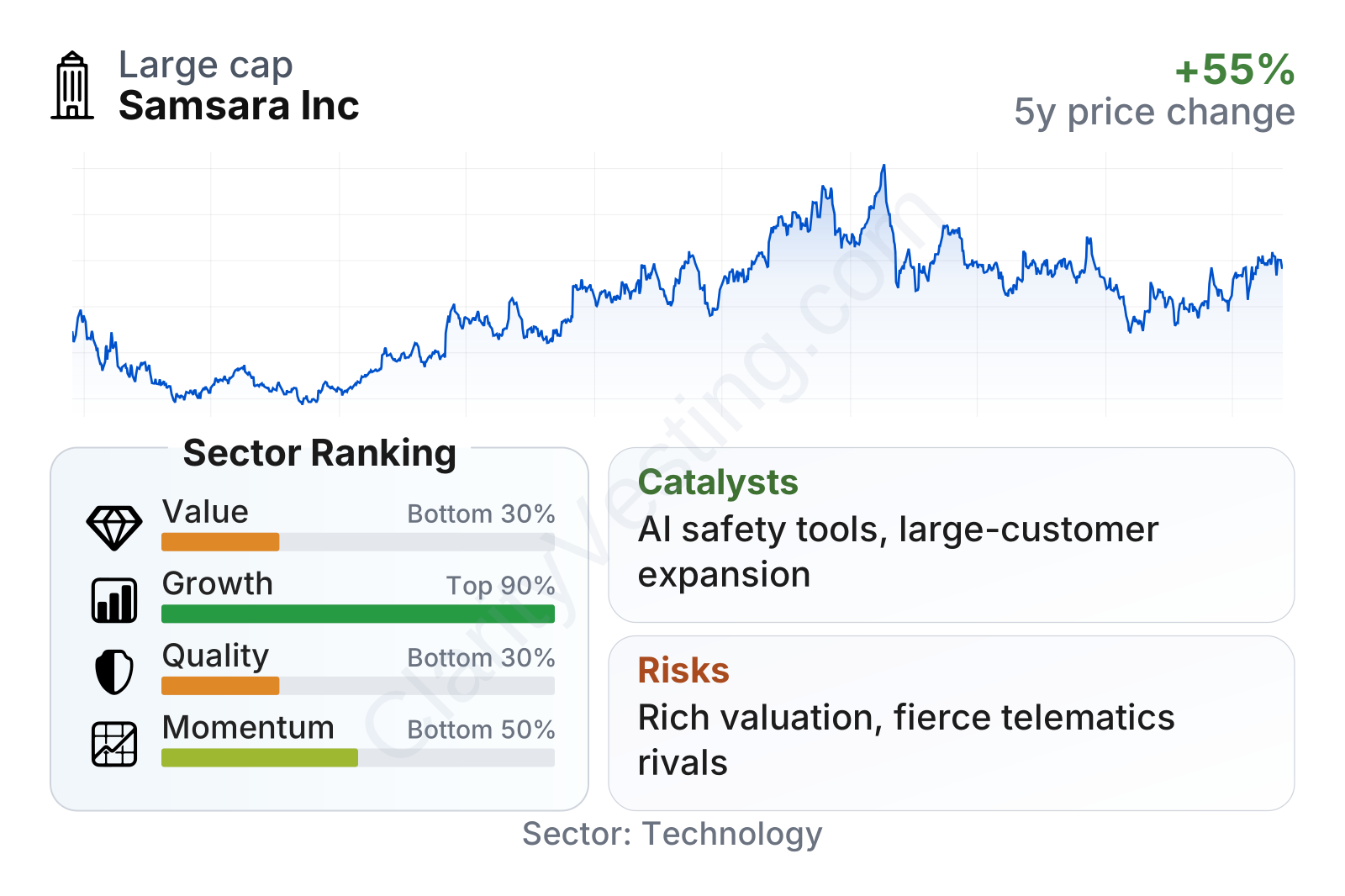
Samsara stands out most clearly on growth, where it ranks near the top of its sector. Revenue growth is still close to 30% year over year, and its multi-year expansion rate is far above the sector median. By contrast, value and quality measures remain weaker: profitability has improved, but returns on capital and cash flow yield still trail many software peers, while the earnings multiple is far above the sector norm. Balance sheet risk is low, however, with very limited leverage and net cash characteristics.
The stock history also shows that the market’s view of Samsara has shifted sharply since its public listing. After a steep decline in 2022, the shares rebounded strongly as growth held up and losses narrowed. More recently, the price has cooled from prior highs, which reflects both normal volatility in high-growth software names and the market’s sensitivity to valuation.
Growth
Samsara operates in a sector with durable long-term tailwinds. Many industries that rely on vehicles, machinery, facilities, and frontline labor are still relatively early in their digital transformation. Fleet tracking, AI-enabled safety systems, telematics, maintenance analytics, compliance tools, and workflow digitization all address large and fragmented markets. That gives the company room to grow not only by adding new customers, but also by expanding the number of applications used by each customer.
The company’s strategy appears coherent for future expansion because it starts with a practical operational need and then broadens into a larger software relationship. A business might begin with fleet visibility, then add video safety, equipment monitoring, driver workflows, site monitoring, or maintenance tools. That land-and-expand model can support higher revenue per customer over time and makes the platform more embedded in everyday operations.
Growth has naturally slowed from the extremely high rates seen a few years ago, but it remains strong in absolute terms. Recent year-over-year revenue growth has stayed around 30%, which is still well above the sector median. For a company already above $1.5 billion in annual revenue, that pace suggests demand is still healthy rather than fading.
Another encouraging sign is the shift in cash generation. Free cash flow has moved from clearly negative territory to solidly positive over the last few years, reaching roughly a quarter of a billion dollars on a trailing basis. That matters because it shows Samsara is not just growing revenue, but increasingly turning that growth into real financial flexibility.
Recent company updates have also pointed to continued product development around artificial intelligence, especially in safety, video intelligence, and operational automation. These features can strengthen customer retention and create new selling opportunities because the value proposition is easy to understand: fewer accidents, lower insurance friction, better compliance, and improved productivity. For a platform serving real-world operations, AI is useful only if it produces measurable results, and Samsara’s positioning is more practical than experimental.
A further catalyst is customer expansion among larger organizations. Samsara has emphasized growth in higher annual recurring revenue accounts, which suggests the platform is gaining acceptance in more complex enterprise environments. If that trend continues, it could support both scale and better unit economics over time.
Risks
This article is for informational purposes only and does not constitute financial advice. Some content is AI-generated. See Disclaimer