Stock Analysis · IONQ Inc (IONQ)
Overview
IonQ is a quantum computing company. In simple terms, it is building a new kind of computer designed to solve certain problems that are extremely difficult for today’s classical machines. Its systems are based on trapped-ion technology, where individual ions are controlled with lasers to perform computations. The company sells access to its quantum computers through the cloud, develops systems for government and research customers, and is working toward broader commercial use in areas such as optimization, chemistry, materials, and machine learning.
For long-term analysis, the most important point is that IonQ is still an early-stage business. It operates in a field with very large potential, but current revenue remains small compared with its market value and spending base. That makes the company more dependent on future execution than on today’s established earnings power.
Based on company filings and disclosures, revenue is primarily generated from a small number of categories:
- Quantum computing and networking contracts, cloud access, and related services: the large majority of revenue. This includes sales to commercial customers, government agencies, and research institutions, as well as access through major cloud platforms.
- Technology development, systems, and milestone-based agreements: a smaller but still meaningful share. This can include custom projects, research partnerships, hardware-related work, and technical delivery milestones.
- Other revenue: limited. IonQ’s public disclosures do not present a highly granular recurring revenue breakdown by product line, so precise percentages by subcategory are not consistently available.
Revenue concentration is also worth noting. In recent filings, a limited number of customers have represented a large share of total sales, which is common for a young deep-tech company but increases volatility from quarter to quarter.
The broader financial picture shows a business scaling quickly from a very small base. Revenue has grown sharply over the last few years, but operating expenses have grown even faster, especially in research and development. That pattern fits a company trying to establish leadership in a frontier technology, though it also means profitability is still not the central feature of the investment case.
The financial flow highlights that revenue has expanded from just a few million dollars to well above $100 million annually, but research and administrative spending have risen even faster. Gross profit has improved in absolute terms, yet losses remain large because IonQ is still funding technology development and commercial buildout at an aggressive pace.
Key Figures
| Metric | Value | Sector ⓘ |
|---|---|---|
| Date | Sep 12, 2026 | |
| Context | ||
| Sector | Technology | |
| Industry | Computer Hardware | |
| Market Cap ⓘ | $14.93B | |
| Beta ⓘ | 3.29 | |
Value (Cheapness) | ||
| P/E Ratio ⓘ | 101.85 | 29.51 |
| FCF Yield ⓘ | -3.24% | 4.25% |
| EBIT / EV ⓘ | 12.45% | 2.85% |
| PEG ⓘ | N/A | |
Growth (Business expansion) | ||
| Revenue Growth ⓘ | 286.80% | 15.40% |
| RPS Growth (5Y CAGR) ⓘ | 155.89% | 8.56% |
| EPS Growth (5Y CAGR) ⓘ | N/A | -11.88% |
| Margin Growth (5Y Trend) ⓘ | N/A | 0.46% |
| FCF Growth (5Y CAGR) ⓘ | N/A | 9.80% |
Quality (Business durability) | ||
| ROIC (Latest) ⓘ | 45.00% | 9.44% |
| ROIC (5Y Median) ⓘ | -22.06% | 8.30% |
| Net Debt / EBIT (Latest) ⓘ | -0.71 | 0.54 |
| Net Debt / EBIT (5Y Median) ⓘ | N/A | 0.44 |
| Operating Margin (Latest) ⓘ | 676.24% | 9.58% |
| Operating Margin (5Y Median) ⓘ | -715.56% | 8.25% |
| Debt to Equity (Latest) ⓘ | 1.64% | 33.33% |
| Profit Margin (Latest) ⓘ | N/A | 7.14% |
| Free Cash Flow (Latest) ⓘ | -$483.87M | |
Momentum (Price trend) | ||
| 3Y Return ⓘ | +90.32% | +45.48% |
| 12M Return (excl. last month) ⓘ | +5.12% | +23.48% |
| 6M Return ⓘ | +11.26% | +20.93% |
| Price vs. 200-Day MA ⓘ | -16.63% | +7.43% |
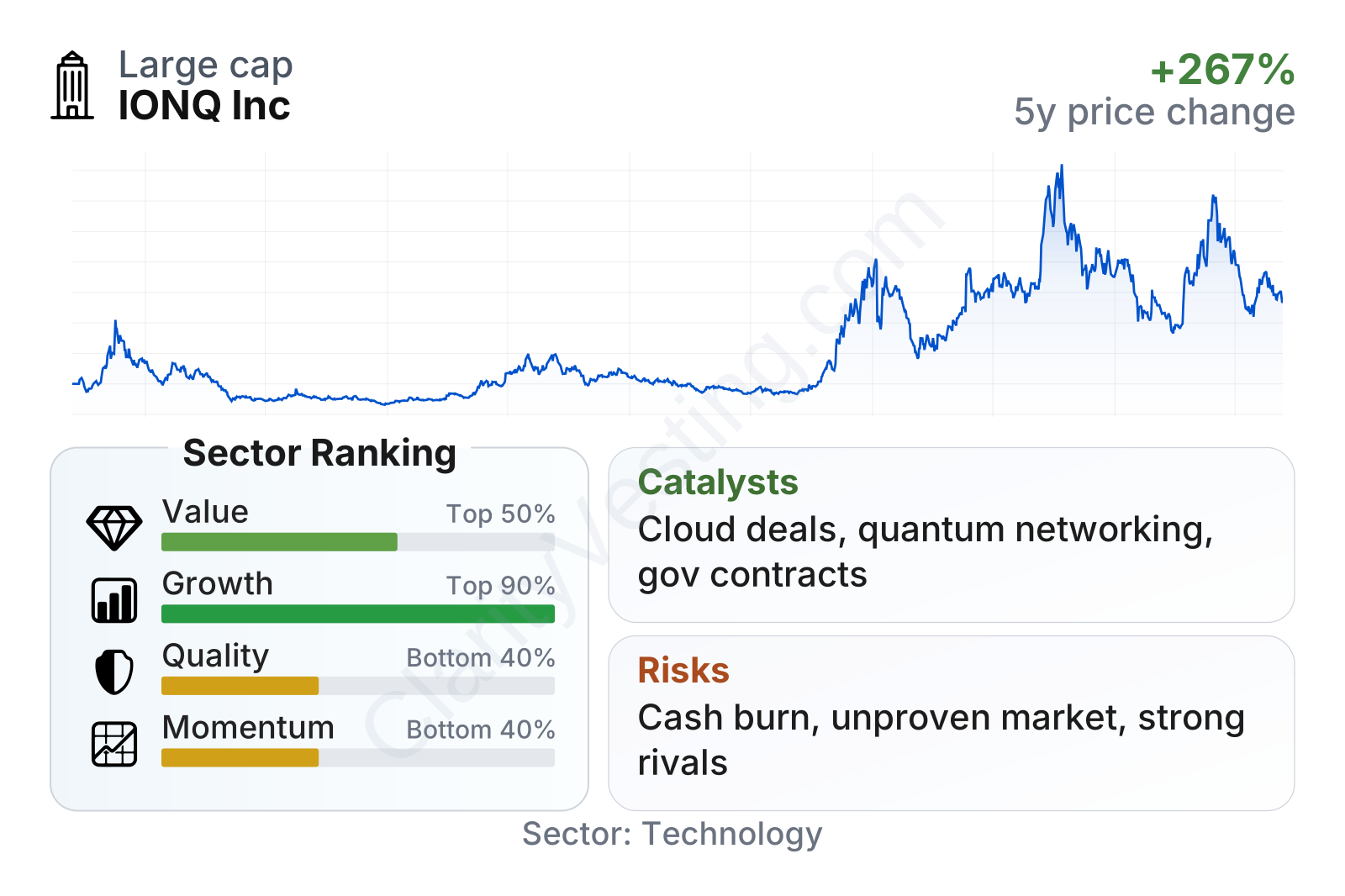
The stock has been extremely volatile since listing, with large swings that are much bigger than the typical technology company. In the latest factor view, growth stands out as the strongest area relative to the sector, while quality is weaker because profits and cash generation remain inconsistent. The balance sheet is unusually light on debt, which gives the company more flexibility than many early-stage peers.
Growth
IonQ operates in one of the most promising areas of advanced computing. Quantum computing is still early, but governments, large enterprises, and cloud providers are investing heavily because the long-term payoff could be significant. If the technology becomes commercially useful at scale, companies that establish strong hardware, software, and customer relationships early could benefit disproportionately. That is the foundation of the growth argument around IonQ.
The company’s strategy broadly makes sense for that opportunity. It is trying to build an integrated position across hardware, software access, networking, and partnerships. Rather than depending only on direct hardware sales, IonQ has focused on making its systems available through cloud ecosystems and signing development agreements with public-sector and enterprise customers. That lowers some adoption friction and helps the company build credibility before quantum computing becomes mainstream.
Revenue growth has been very uneven, which is normal for a contract-driven company at this stage, but the overall trend has been powerful. Recent year-over-year growth rates moved from merely strong to exceptionally high, reflecting both customer traction and the lumpy nature of milestone revenue. Even so, the small revenue base means growth percentages can look more dramatic than the underlying business scale.
Several catalysts support the long-term growth case. IonQ has continued expanding its technology roadmap, including progress in higher-performance systems and quantum networking ambitions. The company has also emphasized government and defense relationships, a useful positioning advantage because public funding often arrives earlier than broad commercial demand in frontier technologies. In addition, partnerships with large cloud platforms help put IonQ’s systems in front of developers and enterprise users without requiring customers to adopt new infrastructure on their own.
Recent corporate updates have also pointed to a widening addressable market beyond pure computation. IonQ’s messaging increasingly includes quantum networking and quantum-enabled secure communications, which could broaden the company’s future revenue sources if those initiatives mature. For long-term analysis, that matters because the largest winner in quantum may not be limited to selling raw compute time alone.
The main limitation is that growth is not yet self-funding. Free cash flow has become substantially more negative over time, showing that expansion is still consuming capital rather than producing it. That does not invalidate the growth case, but it raises the threshold for future execution: revenue must eventually scale much faster than spending for the business model to prove itself.
Risks
This article is for informational purposes only and does not constitute financial advice. Some content is AI-generated. See Disclaimer


