Stock Analysis · Intuit Inc (INTU)
Overview
Intuit is a software company focused on financial management for consumers, self-employed workers, small and mid-sized businesses, accountants, and tax professionals. Its best-known products are TurboTax for tax preparation, QuickBooks for accounting and payroll, Credit Karma for consumer finance tools and credit monitoring, and Mailchimp for email marketing and customer outreach. In simple terms, Intuit sells software that helps people handle taxes, run a business, get paid, manage money, and market to customers.
The business is increasingly built around connected services rather than one-time software sales. That matters for long-term analysis because subscription revenue, payroll processing, payments, and business services tend to be more recurring and can grow with customer activity over time.
Based on Intuit’s recent annual reporting structure, the main revenue sources are approximately:
- Global Business Solutions: about 62% of revenue. This is mainly QuickBooks online accounting, payroll, payments, merchant services, and related tools for small businesses.
- Consumer: about 20% of revenue. This is mostly TurboTax products and services for individuals filing their taxes.
- ProTax: about 12% of revenue. This includes tax software and tools used by accountants and professional tax preparers.
- Credit Karma: about 6% of revenue. This segment includes personal finance, credit monitoring, and marketplace revenue tied to financial product referrals and related services.
That mix shows a company no longer centered only on tax season. Small-business software is now the largest engine, while tax and professional filing remain important profit contributors. Over the last several years, revenue has climbed strongly, and operating profit has expanded even faster, showing that growth has not come only from spending more to acquire customers.
Revenue has moved from roughly $13 billion to more than $21 billion over four fiscal years, while net income has more than doubled. Research and development spending has also increased steadily, which fits Intuit’s push into automation and AI-enabled workflows without preventing margin expansion.
Key Figures
| Metric | Value | Sector ⓘ |
|---|---|---|
| Date | Sep 12, 2026 | |
| Context | ||
| Sector | Technology | |
| Industry | Software - Application | |
| Market Cap ⓘ | $85.94B | |
| Beta ⓘ | 0.98 | |
Value (Cheapness) | ||
| P/E Ratio ⓘ | 19.55 | 29.51 |
| FCF Yield ⓘ | 10.03% | 4.25% |
| EBIT / EV ⓘ | 6.37% | 2.85% |
| PEG ⓘ | 0.99 | |
Growth (Business expansion) | ||
| Revenue Growth ⓘ | 13.70% | 15.40% |
| RPS Growth (5Y CAGR) ⓘ | 14.65% | 8.56% |
| EPS Growth (5Y CAGR) ⓘ | 15.62% | -11.88% |
| Margin Growth (5Y Trend) ⓘ | 6.37% | 0.46% |
| FCF Growth (5Y CAGR) ⓘ | 23.87% | 9.80% |
Quality (Business durability) | ||
| ROIC (Latest) ⓘ | 18.94% | 9.44% |
| ROIC (5Y Median) ⓘ | 30.15% | 8.30% |
| Net Debt / EBIT (Latest) ⓘ | 0.36 | 0.54 |
| Net Debt / EBIT (5Y Median) ⓘ | 0.97 | 0.44 |
| Operating Margin (Latest) ⓘ | 29.65% | 9.58% |
| Operating Margin (5Y Median) ⓘ | 22.91% | 8.25% |
| Debt to Equity (Latest) ⓘ | 43.89% | 33.33% |
| Profit Margin (Latest) ⓘ | 21.29% | 7.14% |
| Free Cash Flow (Latest) ⓘ | $8.62B | |
Momentum (Price trend) | ||
| 3Y Return ⓘ | -39.70% | +45.48% |
| 12M Return (excl. last month) ⓘ | -52.56% | +23.48% |
| 6M Return ⓘ | -25.54% | +20.93% |
| Price vs. 200-Day MA ⓘ | -23.10% | +7.43% |
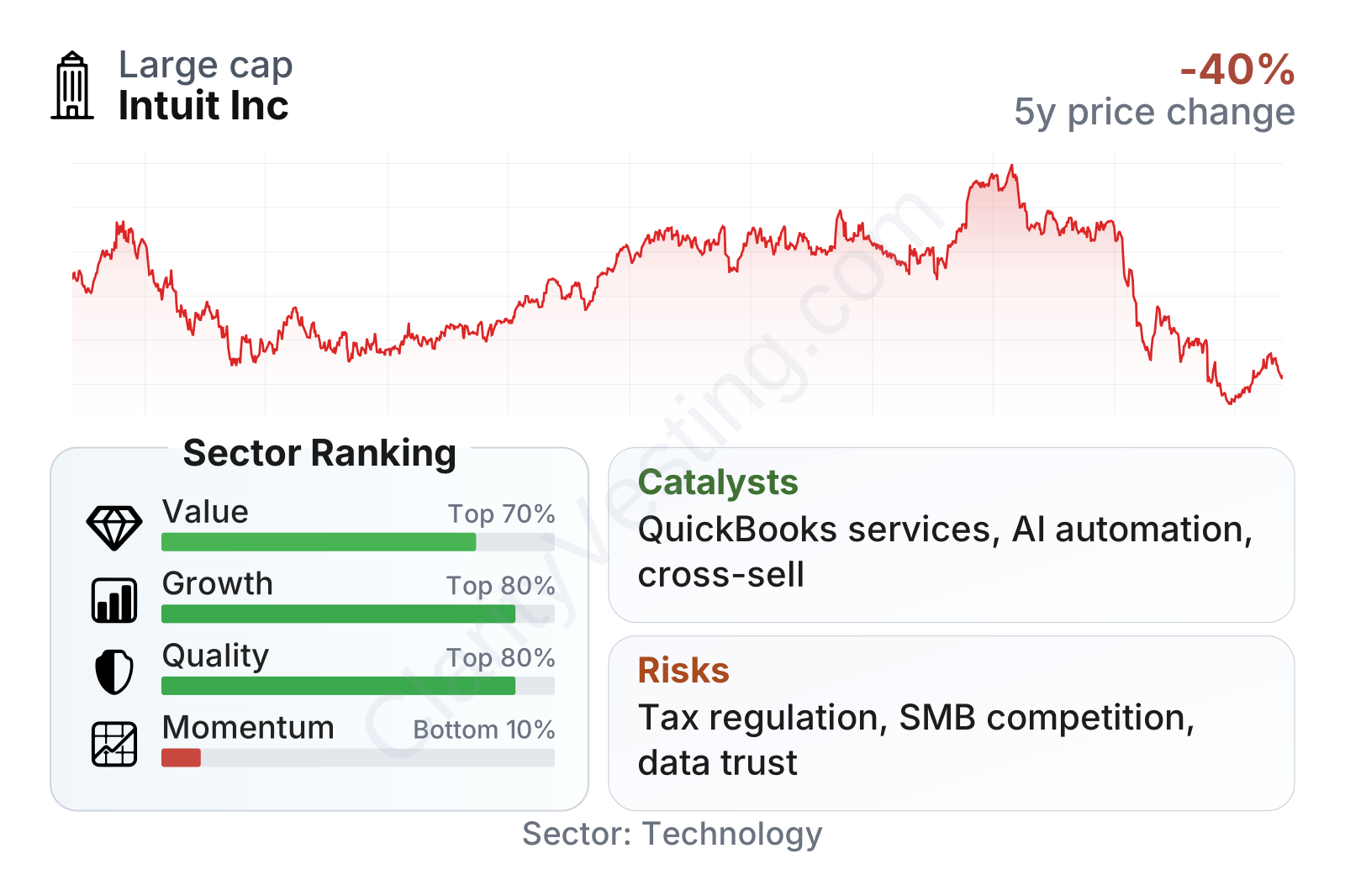
Intuit stands out on business quality and cash generation. Profitability measures are well above the software sector median, returns on invested capital are strong, and free cash flow is unusually high for a company of this size. Growth remains solid over multi-year periods, even if the latest year-over-year revenue increase is a bit below the sector median. The weaker area is stock momentum: the share price has fallen sharply from recent highs, which has changed the valuation picture much more than the underlying operating profile.
With a market value near $100 billion, Intuit is large but still focused enough for its core products to matter. Its beta is close to 1, which means the stock has historically moved broadly in line with the market rather than behaving like an extreme high-volatility name.
Growth
Intuit operates in a favorable part of software: digital financial management for households and businesses. Tax filing, bookkeeping, payroll, payments, invoicing, and customer communication are all areas still shifting toward cloud-based, automated tools. Small businesses especially continue to adopt software that reduces manual work and connects accounting with payments, lending, marketing, and compliance. That gives Intuit a long runway because it can expand not only by adding customers, but also by selling more services to existing ones.
The strategy is coherent. QuickBooks has become the center of a broader business platform, not just a bookkeeping tool. A customer may start with accounting, then add payroll, payment acceptance, bill pay, marketing, or live expert help. This creates a practical form of cross-selling that can raise revenue per customer over time and make the product harder to replace.
Recent revenue growth has settled into a healthier, more normal range after the unusually volatile period around acquisitions and post-pandemic comparisons. Growth in the low-to-high teens is still meaningful at Intuit’s scale, and the longer-term record remains stronger than much of the software sector when measured per share.
Artificial intelligence is one of the clearest catalysts. Intuit has been embedding AI assistants and automation across TurboTax, QuickBooks, Credit Karma, and Mailchimp. The company’s pitch is straightforward: reduce repetitive admin work, improve financial decision-making, and help users complete more tasks inside the platform. If this leads customers to use more services instead of separate tools, it could strengthen retention and raise average revenue per user.
Another important catalyst is the combination of accounting software and money movement. Payments, payroll, and related business services can grow alongside the installed base of QuickBooks users. These categories often carry attractive economics because they are tied to daily operations, not discretionary software experiments.
Cash generation has been rising year after year, reaching well above $6 billion on a trailing basis and around $8.6 billion on the latest metric snapshot. That matters because strong free cash flow gives Intuit room to invest in product development, integrate acquisitions, repurchase shares, and absorb slower periods without putting pressure on the balance sheet.
A recent opportunity worth watching is the continued rollout of AI-driven expert platforms and business automation tools. For Intuit, the significance is less about headline technology and more about whether it can turn AI into better customer outcomes inside products people already use for essential tasks.
Risks
This article is for informational purposes only and does not constitute financial advice. Some content is AI-generated. See Disclaimer


