Stock Analysis · Intel Corporation (INTC)
Overview
Intel is one of the world’s largest semiconductor companies. It designs and sells processors and related platform products used in personal computers, data centers, networking equipment, industrial systems, and a wide range of embedded devices. The company is also rebuilding itself as a manufacturing platform through Intel Foundry, which aims to produce chips both for Intel’s own products and for outside customers. In simple terms, Intel is trying to be both a chip designer and a major chip manufacturer at the same time.
Its revenue base is still centered on computing chips, but the mix has changed as the company pushes harder into foundry services and products for AI infrastructure, communications, and edge computing. Based on recent annual reporting, the main sources of revenue can be summarized as follows:
- Client Computing Group: about 52% of revenue. This is Intel’s biggest business and includes PC processors and related components for notebooks, desktops, and commercial computers.
- Data Center and AI: about 24%. This includes server processors and platform products used in cloud, enterprise, and AI-related computing environments.
- Network and Edge: about 11%. This covers networking, telecom, and edge computing chips.
- Intel Foundry: about 9%. This includes manufacturing services, advanced packaging, wafer production, and related foundry activities for internal and external customers.
- Mobileye and other businesses: about 4% combined. These activities include advanced driver-assistance technology and smaller non-core operations.
That revenue mix shows two important realities. First, Intel still depends heavily on the mature PC and server markets. Second, management is deliberately investing in new capacity and manufacturing capabilities so the company can participate more broadly in AI and outsourced chip production, which could make Intel structurally different from what it was a few years ago.
The long-term business question is therefore not whether Intel is relevant today, because it clearly is, but whether its expensive rebuilding phase can restore stronger profitability and place it in a better position in the semiconductor value chain.
The multi-year income flow highlights a sharp change in the business. Revenue has fallen meaningfully from the 2021 level, while research and development spending stayed elevated and manufacturing costs remained heavy. That combination compressed gross profit and pushed earnings far below prior peaks, which explains why the turnaround depends not only on sales recovery but also on cost discipline and better factory utilization.
Key Figures
| Metric | Value | Sector ⓘ |
|---|---|---|
| Date | Sep 12, 2026 | |
| Context | ||
| Sector | Technology | |
| Industry | Semiconductors | |
| Market Cap ⓘ | $544.15B | |
| Beta ⓘ | 2.23 | |
Value (Cheapness) | ||
| P/E Ratio ⓘ | N/A | 29.51 |
| FCF Yield ⓘ | 0.52% | 4.25% |
| EBIT / EV ⓘ | -1.58% | 2.85% |
| PEG ⓘ | 0.50 | |
Growth (Business expansion) | ||
| Revenue Growth ⓘ | 25.40% | 15.40% |
| RPS Growth (5Y CAGR) ⓘ | -13.37% | 8.56% |
| EPS Growth (5Y CAGR) ⓘ | -27.88% | -11.88% |
| Margin Growth (5Y Trend) ⓘ | -19.61% | 0.46% |
| FCF Growth (5Y CAGR) ⓘ | N/A | 9.80% |
Quality (Business durability) | ||
| ROIC (Latest) ⓘ | -4.70% | 9.44% |
| ROIC (5Y Median) ⓘ | 0.14% | 8.30% |
| Net Debt / EBIT (Latest) ⓘ | 108.23 | 0.54 |
| Net Debt / EBIT (5Y Median) ⓘ | 12.72 | 0.44 |
| Operating Margin (Latest) ⓘ | -15.27% | 9.58% |
| Operating Margin (5Y Median) ⓘ | 3.70% | 8.25% |
| Debt to Equity (Latest) ⓘ | 57.73% | 33.33% |
| Profit Margin (Latest) ⓘ | -19.79% | 7.14% |
| Free Cash Flow (Latest) ⓘ | $2.83B | |
Momentum (Price trend) | ||
| 3Y Return ⓘ | +169.33% | +45.48% |
| 12M Return (excl. last month) ⓘ | +362.86% | +23.48% |
| 6M Return ⓘ | +127.49% | +20.93% |
| Price vs. 200-Day MA ⓘ | +36.28% | +7.43% |
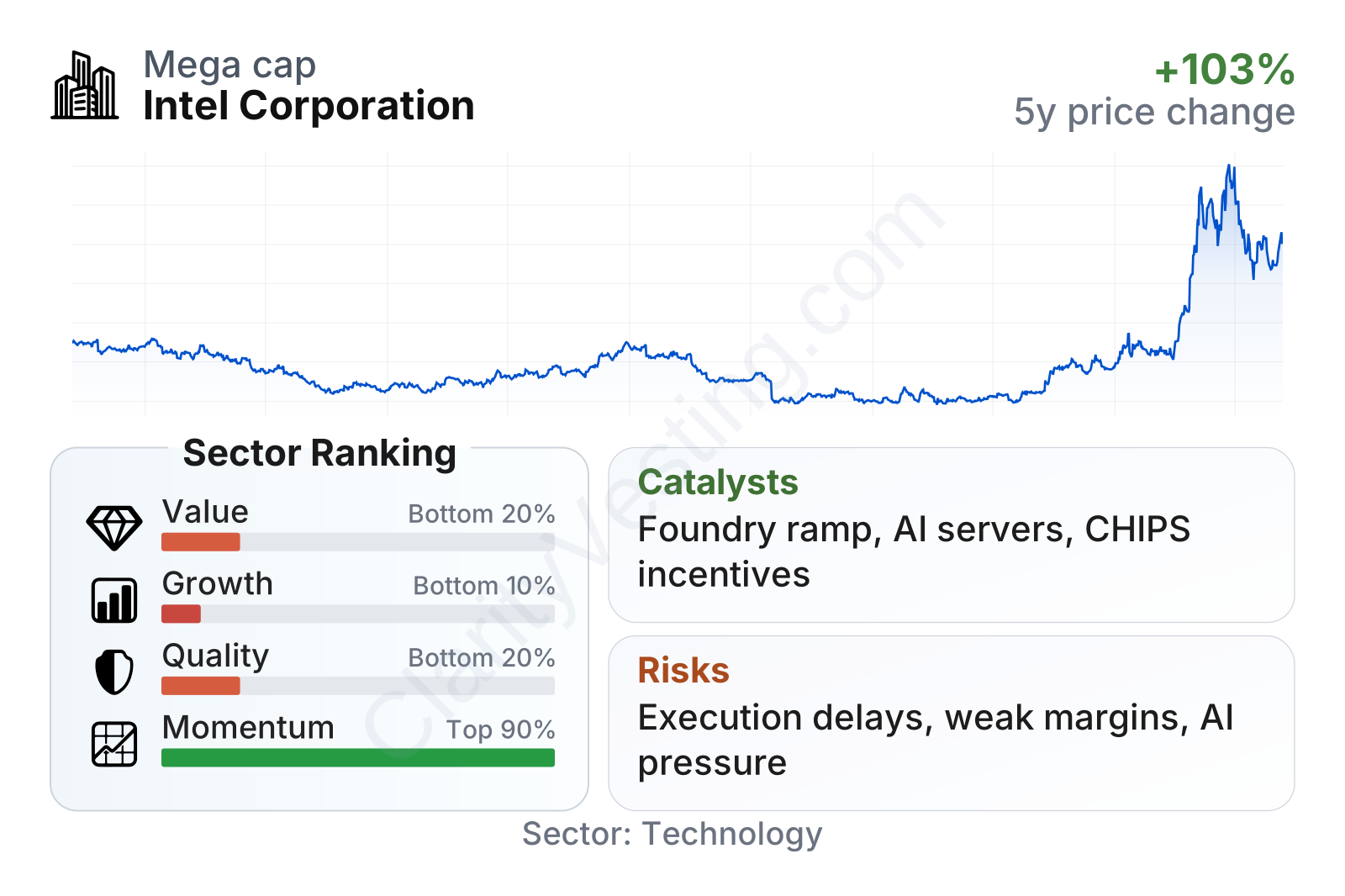
The overall profile is unusual. Intel ranks weakly on value, quality, and long-term growth measures versus the semiconductor sector, but very strongly on momentum after a major stock rebound. Revenue growth has recently improved and now runs above the sector median, yet most longer-term profitability and return metrics remain well below typical industry levels. In other words, the market has started to price in recovery well before the company has fully rebuilt its earnings base.
The share price history also shows how dramatic sentiment has been. The stock dropped heavily from 2021 into 2025, then rebounded sharply into 2026. That kind of move usually reflects a company in transition rather than a stable, mature compounder.
Growth
Intel operates in a sector with powerful long-term demand drivers. Semiconductors are essential to cloud computing, AI workloads, enterprise servers, consumer electronics, industrial automation, and connected infrastructure. Demand for advanced computing is expected to keep rising over many years, so the sector itself remains attractive. The challenge for Intel is not whether chip demand exists, but whether Intel can capture a larger and more profitable share of that demand than it has in recent years.
Its current strategy is built around several growth pillars: regaining competitiveness in PC and server processors, building a stronger AI product lineup, and creating a foundry business that can manufacture chips for external customers. Strategically, that combination makes sense. A successful foundry business could diversify revenue away from Intel’s own product cycles, while stronger server and AI offerings could help it recover share in data center markets where leadership has become more contested.
The revenue trend suggests the downturn may have passed its deepest point. Intel went through a long stretch of declining year-over-year sales from 2022 into 2025, but recent quarters show a return to positive growth, with the latest increase reaching the mid-20% range. That is encouraging, although it follows a weak base and does not yet erase the company’s weaker five-year track record.
Cash generation has also improved from the worst period, but it remains a key area to watch. Free cash flow was deeply negative during Intel’s heavy investment phase and has moved closer to break-even more recently. That improvement matters because large semiconductor fabrication projects consume enormous capital, and a durable recovery becomes more convincing only when those investments begin producing steadier cash returns.
Several catalysts could support Intel’s next phase. The company has continued to expand advanced packaging and manufacturing capabilities, and government-backed semiconductor incentives in the United States and Europe may reduce part of the burden of building new capacity. Intel’s product roadmap in PCs and servers also matters: if newer generations perform well and ship at scale, revenue recovery could broaden beyond a simple cyclical rebound.
A recent opportunity often highlighted by the company is the geopolitical push for more domestically based semiconductor manufacturing. Governments and large customers increasingly want a more geographically diversified supply chain. That trend does not guarantee success, but it creates a real opening for Intel Foundry if the company can deliver competitive process technology, yield, and reliability.
Risks
This article is for informational purposes only and does not constitute financial advice. Some content is AI-generated. See Disclaimer


