Stock Analysis · Intapp Inc (INTA)
Overview
Intapp is a software company focused on professional and financial services firms. Its products help organizations such as law firms, accounting firms, consulting groups, private capital managers, and investment banking teams manage client relationships, compliance, deals, collaboration, and firm operations. In simple terms, Intapp sells industry-specific software to complex firms that need both productivity tools and strict risk controls.
The company’s business model is mainly subscription-based, which usually creates recurring revenue and better visibility than one-time software sales. Intapp has also expanded its platform through artificial intelligence features, cloud delivery, and products tailored to client origination and deal management. That specialization matters because many customers operate in heavily regulated, relationship-driven industries where generic software is often not enough.
Based on company filings, the main revenue sources are organized as follows:
- Cloud subscription and term-based software: the large majority of revenue, likely around 80% to 90%. This includes access to Intapp’s cloud platform and recurring software subscriptions.
- Professional services and other: likely around 10% to 20%. This includes implementation, configuration, consulting, training, and related support work tied to customer deployments.
Intapp also serves several end markets, with legal, private capital, accounting, consulting, and investment banking among the most important verticals. Recent annual disclosures emphasize that the company is increasingly oriented toward cloud software rather than lower-margin service work, which helps explain its strong gross margin profile even though it remains loss-making on a net income basis.
Over the last several years, revenue has grown from roughly $272 million to nearly $578 million, while gross profit expanded even faster in absolute dollars. The broad pattern is favorable: cost of revenue has risen much more slowly than sales, showing that the core platform scales well. The challenge is that operating expenses, especially research and development and broader operating costs, have also continued to climb, preventing a sustained move into accounting profitability.
Key Figures
| Metric | Value | Sector ⓘ |
|---|---|---|
| Date | Sep 12, 2026 | |
| Context | ||
| Sector | Technology | |
| Industry | Software - Application | |
| Market Cap ⓘ | $2.91B | |
| Beta ⓘ | 0.45 | |
Value (Cheapness) | ||
| P/E Ratio ⓘ | N/A | 29.51 |
| FCF Yield ⓘ | 4.69% | 4.25% |
| EBIT / EV ⓘ | -1.17% | 2.85% |
| PEG ⓘ | 0.69 | |
Growth (Business expansion) | ||
| Revenue Growth ⓘ | 13.00% | 15.40% |
| RPS Growth (5Y CAGR) ⓘ | 14.15% | 8.56% |
| EPS Growth (5Y CAGR) ⓘ | N/A | -11.88% |
| Margin Growth (5Y Trend) ⓘ | N/A | 0.46% |
| FCF Growth (5Y CAGR) ⓘ | 77.68% | 9.80% |
Quality (Business durability) | ||
| ROIC (Latest) ⓘ | -6.70% | 9.44% |
| ROIC (5Y Median) ⓘ | -6.94% | 8.30% |
| Net Debt / EBIT (Latest) ⓘ | N/A | 0.54 |
| Net Debt / EBIT (5Y Median) ⓘ | N/A | 0.44 |
| Operating Margin (Latest) ⓘ | -5.71% | 9.58% |
| Operating Margin (5Y Median) ⓘ | -6.95% | 8.25% |
| Debt to Equity (Latest) ⓘ | 4.99% | 33.33% |
| Profit Margin (Latest) ⓘ | -7.15% | 7.14% |
| Free Cash Flow (Latest) ⓘ | $136.36M | |
Momentum (Price trend) | ||
| 3Y Return ⓘ | +6.34% | +45.48% |
| 12M Return (excl. last month) ⓘ | +7.07% | +23.48% |
| 6M Return ⓘ | +51.03% | +20.93% |
| Price vs. 200-Day MA ⓘ | +20.72% | +7.43% |
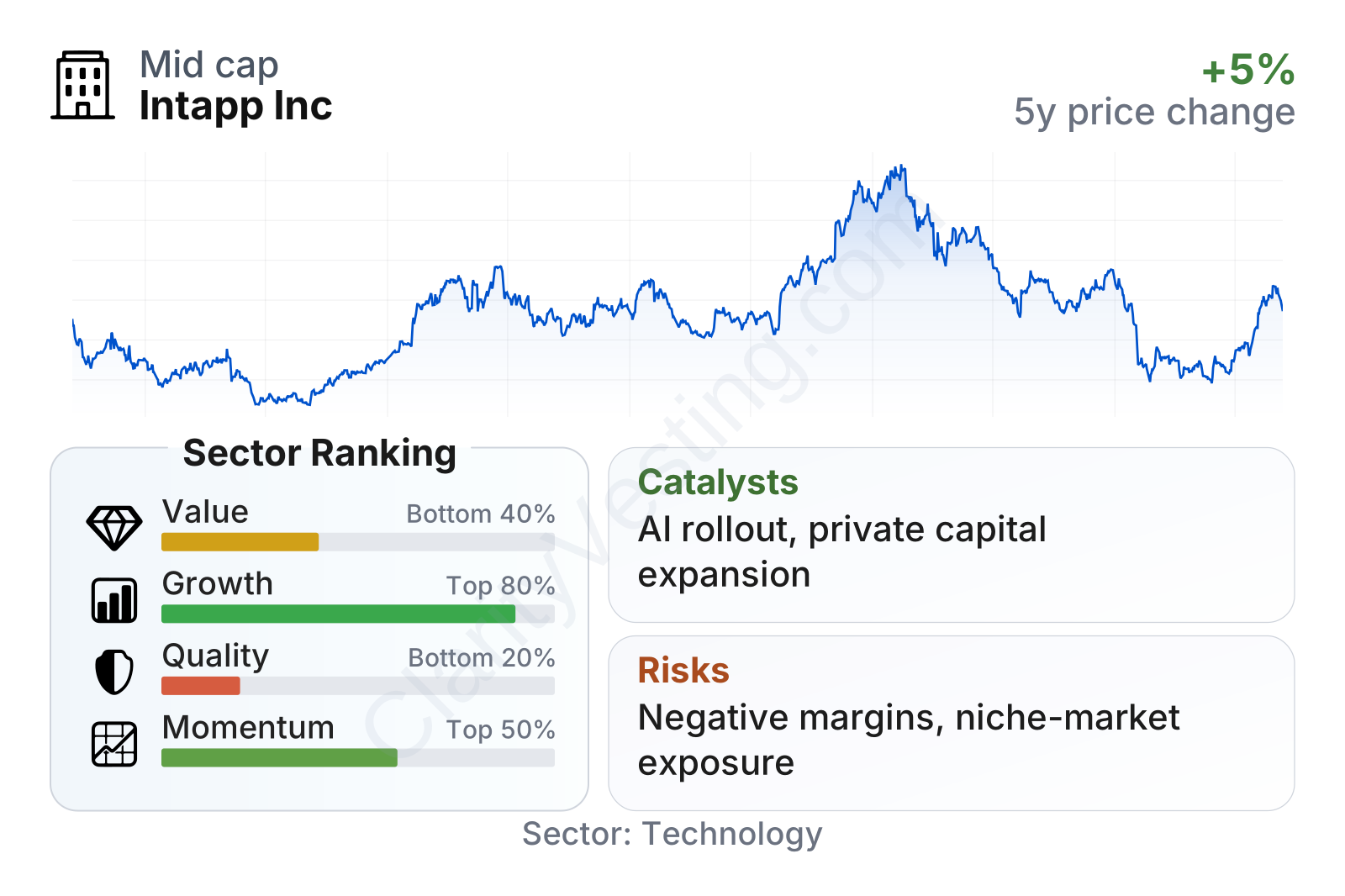
Intapp is a mid-sized software company with an unusually low share-price volatility for the sector, reflected in a beta near 0.4. The metric table shows a mixed profile: growth ranks well above much of the software sector, while quality and value remain weaker because profitability is still negative. One important offset is cash generation. Free cash flow yield is slightly better than the sector median, and balance-sheet leverage is very low, which gives the company more flexibility than many unprofitable software peers.
The stock’s history has been volatile despite that low beta reading. Shares climbed strongly through parts of 2023 to early 2025, then fell sharply into 2026. More recently, momentum over the last six months has improved from depressed levels, but the longer three-year return still trails the broader software peer group.
Growth
Intapp operates in a part of software that still has long-term expansion potential. Professional services firms and private capital managers continue shifting from legacy, on-premise, or fragmented tools toward cloud-based systems that combine workflow, compliance, CRM, and AI-driven insights. This is not the fastest-growing corner of software, but it is a durable one because customers tend to value specialization, security, and integration over novelty.
The company’s strategy is coherent for that market. Rather than competing head-on with broad enterprise software vendors across every industry, Intapp focuses on a narrower set of customers with demanding workflows. That can support sticky relationships, cross-selling, and lower churn once the software is embedded in daily operations. Intapp has also emphasized AI capabilities, including tools designed to help firms surface relationship intelligence, automate work, and improve decision-making around business development and execution.
Growth has clearly moderated from the very high levels seen earlier in its public-company life. Year-over-year revenue expansion was often above 20% and at times much higher, but it has recently settled more in the low-to-high teens. That is still healthy, especially for a company approaching $600 million in annual revenue, but it shows that Intapp is moving from an earlier rapid-expansion phase toward a more measured scaling phase. Even so, its five-year revenue-per-share growth remains well ahead of the sector median.
A major positive is the steady improvement in cash generation. Free cash flow moved from negative territory a few years ago to well above $100 million on a trailing basis. That is a meaningful signal because it suggests the business is becoming more self-funding even before full GAAP profitability arrives. If Intapp can keep revenue growing in the teens while holding expense growth closer to revenue growth, the path toward stronger operating leverage becomes more credible.
As for catalysts, the clearest ones are continued cloud migration among professional services firms, deeper adoption in private capital, and broader rollout of AI features across the installed base. Recent company communications have also highlighted strategic customer wins, platform expansion, and product innovation aimed at increasing wallet share inside existing clients. For a specialized vendor like Intapp, expansion within current accounts can be nearly as important as landing new ones.
Risks
This article is for informational purposes only and does not constitute financial advice. Some content is AI-generated. See Disclaimer