Stock Analysis · Innodata Inc (INOD)
Overview
Innodata Inc is a technology services company that helps enterprises turn large amounts of unstructured information into usable digital assets. In practical terms, it prepares, enriches, labels, checks, and manages content and data so customers can use it in products, research systems, search tools, and increasingly in artificial intelligence applications. The company has been repositioning itself around higher-value AI-related work, especially data engineering, data annotation, evaluation, and model support services for large technology clients.
Its business has historically included digital content services, publishing-related work, and platforms that help customers manage information workflows. More recently, the clearest growth engine has been AI data operations and related services for major enterprise and technology customers. That shift matters because it has moved Innodata from a low-growth outsourcing profile toward a more specialized role in the AI supply chain.
Based on recent company disclosures, revenue is primarily generated from services rather than product licensing, and customer concentration is meaningful. Public filings indicate that a small number of large clients account for a substantial share of sales, with AI-related work becoming the dominant contributor. Precise current segment percentages are limited in public reporting, but the revenue mix can be summarized as follows:
- AI data engineering and model support services: likely the majority of revenue, driven by data preparation, annotation, evaluation, and related managed services for large AI and technology customers.
- Digital content and information process services: includes content transformation, enrichment, and workflow support for publishers, enterprises, and information owners.
- Platforms and other technology-enabled solutions: smaller contribution, including software-assisted workflow tools and niche information services offerings.
Over the last several years, the business model has improved materially. Revenue has expanded sharply, gross profit has grown faster than in the company’s earlier outsourcing phase, and operating income has moved from losses to meaningful profitability. That suggests Innodata is not just selling more volume, but doing more valuable work.
The long-term change is striking: annual revenue rose from about $70 million in 2021 to more than $250 million in 2025, while net income moved from losses to more than $30 million. The biggest operating expense remains selling, general, and administrative costs, but profit conversion has improved considerably as scale increased.
Key Figures
| Metric | Value | Sector ⓘ |
|---|---|---|
| Date | Sep 12, 2026 | |
| Context | ||
| Sector | Technology | |
| Industry | Information Technology Services | |
| Market Cap ⓘ | $1.83B | |
| Beta ⓘ | 2.88 | |
Value (Cheapness) | ||
| P/E Ratio ⓘ | 41.25 | 29.51 |
| FCF Yield ⓘ | 11.95% | 4.25% |
| EBIT / EV ⓘ | 3.70% | 2.85% |
| PEG ⓘ | 0.87 | |
Growth (Business expansion) | ||
| Revenue Growth ⓘ | 57.80% | 15.40% |
| RPS Growth (5Y CAGR) ⓘ | 28.69% | 8.56% |
| EPS Growth (5Y CAGR) ⓘ | N/A | -11.88% |
| Margin Growth (5Y Trend) ⓘ | 18.83% | 0.46% |
| FCF Growth (5Y CAGR) ⓘ | 159.76% | 9.80% |
Quality (Business durability) | ||
| ROIC (Latest) ⓘ | 37.77% | 9.44% |
| ROIC (5Y Median) ⓘ | -4.32% | 8.30% |
| Net Debt / EBIT (Latest) ⓘ | -3.85 | 0.54 |
| Net Debt / EBIT (5Y Median) ⓘ | -1.88 | 0.44 |
| Operating Margin (Latest) ⓘ | 18.42% | 9.58% |
| Operating Margin (5Y Median) ⓘ | 0.37% | 8.25% |
| Debt to Equity (Latest) ⓘ | 9.42% | 33.33% |
| Profit Margin (Latest) ⓘ | 14.66% | 7.14% |
| Free Cash Flow (Latest) ⓘ | $218.57M | |
Momentum (Price trend) | ||
| 3Y Return ⓘ | +476.49% | +45.48% |
| 12M Return (excl. last month) ⓘ | +43.12% | +23.48% |
| 6M Return ⓘ | +24.47% | +20.93% |
| Price vs. 200-Day MA ⓘ | -12.43% | +7.43% |
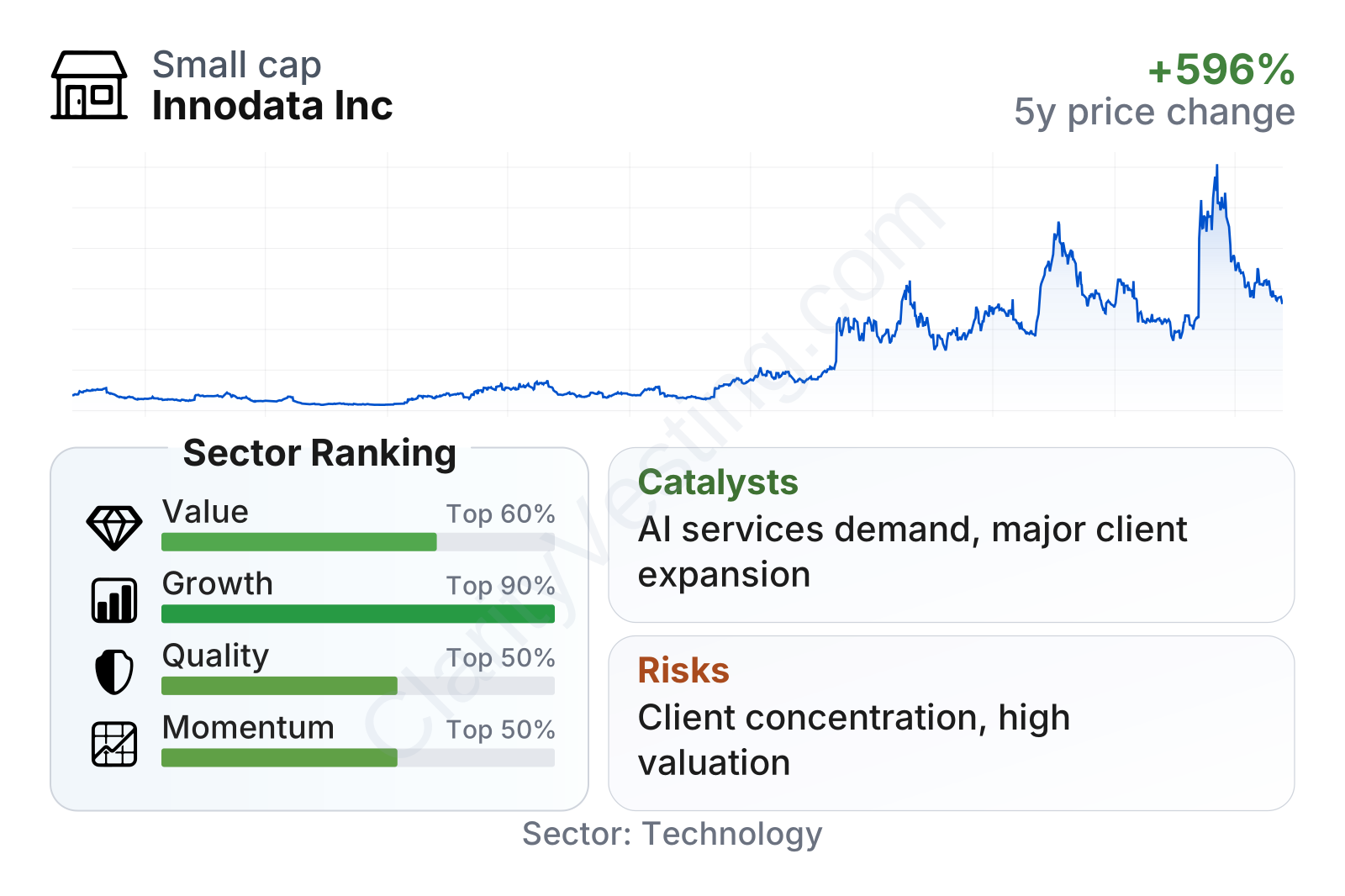
Innodata is still a relatively small public company by technology-sector standards, but its financial profile has strengthened quickly. Growth ranks near the top of the sector, and recent profitability and returns on capital are clearly above typical peers. The balance sheet is also unusually clean, with very low leverage and net cash rather than net debt. The main trade-off is valuation and volatility: the earnings multiple is above the sector median, and the stock’s beta near 2.9 points to large price swings.
The stock price history reflects that changing profile. Shares traded at low single-digit levels in 2022, then re-rated sharply as revenue growth accelerated and margins turned positive. That kind of move can signal improving fundamentals, but it also means expectations are now much higher than they were a few years ago.
Growth
Innodata operates in a part of the market that is benefiting from one of the strongest spending themes in technology: artificial intelligence adoption. Building and maintaining AI systems requires large volumes of organized, validated, and continuously refreshed information. That is exactly where Innodata is positioned. As more companies move from experimenting with AI to deploying it in real products, demand for data preparation, evaluation, and model-support work can expand alongside them.
The company’s strategy appears coherent for that environment. Rather than competing head-on with the largest cloud platforms or model developers, Innodata sits in an enabling layer of the value chain. It provides labor-intensive and process-heavy services that many customers prefer not to build internally at scale. That role can be attractive because demand may grow with AI usage across many industries, not just in one niche.
Recent growth has been exceptional. Year-over-year revenue growth moved from contraction in 2023 to very strong expansion in 2024 and remained elevated into 2026, recently running near 58%, far above the sector median near 16%. The pace has cooled from the most explosive quarters, which is normal after very large jumps, but current levels still point to a business expanding much faster than most information technology services peers.
Cash generation has also improved. Free cash flow was negative in 2022 and 2023, then turned positive and climbed rapidly through 2024 and 2025. That matters because it suggests the recent expansion is not only visible in accounting profits but is also beginning to convert into cash. For a services company, that is an important sign that growth is becoming financially productive rather than simply more expensive.
A major catalyst is continued spending by large technology customers on AI model development, deployment, and maintenance. Another is Innodata’s ability to deepen relationships with existing clients by moving from one-off projects to recurring workflows. Recent company communications have also emphasized expanding demand for generative AI-related services, which supports the view that the opportunity is broader than a short-lived contract bump.
Risks
This article is for informational purposes only and does not constitute financial advice. Some content is AI-generated. See Disclaimer


