Stock Analysis · Ingram Micro Holding Corporation (INGM)
Overview
Ingram Micro Holding Corporation is a large technology distributor and services provider. In simple terms, it sits between technology manufacturers and the businesses, resellers, cloud partners, and service providers that ultimately deliver those products and services to end customers. The company helps move hardware, software, cloud subscriptions, and related services through a global logistics and partner network. Its role is less about inventing consumer technology and more about making the technology supply chain work at scale.
The business is built around very high sales volume and very thin margins, which is typical for broadline technology distribution. Ingram Micro works with vendors such as hardware makers, software publishers, and cloud providers, then sells through a large ecosystem of channel partners. That makes scale, inventory management, financing, and logistics especially important to its economics.
Based on the company’s recent public filings, revenue comes primarily from product distribution, with cloud and higher-value services still representing a smaller but strategically important part of the mix. A practical breakdown is:
- Technology products distribution: about 90% to 95% of revenue. This includes client and endpoint devices, servers, networking, peripherals, software sold through distribution, and other traditional IT products.
- Cloud, platform, and other higher-value solutions: about 5% to 10% of revenue. This includes cloud subscriptions, digital platform activity, configuration, lifecycle, and other service-led offerings. While smaller in revenue share, these activities can carry better economics than pure hardware distribution.
- Geographically, the company is diversified across North America, Europe, Asia-Pacific, Latin America, and other international markets, reducing dependence on any single country.
One clear pattern in the business model is that most revenue is absorbed by product costs before reaching profit. Revenue recovered in 2025 after a weaker 2023-2024 period, but operating income and net income remained comparatively modest, showing how sensitive results are to margins, financing costs, and working-capital execution.
Key Figures
| Metric | Value | Sector ⓘ |
|---|---|---|
| Date | Sep 12, 2026 | |
| Context | ||
| Sector | Technology | |
| Industry | Information Technology Services | |
| Market Cap ⓘ | $6.34B | |
| Beta ⓘ | N/A | |
Value (Cheapness) | ||
| P/E Ratio ⓘ | 14.42 | 29.51 |
| FCF Yield ⓘ | -3.65% | 4.25% |
| EBIT / EV ⓘ | 9.93% | 2.85% |
| PEG ⓘ | N/A | |
Growth (Business expansion) | ||
| Revenue Growth ⓘ | 13.60% | 15.40% |
| RPS Growth (5Y CAGR) ⓘ | -0.94% | 8.56% |
| EPS Growth (5Y CAGR) ⓘ | -19.71% | -11.88% |
| Margin Growth (5Y Trend) ⓘ | -0.19% | 0.46% |
| FCF Growth (5Y CAGR) ⓘ | N/A | 9.80% |
Quality (Business durability) | ||
| ROIC (Latest) ⓘ | 8.12% | 9.44% |
| ROIC (5Y Median) ⓘ | N/A | 8.30% |
| Net Debt / EBIT (Latest) ⓘ | 3.54 | 0.54 |
| Net Debt / EBIT (5Y Median) ⓘ | 3.70 | 0.44 |
| Operating Margin (Latest) ⓘ | 1.73% | 9.58% |
| Operating Margin (5Y Median) ⓘ | 1.78% | 8.25% |
| Debt to Equity (Latest) ⓘ | 99.12% | 33.33% |
| Profit Margin (Latest) ⓘ | 0.77% | 7.14% |
| Free Cash Flow (Latest) ⓘ | -$231.59M | |
Momentum (Price trend) | ||
| 3Y Return ⓘ | N/A | +45.48% |
| 12M Return (excl. last month) ⓘ | +49.41% | +23.48% |
| 6M Return ⓘ | +29.42% | +20.93% |
| Price vs. 200-Day MA ⓘ | +9.00% | +7.43% |
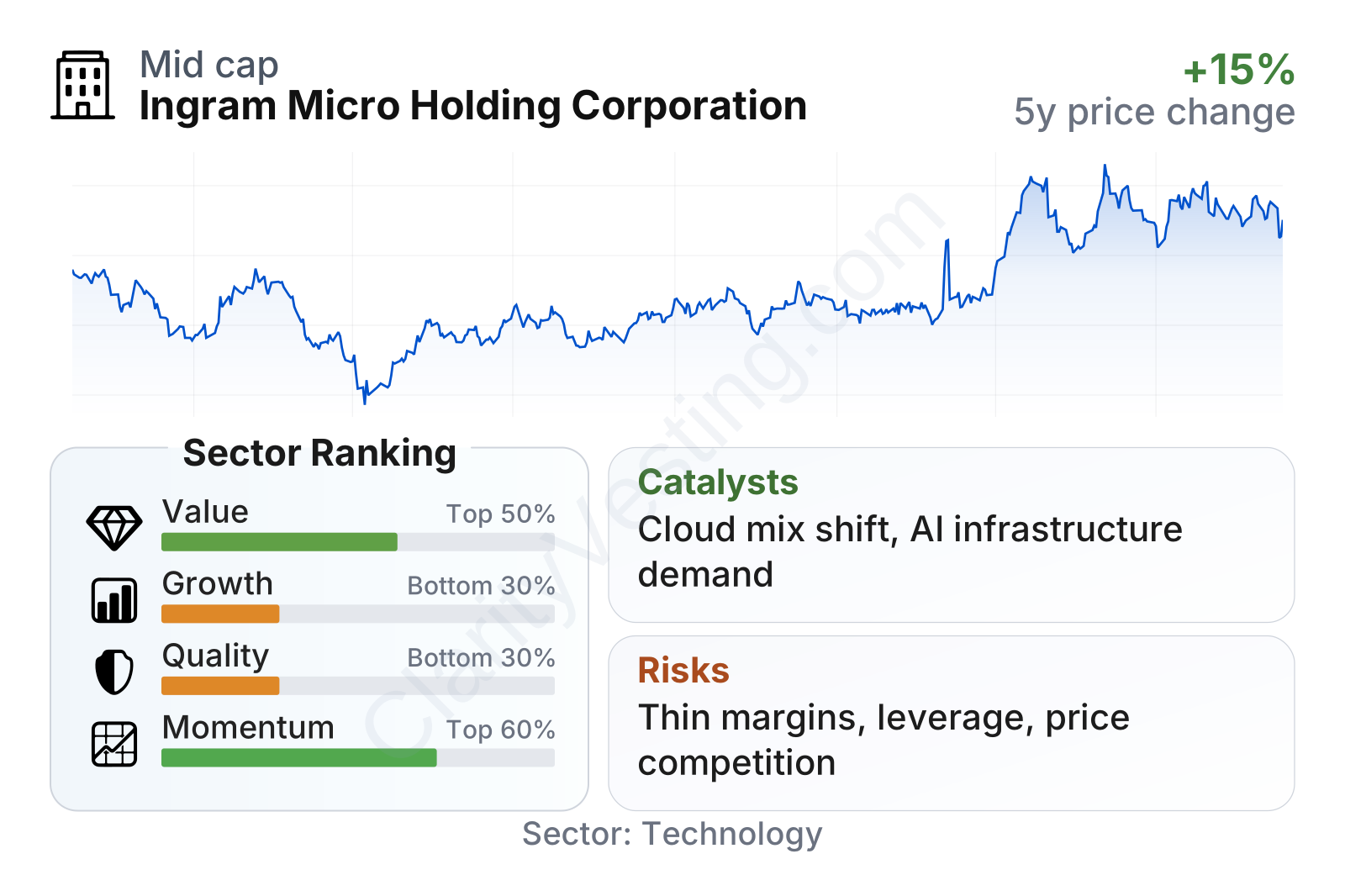
Ingram Micro is a mid-to-large technology company by market value, but its profile is unusual compared with many software-heavy peers in the sector. On valuation measures, it screens cheaper than the sector median, with a price-to-earnings ratio around the mid-teens versus roughly low-30s for the sector and an unusually strong free-cash-flow yield. At the same time, growth and quality metrics rank below much of the sector, which reflects the lower-margin nature of distribution rather than a pure software model. Share-price momentum has been better than the sector over the last six to twelve months, suggesting the market has recently become more constructive on the company’s outlook.
Growth
Ingram Micro operates in a sector that should remain structurally relevant over the long run. Companies still need hardware, networking gear, cybersecurity tools, data-center infrastructure, and cloud subscriptions, and those needs are being reinforced by artificial intelligence workloads, hybrid work, digital transformation, and ongoing IT refresh cycles. The company is not the main creator of those technologies, but it is one of the large intermediaries helping vendors and channel partners bring them to market efficiently.
The growth case depends less on breakthrough invention and more on execution. Ingram Micro’s strategy makes sense if it can keep expanding in areas that are more valuable than simple box-moving: cloud marketplace activity, platform-based automation, lifecycle services, and solutions attached to infrastructure demand. These activities can strengthen partner relationships and potentially improve margins over time.
Recent sales trends have improved. Year-over-year revenue growth has been running in the low-to-mid teens in the latest periods, which is roughly in line with the broader technology sector median and clearly better than the softer backdrop seen earlier in the company’s recent history. That matters because distribution businesses benefit from scale: when volumes rise, even small improvements in operating efficiency can have a noticeable effect on earnings.
Cash generation, however, deserves a careful reading. Ingram Micro’s trailing free cash flow is strong on the latest snapshot, but the historical path has been uneven, which is common in a business with large swings in inventory, receivables, and payables. For long-term analysis, this means reported cash flow can look excellent in one period and much weaker in another without necessarily reflecting a permanent change in underlying competitiveness.
A meaningful catalyst is the ongoing mix shift toward cloud and digital platform activity. If more partner transactions move through Ingram Micro’s platform and if attach rates for services rise alongside infrastructure sales, the company could gradually improve the earnings quality of what has historically been a low-margin distribution model. Another supportive factor is enterprise demand tied to AI infrastructure, data-center upgrades, and security spending, all of which can lift demand across servers, networking, storage, and related software channels.
Recent company updates have also pointed to continued business momentum after its public listing period, with improving revenue and a still large global vendor-and-partner ecosystem. That does not guarantee a step-change in profitability, but it does support the idea that the company remains relevant in a growing part of the technology supply chain.
Risks
This article is for informational purposes only and does not constitute financial advice. Some content is AI-generated. See Disclaimer


