Stock Analysis · Infosys Ltd (INFY)
Overview
Infosys is a global IT services and consulting company headquartered in India. It helps large organizations build, run, and modernize their technology systems. In practice, that means designing software, managing cloud infrastructure, supporting cybersecurity, analyzing data, automating business processes, and advising clients on digital transformation. Its customer base is broad and includes companies in finance, manufacturing, retail, telecom, energy, healthcare, and public services.
The business model is largely service-based: clients hire Infosys for multi-year technology work, recurring support, and strategic consulting. That tends to create durable relationships, although spending can slow when corporate customers delay projects. Infosys has also been pushing more strongly into cloud, artificial intelligence, data, and platform-based services to move beyond traditional outsourcing.
Revenue is mainly organized by industry verticals. Based on the company’s latest annual reporting, the largest sources are approximately:
- Financial Services: about 28% of revenue. This includes banks, insurers, capital markets firms, and related digital systems work.
- Manufacturing: about 16%. This covers engineering-related IT, supply chain systems, and enterprise software support.
- Retail: about 15%. This includes e-commerce, merchandising systems, customer analytics, and store operations technology.
- Communication: about 13%. This serves telecom, media, and related connectivity businesses.
- Energy, Utilities, Resources and Services: about 13%. This includes energy companies, utilities, logistics, and business services clients.
- Hi-Tech: about 8%. This supports software, hardware, semiconductor, and digital platform companies.
- Life Sciences and other segments: about 7%. This includes healthcare-related clients and smaller verticals.
Geographically, North America remains the biggest market by a wide margin, followed by Europe, with the rest coming from India and other regions. That concentration matters because spending patterns in the U.S. and Europe have a major influence on growth. Over the last few years, revenue has continued to rise, while profitability has stayed solid, showing that Infosys is still converting a large share of sales into operating income and cash.
The long-term pattern is constructive: revenue has climbed from roughly $16 billion to above $20 billion in four years, while net income has remained resilient and operating profit has edged higher. Costs have grown too, but the company still retains a strong profit pool for a services business.
Key Figures
| Metric | Value | Sector ⓘ |
|---|---|---|
| Date | Sep 12, 2026 | |
| Context | ||
| Sector | Technology | |
| Industry | Information Technology Services | |
| Market Cap ⓘ | $44.19B | |
| Beta ⓘ | 0.11 | |
Value (Cheapness) | ||
| P/E Ratio ⓘ | 13.47 | 29.51 |
| FCF Yield ⓘ | 8.64% | 4.25% |
| EBIT / EV ⓘ | 10.91% | 2.85% |
| PEG ⓘ | 1.85 | |
Growth (Business expansion) | ||
| Revenue Growth ⓘ | 2.90% | 15.40% |
| RPS Growth (5Y CAGR) ⓘ | 6.88% | 8.56% |
| EPS Growth (5Y CAGR) ⓘ | -32.28% | -11.88% |
| Margin Growth (5Y Trend) ⓘ | -2.32% | 0.46% |
| FCF Growth (5Y CAGR) ⓘ | 5.14% | 9.80% |
Quality (Business durability) | ||
| ROIC (Latest) ⓘ | 33.40% | 9.44% |
| ROIC (5Y Median) ⓘ | 29.40% | 8.30% |
| Net Debt / EBIT (Latest) ⓘ | -0.30 | 0.54 |
| Net Debt / EBIT (5Y Median) ⓘ | -0.30 | 0.44 |
| Operating Margin (Latest) ⓘ | 22.56% | 9.58% |
| Operating Margin (5Y Median) ⓘ | 23.33% | 8.25% |
| Debt to Equity (Latest) ⓘ | 9.60% | 33.33% |
| Profit Margin (Latest) ⓘ | 16.37% | 7.14% |
| Free Cash Flow (Latest) ⓘ | $3.82B | |
Momentum (Price trend) | ||
| 3Y Return ⓘ | -32.61% | +45.48% |
| 12M Return (excl. last month) ⓘ | -20.76% | +23.48% |
| 6M Return ⓘ | -15.85% | +20.93% |
| Price vs. 200-Day MA ⓘ | -19.64% | +7.43% |
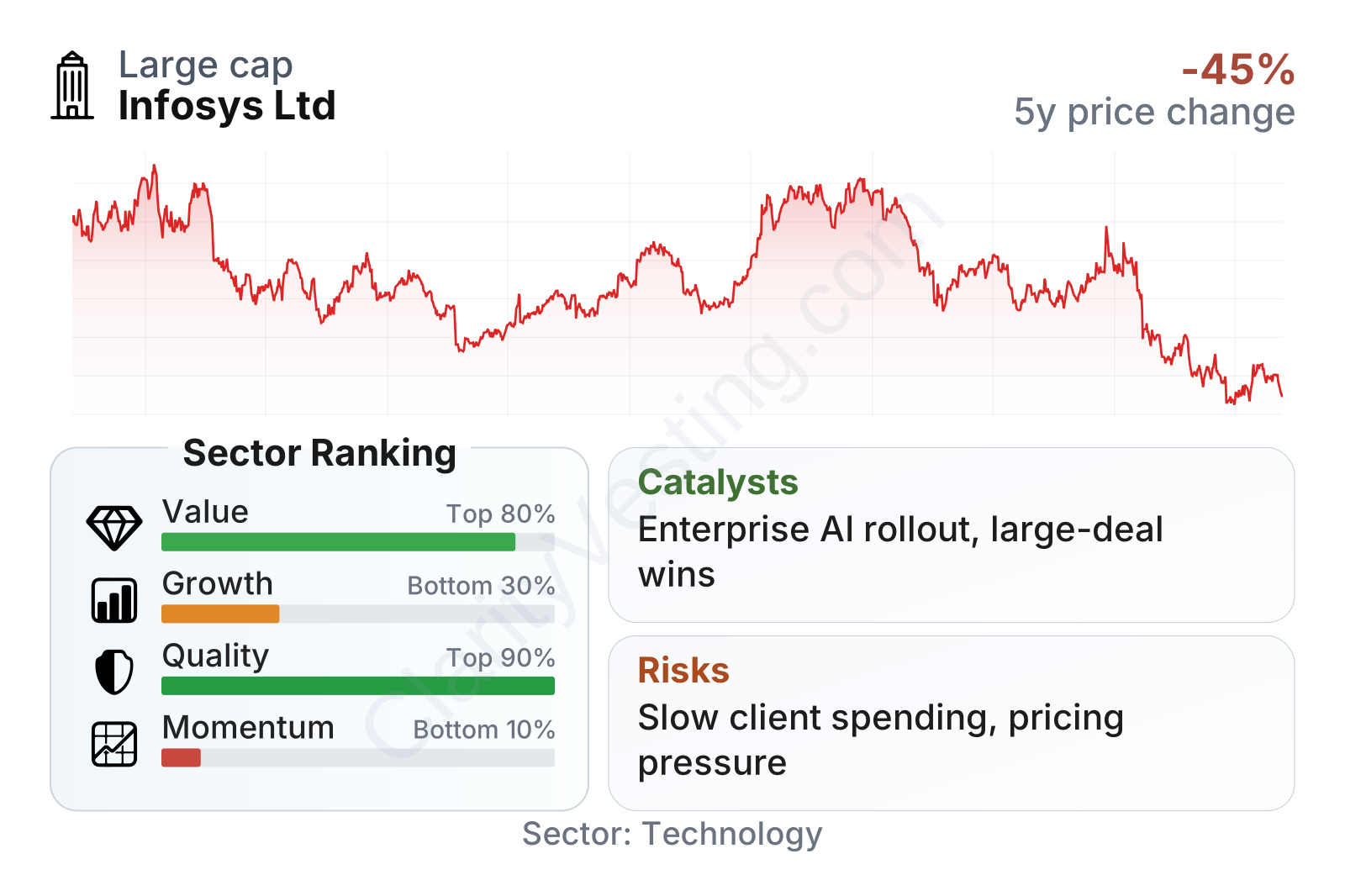
Infosys stands out more for business quality and balance-sheet strength than for fast expansion. Profitability is well above the sector median, return on invested capital is exceptionally strong at a little above 30%, and leverage is very low with debt-to-equity near 6%. Free cash flow generation is also healthy, with a yield noticeably above the broader technology median. On the weaker side, recent growth has been modest, and market performance has lagged most technology stocks over the last year and over three years. In short, the company currently looks like a mature, high-quality operator rather than a high-growth technology name.
Growth
Infosys operates in a sector with favorable long-term demand drivers. Large companies continue to shift spending toward cloud computing, cybersecurity, data analytics, automation, and AI-enabled software development. Those trends support ongoing demand for external technology partners, especially among clients that need both consulting and large-scale implementation. Infosys is well positioned to participate because it combines a global delivery model, enterprise relationships, and broad technical capabilities.
Its current strategy appears logical for the next phase of industry demand. Management has been emphasizing AI, cloud, digital engineering, and deeper work with large clients through integrated service offerings. The company has also been investing in platforms and partnerships with major technology vendors. For a services provider, this matters because clients increasingly want fewer vendors that can handle consulting, build-out, migration, operations, and optimization together.
Growth has clearly cooled from the very strong post-pandemic period. Year-over-year revenue expansion was above 20% in 2021, then stepped down steadily and has recently been running in the low single digits, with one stronger quarter near 7%. That slowdown suggests demand has been real but uneven, with customers scrutinizing budgets and delaying discretionary projects. Even so, the pattern also shows that the business has remained positive rather than slipping into a broad revenue contraction.
Cash generation has held up better than top-line momentum. Free cash flow has stayed in the multi-billion-dollar range and remains comfortably strong despite some fluctuation from year to year. That gives Infosys flexibility to invest in new capabilities, pursue acquisitions selectively, and continue shareholder distributions without relying heavily on debt.
A notable catalyst is the broad rollout of enterprise AI. Infosys has been promoting AI-focused services and platforms, including offerings intended to help clients adopt generative AI in a controlled and practical way. If AI spending moves from pilot programs to company-wide deployments, service providers with trusted enterprise relationships could capture a meaningful share of that work. Another supportive factor is large-deal momentum: in slower spending environments, major clients often consolidate work with established vendors, which can favor scaled firms like Infosys.
Risks
This article is for informational purposes only and does not constitute financial advice. Some content is AI-generated. See Disclaimer