Stock Analysis · InterContinental Hotels Group PLC (IHG)
Overview
InterContinental Hotels Group PLC, known as IHG, is one of the world’s largest hotel companies. It operates mainly as a brand owner, franchisor, and manager rather than as a heavy owner of hotel real estate. In simple terms, IHG builds hotel brands, signs up property owners to use those brands, provides reservation systems and loyalty programs, and earns fees from hotels that carry its names. Its portfolio ranges from luxury to midscale and extended-stay, with brands including InterContinental, Kimpton, Regent, Six Senses, Hotel Indigo, voco, Crowne Plaza, Holiday Inn, Holiday Inn Express, avid hotels, Candlewood Suites, Staybridge Suites, and Atwell Suites.
This “asset-light” structure matters for long-term analysis because it usually requires less capital than owning large numbers of hotels directly. It can support strong margins, resilient cash generation, and faster expansion when demand is healthy. IHG’s scale also comes from its global room network, direct booking channels, and the IHG One Rewards loyalty ecosystem, which helps keep guests inside the company’s brand family.
IHG’s revenue is mainly fee-based. Based on recent annual reporting, the broad mix can be summarized as follows:
- Franchise and royalty fees: approximately 50% to 60% of total revenue. This is the largest source and comes from hotel owners paying ongoing fees tied to room revenue and brand use.
- Managed hotel fees: approximately 15% to 25%. These are fees earned when IHG directly manages hotels for owners.
- Owned, leased, and managed lease hotels revenue: approximately 20% to 30%. This includes revenue where IHG has a more direct operating role, though this is not the core long-term model.
- Reimbursables and other revenue: a smaller portion, generally tied to pass-through items, technology, marketing programs, and other hotel services.
Geographically, the Americas remain IHG’s biggest earnings engine, with Holiday Inn, Holiday Inn Express, and its extended-stay brands playing a major role. Growth efforts are also focused on luxury and lifestyle, as well as conversion-friendly brands that allow independent hotels to join the system more easily.
The business flow also shows why the model is attractive: revenue has risen strongly since the pandemic recovery, while operating income and net income have remained solid even as reported revenue mix moved around. That points to a company whose economics depend more on fee streams and brand strength than on simple room ownership.
Key Figures
| Metric | Value | Sector ⓘ |
|---|---|---|
| Date | Sep 06, 2026 | |
| Context | ||
| Sector | Consumer Cyclical | |
| Industry | Lodging | |
| Market Cap ⓘ | $23.48B | |
| Beta ⓘ | 1.02 | |
Value (Cheapness) | ||
| P/E Ratio ⓘ | 34.10 | 17.51 |
| FCF Yield ⓘ | 7.49% | 8.30% |
| EBIT / EV ⓘ | 8.61% | 6.27% |
| PEG ⓘ | 1.30 | |
Growth (Business expansion) | ||
| Revenue Growth ⓘ | 5.60% | 5.90% |
| RPS Growth (5Y CAGR) ⓘ | 20.50% | 9.14% |
| EPS Growth (5Y CAGR) ⓘ | N/A | -17.43% |
| Margin Growth (5Y Trend) ⓘ | 3.50% | -0.30% |
| FCF Growth (5Y CAGR) ⓘ | 10.48% | 4.91% |
Quality (Business durability) | ||
| ROIC (Latest) ⓘ | 143.22% | 12.46% |
| ROIC (5Y Median) ⓘ | 62.68% | 10.68% |
| Net Debt / EBIT (Latest) ⓘ | 1.58 | 2.11 |
| Net Debt / EBIT (5Y Median) ⓘ | 2.79 | 2.32 |
| Operating Margin (Latest) ⓘ | 22.48% | 9.12% |
| Operating Margin (5Y Median) ⓘ | 20.70% | 9.56% |
| Debt to Equity (Latest) ⓘ | -152.82% | 75.78% |
| Profit Margin (Latest) ⓘ | 13.40% | 5.31% |
| Free Cash Flow (Latest) ⓘ | $1.76B | |
Momentum (Price trend) | ||
| 3Y Return ⓘ | +120.84% | +15.88% |
| 12M Return (excl. last month) ⓘ | +41.33% | +5.17% |
| 6M Return ⓘ | +20.74% | 0.00% |
| Price vs. 200-Day MA ⓘ | +9.24% | +0.59% |
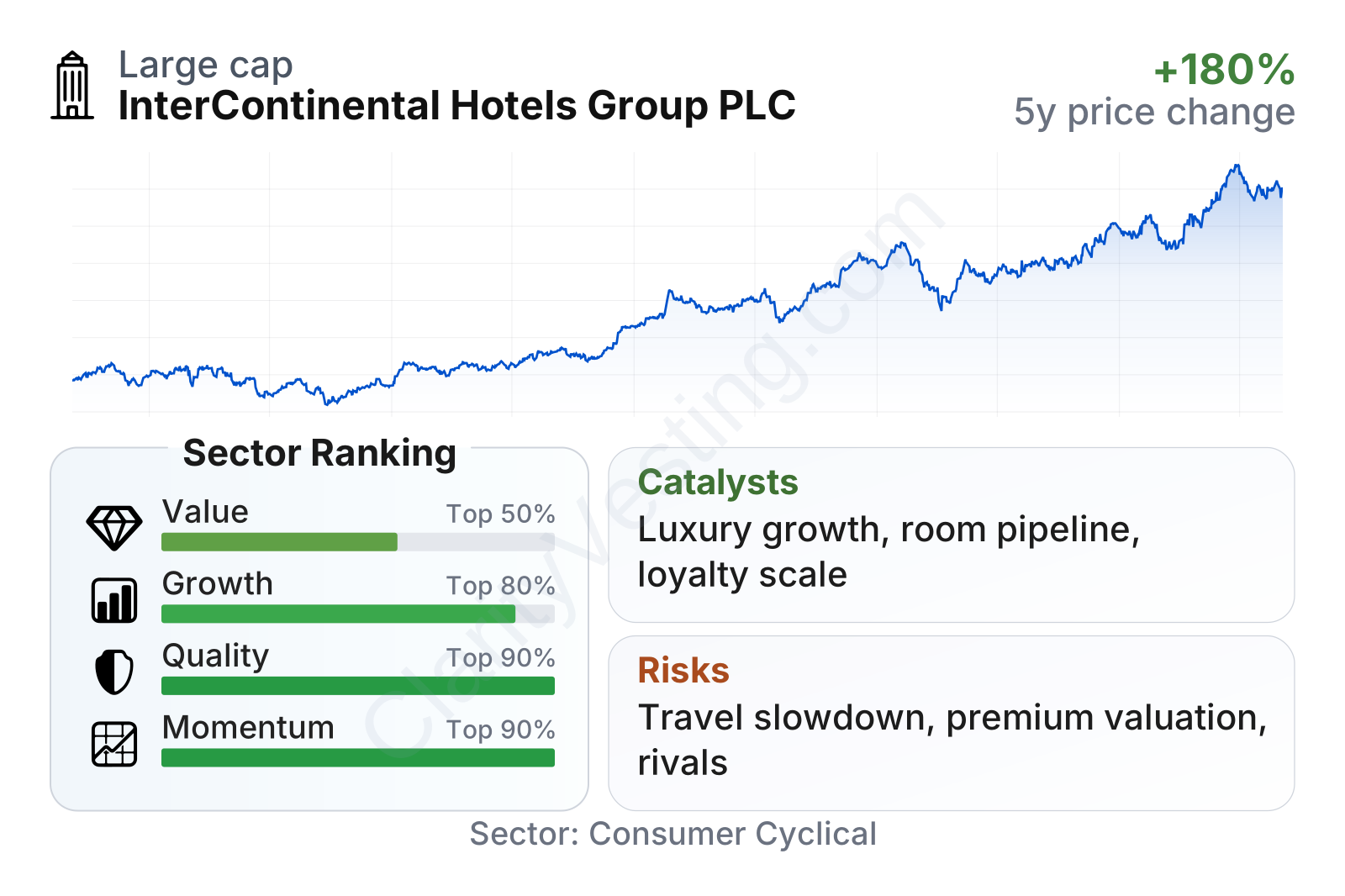
IHG is a large global lodging company with market value in the tens of billions of dollars and a share price pattern that has been very strong over the last three years. In the factor table, quality and momentum stand out the most, with growth also ranking well above much of the sector. Profitability is clearly ahead of the industry median, while valuation looks more demanding, especially on earnings multiples. The negative debt-to-equity ratio should not be read the same way as a typical industrial company’s leverage ratio; it largely reflects a balance sheet shaped by buybacks and capital returns that have pushed accounting equity below zero.
Growth
The lodging sector is structurally tied to travel demand, business activity, tourism flows, and consumer confidence. Over a long horizon, global travel has generally expanded faster than many mature consumer categories, helped by rising middle-class travel in emerging markets, more international mobility, and the long-term growth of branded accommodation. Within that sector, branded hotel groups with strong reservation systems and loyalty platforms are in a favorable position because owners often prefer established brands that can improve occupancy and pricing power.
IHG’s strategy for future growth is coherent. The company continues to lean into its asset-light model, which means signing more franchise and management contracts rather than owning many buildings. That allows room growth with lower capital intensity. It is also pushing in segments where demand appears durable: luxury and lifestyle, extended stay, and conversion brands. Luxury and lifestyle can raise fee rates and brand prestige, while extended stay can be more resilient during softer travel periods because guests tend to stay longer. Conversion brands are useful when developers are cautious, since existing hotels can switch to an IHG flag without the cost and delay of building from scratch.
Growth has normalized from the post-pandemic rebound, which is natural. Earlier periods showed very high year-over-year gains as travel recovered, while more recent increases have been much lower. That does not necessarily signal weakness on its own; it suggests IHG has moved from recovery mode back into a steadier growth phase. The stronger five-year revenue-per-share trend versus the sector indicates that the company has still compounded better than many peers over a full cycle.
Cash generation is another important part of the growth picture. Free cash flow has been strong and has improved materially from earlier years, which supports reinvestment in technology, loyalty, brand development, and shareholder distributions. For an asset-light hotel company, healthy free cash flow is often a better sign of business strength than raw revenue growth alone.
Recent company updates have also pointed to continued signings and pipeline expansion, especially in conversion-friendly and higher-end brands. Another meaningful catalyst is loyalty scale: a larger member base can improve direct bookings, reduce dependence on third-party travel platforms, and make IHG more attractive to hotel owners choosing a brand partner. In a business where each additional signed room adds recurring fee potential, pipeline momentum matters almost as much as current occupancy.
Risks
This article is for informational purposes only and does not constitute financial advice. Some content is AI-generated. See Disclaimer


