Stock Analysis · IDT Corporation (IDT)
Overview
IDT Corporation is a diversified communications and payments company that has gradually shifted away from being just a traditional telecom reseller. Today, it operates a mix of mature cash-generating services and younger growth businesses. Its activities include international calling and mobile top-ups, money transfer, cloud-based communications, and national infrastructure used to exchange text messages and voice traffic between telecom networks.
The business is organized into several reporting segments. Based on the latest annual filing for fiscal 2025, revenue is still led by legacy communications services, while newer platforms contribute a smaller share of sales but are increasingly important for profits and future positioning.
- Fintech segment — about 73% of revenue: mainly National Retail Solutions and BOSS Money. National Retail Solutions provides point-of-sale software, payment services, advertising, and merchant tools to independent retailers, while BOSS Money handles remittances and related payment transactions.
- Global segment — about 21% of revenue: includes international long-distance calling, mobile airtime top-up, and related communications services sold under brands such as BOSS Revolution.
- net2phone segment — about 5% of revenue: unified communications as a service for businesses, including cloud phone systems and collaboration tools.
- Traditional Communications segment — about 1% of revenue: mainly messaging and voice interconnection services such as international SMS and carrier-related telecom traffic.
That revenue mix can be misleading at first glance. Lower-margin transaction businesses account for most sales, while higher-value software and communications platforms can matter more to earnings than their revenue share suggests. Over the last few years, IDT has also improved its overall economics: gross profit has risen even while total revenue has stayed relatively flat, showing a favorable shift toward better-margin activities and tighter control of direct costs.
The company’s recent financial flow highlights that pattern: revenue has been broadly steady, cost of revenue has trended down, gross profit has expanded, and operating income has improved materially. In other words, the business mix appears to be getting better even without dramatic top-line acceleration.
Key Figures
| Metric | Value | Sector ⓘ |
|---|---|---|
| Date | Sep 12, 2026 | |
| Context | ||
| Sector | Communication Services | |
| Industry | Telecom Services | |
| Market Cap ⓘ | $1.75B | |
| Beta ⓘ | 0.62 | |
Value (Cheapness) | ||
| P/E Ratio ⓘ | 21.63 | 18.61 |
| FCF Yield ⓘ | 3.16% | 13.68% |
| EBIT / EV ⓘ | 7.75% | 4.54% |
| PEG ⓘ | 1.42 | |
Growth (Business expansion) | ||
| Revenue Growth ⓘ | 4.50% | 5.40% |
| RPS Growth (5Y CAGR) ⓘ | -3.24% | 4.62% |
| EPS Growth (5Y CAGR) ⓘ | 26.92% | -18.01% |
| Margin Growth (5Y Trend) ⓘ | 4.97% | 1.10% |
| FCF Growth (5Y CAGR) ⓘ | 20.84% | 5.88% |
Quality (Business durability) | ||
| ROIC (Latest) ⓘ | 26.94% | 8.38% |
| ROIC (5Y Median) ⓘ | 29.52% | 8.32% |
| Net Debt / EBIT (Latest) ⓘ | -1.87 | 1.99 |
| Net Debt / EBIT (5Y Median) ⓘ | -1.93 | 2.94 |
| Operating Margin (Latest) ⓘ | 8.96% | 14.89% |
| Operating Margin (5Y Median) ⓘ | 5.00% | 12.96% |
| Debt to Equity (Latest) ⓘ | 0.17% | 59.59% |
| Profit Margin (Latest) ⓘ | 6.41% | 8.77% |
| Free Cash Flow (Latest) ⓘ | $55.33M | |
Momentum (Price trend) | ||
| 3Y Return ⓘ | +207.72% | +46.64% |
| 12M Return (excl. last month) ⓘ | +7.36% | +2.16% |
| 6M Return ⓘ | +43.83% | +5.05% |
| Price vs. 200-Day MA ⓘ | +28.88% | +2.88% |
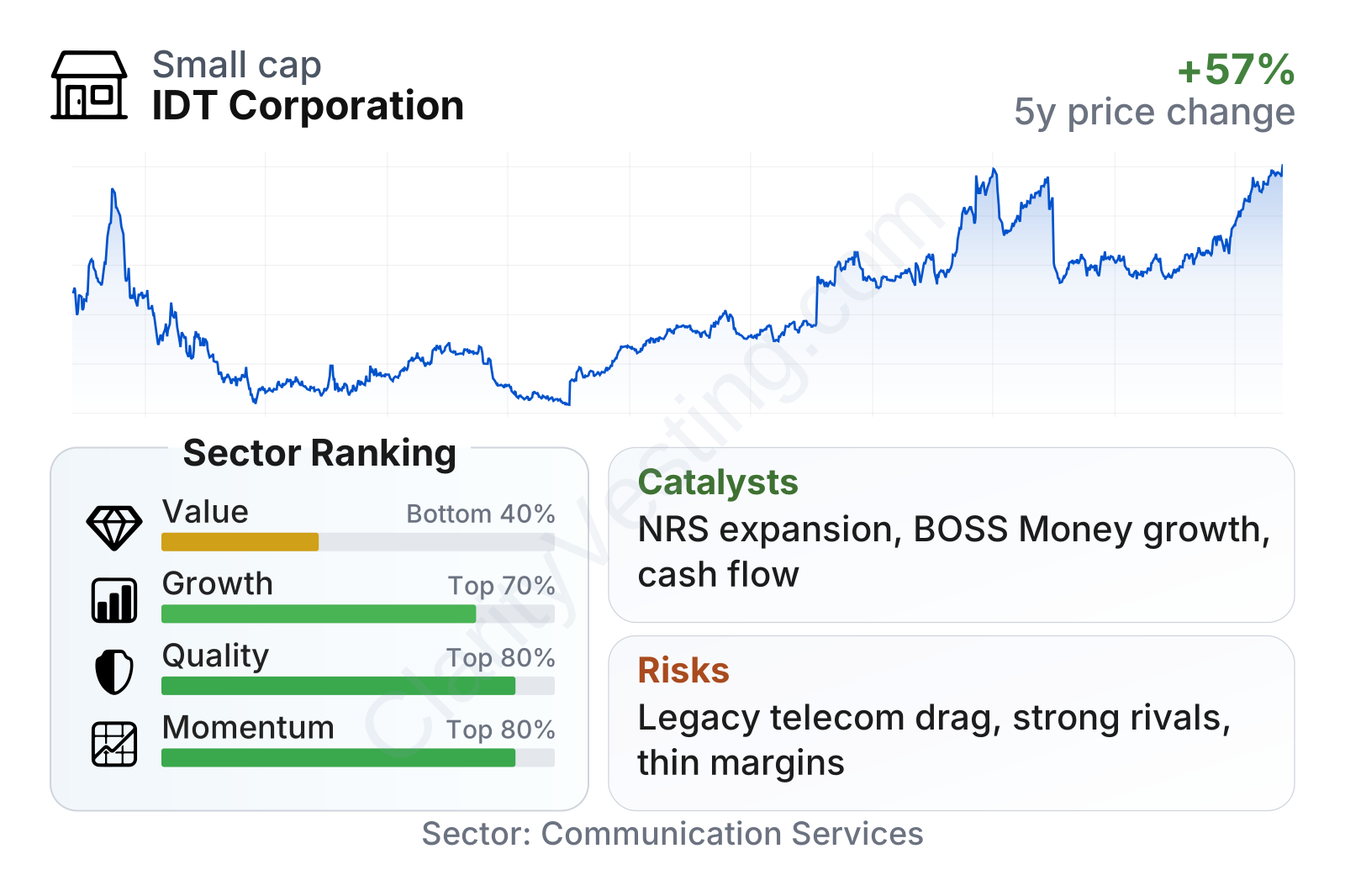
IDT is a mid-sized company with relatively low share-price volatility, as shown by a beta well below 1. Its quality profile stands out more than its value profile: returns on invested capital are far above the sector median, leverage is exceptionally low, and free cash flow is positive. Growth metrics are mixed on revenue but stronger on earnings and cash generation, suggesting the company has become more efficient even if sales growth has not always been fast. Recent market momentum has also been notably stronger than the broader sector.
Growth
IDT operates in parts of the communications and financial technology markets that still offer room for expansion, but not all of its businesses are equally attractive. Legacy international calling is a mature activity with long-term pressure from internet-based alternatives. By contrast, merchant software and payment services for independent retailers, digital remittances, and cloud communications are more structurally promising categories.
The clearest part of the growth case is the company’s strategy of using mature telecom cash flows to support newer platforms. National Retail Solutions is building an ecosystem around small neighborhood stores, combining point-of-sale systems with payments, advertising, and merchant services. That can create recurring revenue and stronger customer retention over time. BOSS Money gives IDT exposure to cross-border remittances, a large market that continues to digitize. net2phone places the company in cloud business communications, where customers are still moving away from on-premise phone systems.
Revenue growth has gone through a visible reset. After a period of contraction, the trend turned positive again and has recently settled into low- to mid-single-digit growth. That is not exceptional for the sector, but the direction matters: it suggests the business has moved from shrinkage toward stabilization and modest expansion.
Cash generation has improved more dramatically than revenue. Free cash flow has climbed sharply, with the latest trailing figure far above the levels seen a few years ago. That usually signals improving unit economics, stronger working capital discipline, or a better segment mix. For a company like IDT, this matters because internally generated cash gives management more flexibility to invest in growth platforms without depending heavily on external financing.
A notable catalyst in recent periods has been the continuing buildout of National Retail Solutions and the broader fintech ecosystem around it. Another is the company’s ability to keep lifting profit from a relatively stable revenue base. If that continues, earnings growth may remain stronger than sales growth. The company has also maintained active capital returns through dividends and special distributions in past periods, which reflects balance sheet strength, although that is secondary to the operating thesis.
Risks
This article is for informational purposes only and does not constitute financial advice. Some content is AI-generated. See Disclaimer


