Stock Analysis · InterDigital Inc (IDCC)
Overview
InterDigital is a technology licensing company focused on wireless, video, and related connected-device innovation. In simple terms, it funds research, develops patented technologies used in standards such as cellular and video compression, and then earns money by licensing those patents to companies that make smartphones, consumer electronics, connected cars, and other devices. This means InterDigital is not primarily a mass-market hardware brand; its business model is built around intellectual property.
The company’s revenue is mainly tied to patent licenses and agreements signed with manufacturers and technology companies. Based on recent annual disclosures, the business is heavily concentrated in recurring and catch-up patent licensing revenue, with a smaller contribution from technology solutions and services.
- Recurring patent royalties and fixed-fee license revenue: approximately 70% to 80% of annual revenue in recent periods. This includes ongoing payments under signed patent license agreements covering wireless and video technologies.
- Past sales, catch-up, and renewal-related license revenue: approximately 15% to 25%. This can include one-time recognition tied to new deals, renewals, or settlements that cover earlier periods.
- Technology solutions and other revenue: generally less than 10%. This includes development contracts, smaller technology offerings, and other non-core items.
That structure makes InterDigital very different from a typical software company. Its economics can be highly attractive because licensing revenue usually carries low direct costs once the patent portfolio is established, but quarterly results can also be uneven because large agreements do not arrive on a perfectly smooth schedule.
Over the last several years, the business has shown a clear improvement in scale. Revenue moved from roughly $425 million in 2021 to more than $830 million in 2025, while operating income and net income expanded even faster. Research and development remains a major use of capital, which is important because the company’s long-term value depends on continuing to create patents that remain relevant in future wireless and media standards.
The operating model has become more efficient as revenue has grown. Gross profit has stayed very high, research spending has remained substantial but controlled, and a larger share of each dollar of revenue has flowed down to operating profit and net income. That is consistent with a licensing business benefiting from scale.
Key Figures
| Metric | Value | Sector ⓘ |
|---|---|---|
| Date | Sep 12, 2026 | |
| Context | ||
| Sector | Technology | |
| Industry | Software - Application | |
| Market Cap ⓘ | $8.94B | |
| Beta ⓘ | 1.42 | |
Value (Cheapness) | ||
| P/E Ratio ⓘ | 40.00 | 29.51 |
| FCF Yield ⓘ | 6.04% | 4.25% |
| EBIT / EV ⓘ | 4.66% | 2.85% |
| PEG ⓘ | 1.32 | |
Growth (Business expansion) | ||
| Revenue Growth ⓘ | -13.40% | 15.40% |
| RPS Growth (5Y CAGR) ⓘ | 15.46% | 8.56% |
| EPS Growth (5Y CAGR) ⓘ | 16.99% | -11.88% |
| Margin Growth (5Y Trend) ⓘ | 41.62% | 0.46% |
| FCF Growth (5Y CAGR) ⓘ | 55.31% | 9.80% |
Quality (Business durability) | ||
| ROIC (Latest) ⓘ | 20.88% | 9.44% |
| ROIC (5Y Median) ⓘ | 19.94% | 8.30% |
| Net Debt / EBIT (Latest) ⓘ | -0.57 | 0.54 |
| Net Debt / EBIT (5Y Median) ⓘ | -0.45 | 0.44 |
| Operating Margin (Latest) ⓘ | 47.54% | 9.58% |
| Operating Margin (5Y Median) ⓘ | 50.84% | 8.25% |
| Debt to Equity (Latest) ⓘ | 33.40% | 33.33% |
| Profit Margin (Latest) ⓘ | 38.32% | 7.14% |
| Free Cash Flow (Latest) ⓘ | $540.33M | |
Momentum (Price trend) | ||
| 3Y Return ⓘ | +352.62% | +45.48% |
| 12M Return (excl. last month) ⓘ | +29.60% | +23.48% |
| 6M Return ⓘ | -2.91% | +20.93% |
| Price vs. 200-Day MA ⓘ | +10.08% | +7.43% |
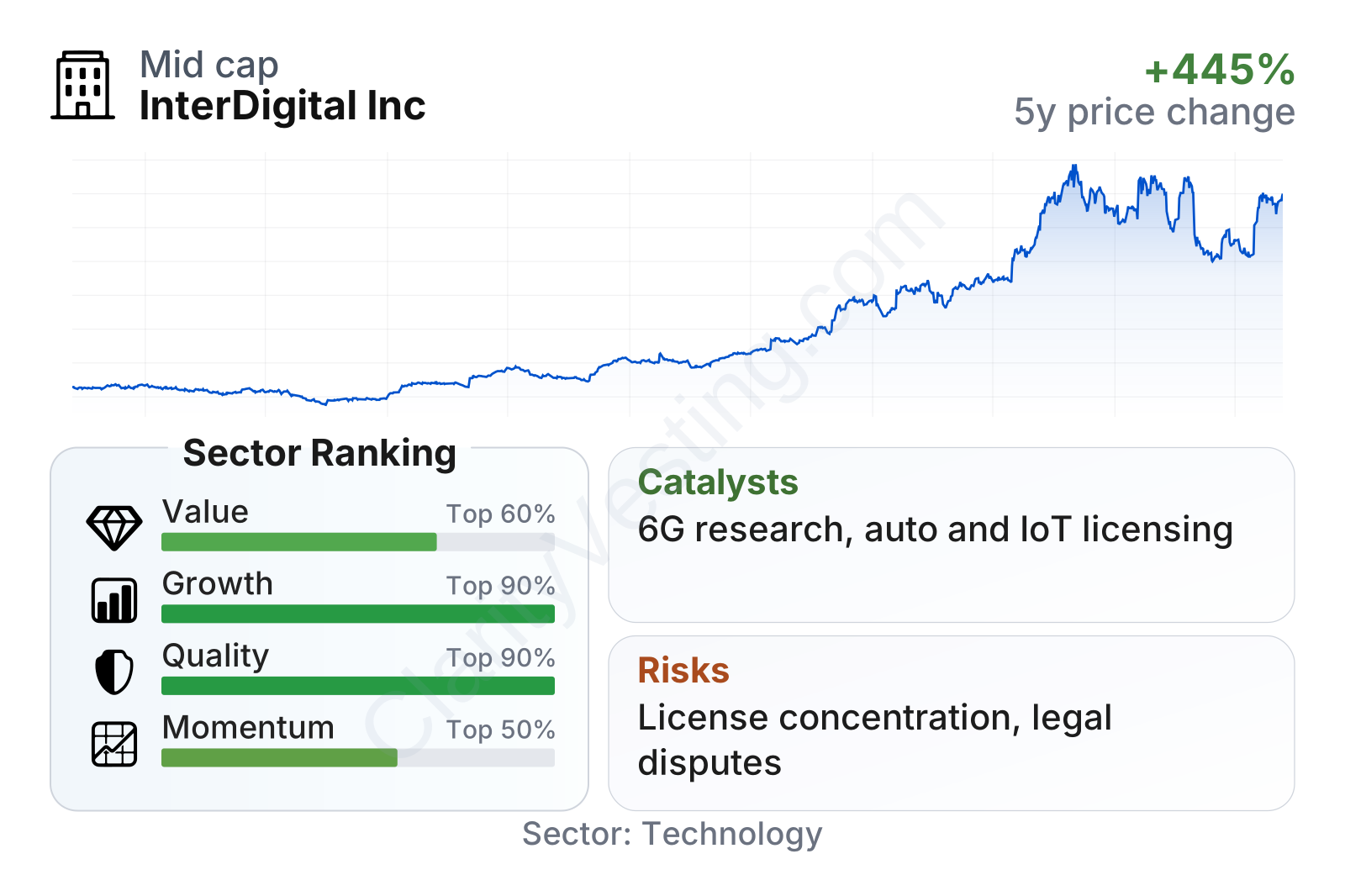
InterDigital sits in the mid-cap range, with a stock that has been more volatile than the broader market. The latest metrics point to an unusual mix: growth and quality rank very strongly versus much of the technology sector, while valuation is not especially cheap on earnings. Profitability stands out the most, with returns on invested capital, operating margin, and profit margin all well above typical sector levels. Balance sheet quality also looks solid because the company currently carries net cash relative to EBIT, even though headline debt-to-equity is close to the sector average.
The table also highlights an important nuance. Recent year-over-year revenue growth is negative, but longer-term trends remain much stronger. Over five years, revenue per share, earnings per share, margin progression, and free cash flow growth all compare favorably with the sector. In other words, short-term lumpiness is masking a business that has compounded well over a longer window.
Growth
InterDigital operates in markets that should remain structurally important for years: 5G and future 6G wireless standards, Wi‑Fi and connected-device communication, and video compression for streaming and media delivery. These are growing areas because more devices are connected, more data is consumed, and more industries are embedding wireless capability into products such as cars, industrial equipment, and consumer electronics.
The strategy is straightforward and logically consistent. InterDigital spends heavily on research, contributes inventions to global technology standards, builds patent portfolios around those inventions, and then monetizes them through licensing. If that cycle works, revenue can scale faster than operating costs, which is exactly what recent margin performance suggests. The company’s very high operating margin and strong free cash flow indicate that the model can be powerful when licensing momentum is favorable.
One point to understand is that growth will rarely look smooth. InterDigital can post very strong jumps when it signs or renews large agreements, followed by weaker periods when the comparison becomes difficult. The recent decline in year-over-year revenue therefore matters, but it should be read in the context of a licensing business rather than a steady subscription model.
Cash generation has strengthened sharply over the past few years, with trailing free cash flow rising to well above earlier levels. That matters because cash is the clearest proof that the licensing model is translating into real economic value rather than only accounting profits. It also gives the company flexibility for dividends, share repurchases, debt management, and continued patent development.
Recent company communications have emphasized progress in expanding licensing coverage across device categories and in preparing for next-generation wireless opportunities. A potentially meaningful catalyst is the broader spread of patented connectivity into markets beyond smartphones, especially automotive and the internet of things. Another is future standard-setting work tied to 6G, where early research positions can matter years before commercialization becomes visible in revenue.
Risks
This article is for informational purposes only and does not constitute financial advice. Some content is AI-generated. See Disclaimer


