Stock Analysis · Ichor Holdings Ltd (ICHR)
Overview
Ichor Holdings Ltd is a supplier to the semiconductor equipment industry. In simple terms, it builds the fluid delivery subsystems that help semiconductor manufacturing tools move and control the ultra-clean gases, chemicals, and vacuum conditions needed to make chips. These subsystems are not the headline machines that fabricate wafers, but they are essential parts inside those machines. Ichor mainly sells to large wafer-fabrication equipment makers, which then sell complete tools to chip manufacturers.
The company also has a precision machining and specialty components business through its MPM operations. That adds exposure beyond fluid handling into metal parts and complex assemblies used in semiconductor capital equipment and related high-specification applications. The business is therefore tied to the broader chip equipment spending cycle rather than to consumer electronics demand directly.
Based on the company’s recent filings, revenue is primarily organized around semiconductor-related components and subsystems rather than a wide mix of unrelated businesses. Public filings do not provide a clean percentage split for every end product line in the latest period, but the business can be summarized this way:
- Fluid delivery subsystems and related components: the large majority of revenue, likely well above 70%. This includes gas and chemical delivery assemblies, weldments, valves, regulators, and other integrated parts used in wafer-fabrication tools.
- Precision-machined components and specialty assemblies: a meaningful but smaller share, likely below 30%. This mainly comes from the MPM business and includes machined parts and complex components for semiconductor equipment customers.
- Service, spares, and other revenue: a relatively small portion. This can include replacement parts, support activities, and smaller ancillary sales.
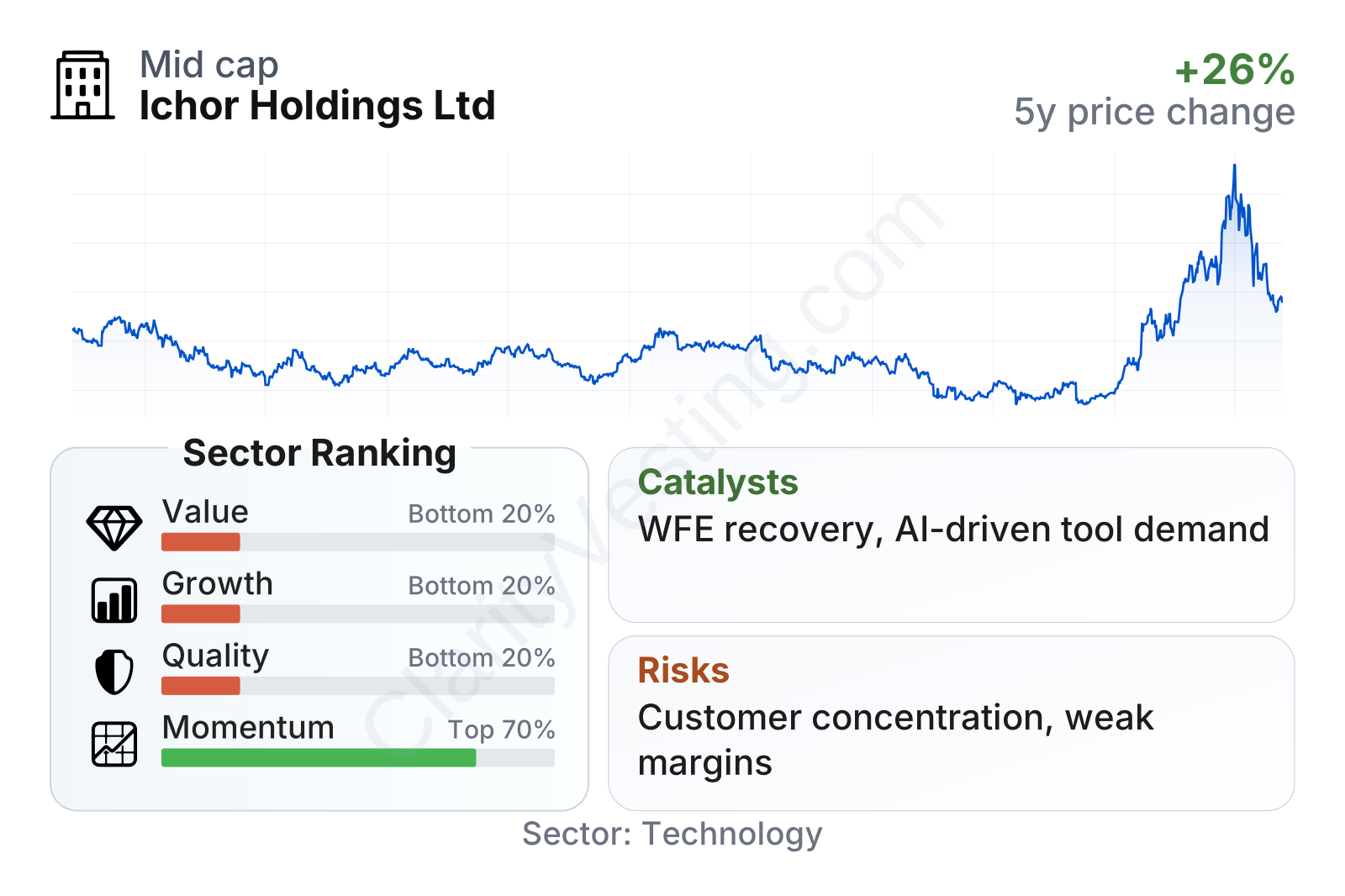
Customer concentration is an important feature of the model. Ichor’s sales depend heavily on a small number of major semiconductor equipment manufacturers, so its revenue mix is driven more by customer programs and chip-fab investment cycles than by broad retail demand.
The financial flow shows a business with high manufacturing costs and thin room for error. Revenue recovered from the 2023 downturn into 2025, but gross profit did not expand at the same pace, which helps explain why the company remained loss-making even as sales improved. Interest expense has eased and operating expenses have been managed, but margins are still under pressure.
Key Figures
| Metric | Value | Sector ⓘ |
|---|---|---|
| Date | Sep 12, 2026 | |
| Context | ||
| Sector | Technology | |
| Industry | Semiconductor Equipment & Materials | |
| Market Cap ⓘ | $2.09B | |
| Beta ⓘ | 1.81 | |
Value (Cheapness) | ||
| P/E Ratio ⓘ | N/A | 29.51 |
| FCF Yield ⓘ | -1.23% | 4.25% |
| EBIT / EV ⓘ | -1.26% | 2.85% |
| PEG ⓘ | 0.24 | |
Growth (Business expansion) | ||
| Revenue Growth ⓘ | 22.70% | 15.40% |
| RPS Growth (5Y CAGR) ⓘ | -7.52% | 8.56% |
| EPS Growth (5Y CAGR) ⓘ | -47.92% | -11.88% |
| Margin Growth (5Y Trend) ⓘ | N/A | 0.46% |
| FCF Growth (5Y CAGR) ⓘ | 3.07% | 9.80% |
Quality (Business durability) | ||
| ROIC (Latest) ⓘ | -9.22% | 9.44% |
| ROIC (5Y Median) ⓘ | -0.84% | 8.30% |
| Net Debt / EBIT (Latest) ⓘ | N/A | 0.54 |
| Net Debt / EBIT (5Y Median) ⓘ | N/A | 0.44 |
| Operating Margin (Latest) ⓘ | -2.57% | 9.58% |
| Operating Margin (5Y Median) ⓘ | -1.04% | 8.25% |
| Debt to Equity (Latest) ⓘ | 17.81% | 33.33% |
| Profit Margin (Latest) ⓘ | -3.97% | 7.14% |
| Free Cash Flow (Latest) ⓘ | -$25.61M | |
Momentum (Price trend) | ||
| 3Y Return ⓘ | +82.47% | +45.48% |
| 12M Return (excl. last month) ⓘ | +265.89% | +23.48% |
| 6M Return ⓘ | +37.73% | +20.93% |
| Price vs. 200-Day MA ⓘ | +3.94% | +7.43% |
Ichor is a mid-sized semiconductor equipment supplier with a stock that has been very volatile. The recent share-price rebound has been much stronger than most of the technology sector, which explains the very high momentum ranking. That strength contrasts with weaker fundamentals in profitability, cash generation, and returns on capital. In the latest snapshot, value, growth, and quality all rank in the bottom part of the sector, while momentum ranks near the top. That combination usually means the market is pricing in a recovery before it is fully visible in margins and cash flow.
Growth
Ichor operates in a sector with attractive long-term demand drivers. Semiconductor manufacturing keeps becoming more complex, and advanced chips require more process steps, tighter contamination control, and increasingly sophisticated tool subsystems. That structural trend supports demand for the kind of fluid delivery and precision component solutions the company makes. Growth in artificial intelligence infrastructure, high-performance computing, advanced memory, and leading-edge foundry investment all support long-term equipment demand.
The challenge is that this is not a smooth growth market. Semiconductor capital equipment spending moves in cycles. When chipmakers pause or delay fab spending, suppliers like Ichor often feel the impact quickly. That is exactly what happened during the recent downturn, when revenue fell sharply before beginning to recover.
The recent pattern is encouraging on the top line. Revenue moved from deep year-over-year declines in 2023 to renewed growth through much of 2024 and 2025, and the latest year-over-year increase is above 20%, better than the sector median. That suggests Ichor is participating in the equipment recovery rather than being left behind. However, the five-year growth record is still weak because the downturn was severe enough to offset much of the earlier expansion.
Ichor’s strategy for future growth is logical. The company is trying to deepen its role in mission-critical subsystems, expand manufacturing capacity in lower-cost regions, and broaden its precision-machining offering. If major customers launch more advanced tools or ramp new platforms, Ichor can benefit because these systems often need highly customized assemblies and close engineering collaboration. Those characteristics can make supplier relationships stickier over time.
Cash generation remains the weaker part of the recovery. Free cash flow improved dramatically from the heavy outflow seen in 2022 and turned positive in parts of the following period, but the latest trailing figure is still around break-even to slightly negative. For a manufacturing supplier in a cyclical industry, that matters because sustained positive cash flow is usually the clearest sign that volume recovery is translating into real financial strength.
A notable recent opportunity is the broader rebound in wafer-fabrication equipment demand, especially in leading-edge logic and advanced packaging-related spending. Public company updates in 2026 have also pointed to continued customer activity and sequential business improvement, which supports the view that Ichor is moving with the industry upcycle. The main catalyst is therefore not a single one-time event, but continued recovery in semiconductor tool demand and stronger content needs inside increasingly complex manufacturing equipment.
Risks
This article is for informational purposes only and does not constitute financial advice. Some content is AI-generated. See Disclaimer


