Stock Analysis · Installed Building Products Inc (IBP)
Overview
Installed Building Products is a large U.S. installer of insulation and other building products used mainly in residential construction. The company works through a broad branch network across many states and serves homebuilders, contractors, and homeowners. Its role is less about manufacturing products and more about distribution, installation, and local service execution. That makes IBP a direct way to follow activity in new home construction, repair and remodeling, and selected commercial projects.
Revenue is generated from installation services tied to a range of building products. Based on the company’s segment reporting, the business is overwhelmingly service-driven and concentrated in installation for construction end markets, with residential activity representing the core exposure. Public filings indicate insulation remains the largest product category by a wide margin, with other complementary products widening the addressable market and supporting cross-selling.
- Insulation installation: the largest source of revenue, estimated at roughly 60% to 70% of total sales. This includes fiberglass and spray foam insulation used in new homes, multifamily projects, and some commercial buildings.
- Waterproofing, fireproofing, and fire-stopping: estimated at roughly 10% to 15%. These services are used to protect structures from moisture and improve building safety compliance.
- Garage doors, rain gutters, and related exterior products: estimated at roughly 10% to 15%. These are often sold into residential new-build projects and help deepen relationships with homebuilders.
- Shower doors, closet shelving, mirrors, bath accessories, and other interior finishes: estimated at roughly 5% to 10%. These products add later-stage installation work on homes and support bundled contracts.
- Other complementary installation services: a smaller share, including items such as window blinds, door products, and adjacent specialty offerings depending on local market mix.
Over the last several years, the business has expanded steadily: revenue increased from just under $2.0 billion in 2021 to about $3.0 billion in 2025, while gross profit and operating income also moved higher. The notable point is that profit growth did not rely only on volume. Margins improved as the company scaled its branch network, added products, and kept operating income expanding faster than revenue over much of that period.
The long-term picture is one of rising sales, growing gross profit, and improving earnings conversion, even though costs still move with labor, materials, and housing activity. That combination helps explain why IBP has stood out from many smaller construction-related operators.
Key Figures
| Metric | Value | Sector ⓘ |
|---|---|---|
| Date | Sep 12, 2026 | |
| Context | ||
| Sector | Consumer Cyclical | |
| Industry | Residential Construction | |
| Market Cap ⓘ | $5.43B | |
| Beta ⓘ | 1.72 | |
Value (Cheapness) | ||
| P/E Ratio ⓘ | 21.73 | 17.10 |
| FCF Yield ⓘ | 0.74% | 8.53% |
| EBIT / EV ⓘ | 6.01% | 6.46% |
| PEG ⓘ | 1.20 | |
Growth (Business expansion) | ||
| Revenue Growth ⓘ | 2.30% | 5.75% |
| RPS Growth (5Y CAGR) ⓘ | 13.39% | 9.14% |
| EPS Growth (5Y CAGR) ⓘ | -17.72% | -18.21% |
| Margin Growth (5Y Trend) ⓘ | 3.68% | -0.23% |
| FCF Growth (5Y CAGR) ⓘ | 31.26% | 4.91% |
Quality (Business durability) | ||
| ROIC (Latest) ⓘ | 16.83% | 12.61% |
| ROIC (5Y Median) ⓘ | 18.21% | 10.72% |
| Net Debt / EBIT (Latest) ⓘ | 2.17 | 2.10 |
| Net Debt / EBIT (5Y Median) ⓘ | 1.88 | 2.32 |
| Operating Margin (Latest) ⓘ | 12.50% | 9.25% |
| Operating Margin (5Y Median) ⓘ | 13.03% | 9.64% |
| Debt to Equity (Latest) ⓘ | 187.57% | 75.78% |
| Profit Margin (Latest) ⓘ | 8.46% | 5.33% |
| Free Cash Flow (Latest) ⓘ | $40.20M | |
Momentum (Price trend) | ||
| 3Y Return ⓘ | +57.04% | +14.53% |
| 12M Return (excl. last month) ⓘ | -6.51% | +3.08% |
| 6M Return ⓘ | -24.18% | +0.55% |
| Price vs. 200-Day MA ⓘ | -21.27% | -0.54% |
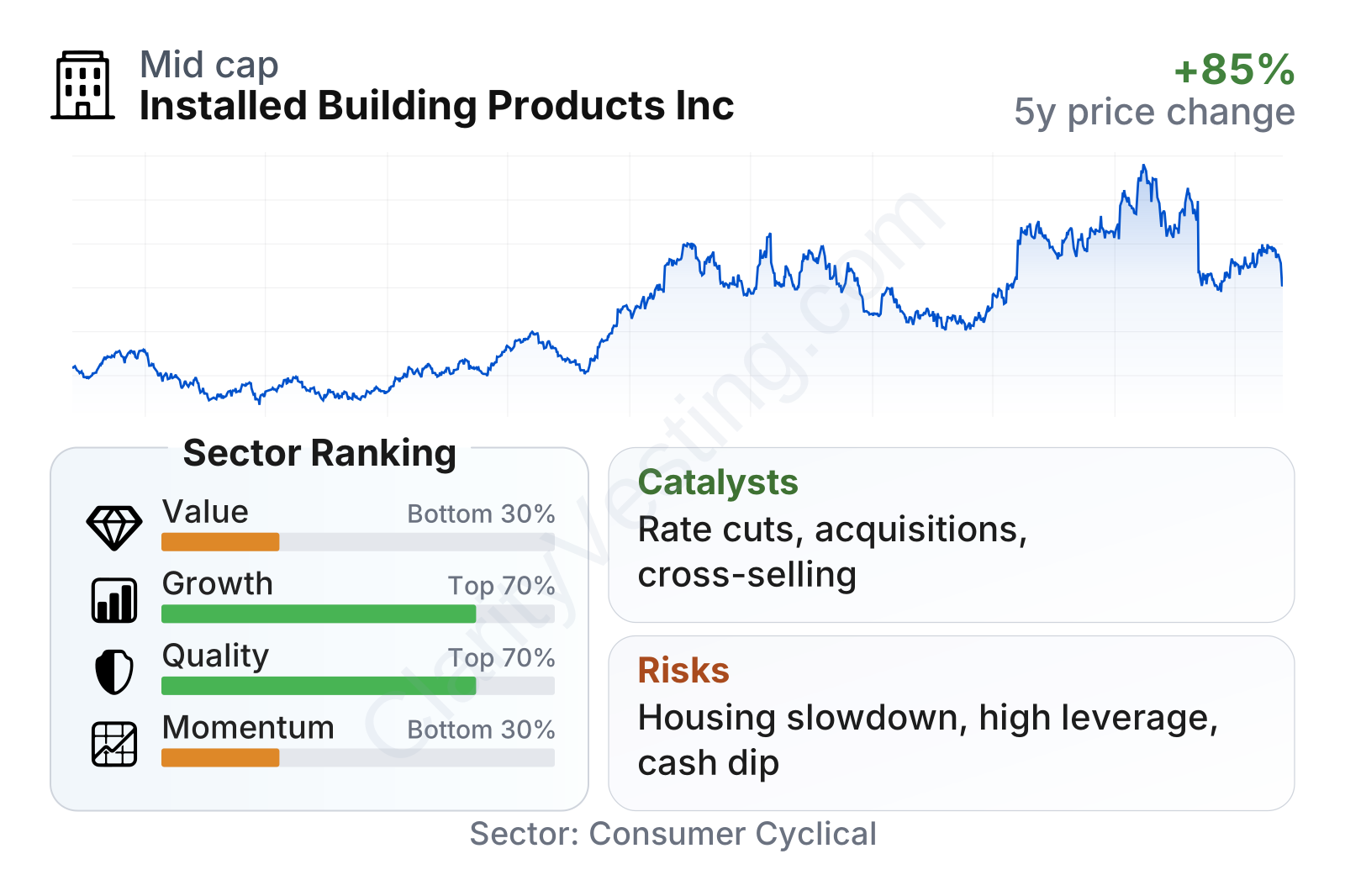
IBP is a mid-sized public company with a stock that has been more volatile than the broader market, reflected in a beta above 1.7. The table points to a mixed profile: quality and long-term growth characteristics rank relatively well versus much of the sector, while valuation looks less favorable. Profitability is clearly stronger than the sector median, and returns on invested capital are also ahead of peers. By contrast, free cash flow yield and earnings multiple suggest the market is still assigning a premium despite a more moderate recent growth pace.
The stock’s multi-year performance has been strong, but the more recent path has been less smooth. After a sharp run-up, the shares pulled back meaningfully in the latest period, which fits the company’s cyclical exposure to housing and interest-rate expectations.
Growth
IBP operates in a sector with real long-term demand drivers, but also clear cyclicality. U.S. housing still faces structural needs tied to population growth, household formation, aging housing stock, and a long-running supply shortage in many regions. On top of that, energy-efficiency standards and building-code requirements support demand for insulation and related products. These trends do not remove short-term volatility, but they do support a longer runway for companies that can execute consistently.
The company’s strategy is straightforward and sensible for this market. It builds scale through local branches, acquisitions, and cross-selling of adjacent installation services. That approach can deepen relationships with large homebuilders while also improving economics at the branch level. A contractor that already installs insulation can often add gutters, garage doors, shelving, or waterproofing on the same jobsite, increasing revenue per home without needing an entirely new customer base.
Recent growth has slowed sharply from the unusually strong expansion seen in 2021 and 2022. Year-over-year revenue growth was recently in the low single digits, and some quarters turned slightly negative. That does not necessarily signal a broken business. It mainly shows that IBP is now operating against a tougher housing backdrop after an earlier boom. More important for a long-term reading, five-year revenue per share growth remains solid, and margin trends over the same period have improved rather than deteriorated.
Cash generation deserves close attention. Free cash flow expanded strongly over the last five years, but the trailing twelve-month level has fallen sharply from earlier highs. That suggests the business is still profitable but not converting earnings into cash as easily as it did at the peak of the cycle. For a company that uses acquisitions as part of its playbook, this is an important moving piece: strong normalized cash generation supports expansion, while weaker near-term cash flow can limit flexibility.
A meaningful catalyst is any improvement in U.S. housing affordability or a decline in mortgage rates, because that could restart stronger order activity for homebuilders and eventually increase installation volumes. Another catalyst is continued acquisition activity in fragmented local markets, where IBP has a long record of adding operators and broadening its product mix. Recent company updates have also emphasized ongoing branch expansion and complementary service additions, which keep growth tied not only to housing volume but also to share gains and broader content per home.
Risks
This article is for informational purposes only and does not constitute financial advice. Some content is AI-generated. See Disclaimer


