Stock Analysis · International Business Machines (IBM)
Overview
International Business Machines, better known as IBM, is one of the oldest large technology companies in the world. Today, it is focused on enterprise technology rather than consumer products. Its main role is to help governments and large organizations run critical computer systems, manage data, automate business processes, secure information, and modernize older IT environments. IBM is especially known for hybrid cloud infrastructure, consulting services, mainframe computers, software used in large businesses, and artificial intelligence tools built around its watsonx platform.
IBM’s revenue base is diversified across software, consulting, infrastructure, and financing activities. Based on the company’s recent annual reporting structure, the largest sources of revenue are approximately:
- Software: about 43% of revenue. This includes hybrid cloud software, automation, data platforms, AI-related offerings, transaction processing software, and Red Hat.
- Consulting: about 33% of revenue. This covers business transformation, technology consulting, application operations, and help for clients moving workloads across cloud and on-premise systems.
- Infrastructure: about 19% of revenue. This includes IBM Z mainframes, distributed infrastructure, storage, and support tied to mission-critical computing environments.
- Financing and other: about 5% of revenue. This mainly includes client financing and a smaller amount of other activities.
This mix matters because IBM is no longer primarily a hardware company. Software and consulting now account for roughly three quarters of revenue, which generally supports steadier recurring sales and better margins than a business heavily dependent on one-time equipment purchases. Over the last several years, revenue and gross profit have both moved higher, while operating profit improved more sharply by 2025, suggesting that the company’s shift toward software, automation, and higher-value enterprise services has started to show up more clearly in profitability.
Key Figures
| Metric | Value | Sector ⓘ |
|---|---|---|
| Date | Sep 12, 2026 | |
| Context | ||
| Sector | Technology | |
| Industry | Information Technology Services | |
| Market Cap ⓘ | $220.48B | |
| Beta ⓘ | 0.71 | |
Value (Cheapness) | ||
| P/E Ratio ⓘ | 20.80 | 29.51 |
| FCF Yield ⓘ | 6.18% | 4.25% |
| EBIT / EV ⓘ | 4.45% | 2.85% |
| PEG ⓘ | 2.27 | |
Growth (Business expansion) | ||
| Revenue Growth ⓘ | 1.10% | 15.40% |
| RPS Growth (5Y CAGR) ⓘ | 2.94% | 8.56% |
| EPS Growth (5Y CAGR) ⓘ | -16.57% | -11.88% |
| Margin Growth (5Y Trend) ⓘ | 5.92% | 0.46% |
| FCF Growth (5Y CAGR) ⓘ | 3.82% | 9.80% |
Quality (Business durability) | ||
| ROIC (Latest) ⓘ | 13.17% | 9.44% |
| ROIC (5Y Median) ⓘ | 8.96% | 8.30% |
| Net Debt / EBIT (Latest) ⓘ | 4.70 | 0.54 |
| Net Debt / EBIT (5Y Median) ⓘ | 6.24 | 0.44 |
| Operating Margin (Latest) ⓘ | 17.90% | 9.58% |
| Operating Margin (5Y Median) ⓘ | 12.15% | 8.25% |
| Debt to Equity (Latest) ⓘ | 189.46% | 33.33% |
| Profit Margin (Latest) ⓘ | 15.52% | 7.14% |
| Free Cash Flow (Latest) ⓘ | $13.63B | |
Momentum (Price trend) | ||
| 3Y Return ⓘ | +82.40% | +45.48% |
| 12M Return (excl. last month) ⓘ | +3.13% | +23.48% |
| 6M Return ⓘ | -0.34% | +20.93% |
| Price vs. 200-Day MA ⓘ | -5.71% | +7.43% |
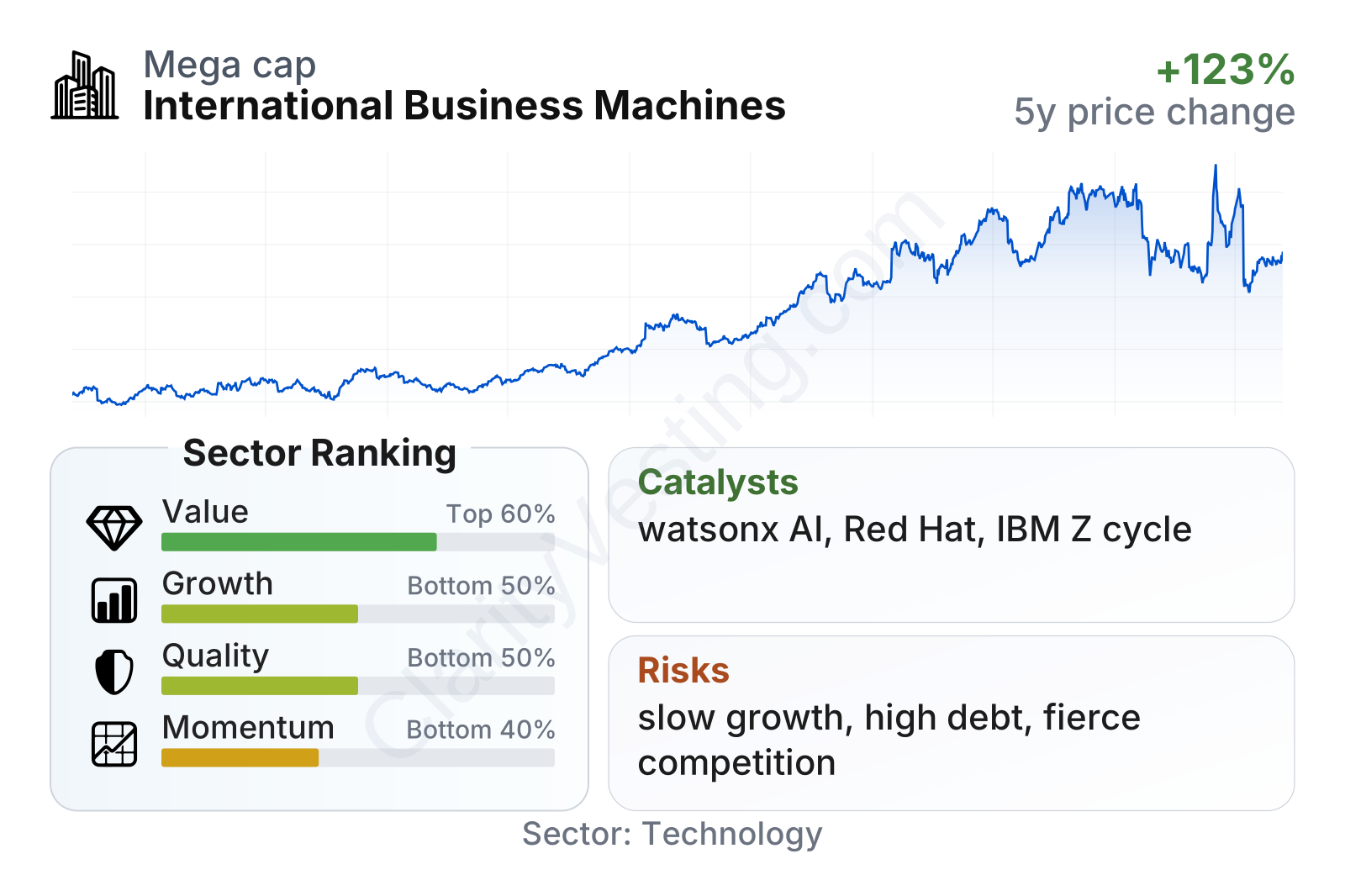
IBM is a very large technology company with relatively low share-price volatility for the sector, as shown by its beta below 1. On valuation and cash generation, the profile looks stronger than much of the technology sector: its earnings multiple is below the sector median, while free cash flow yield and operating earnings relative to enterprise value are comfortably better. The weaker point is growth. Revenue expansion has been modest compared with many technology peers, even though margins and return on invested capital remain solid. Quality is mixed: operating profitability is strong, but leverage is much higher than the sector norm.
Growth
IBM operates in several areas that are still relevant for long-term expansion, especially hybrid cloud, enterprise AI, automation, cybersecurity, and IT modernization. These are attractive markets because many large companies are not replacing all their old systems at once. Instead, they are combining existing infrastructure with cloud services and AI tools. That trend fits IBM’s positioning well. The company is not trying to dominate consumer AI or public cloud at the same scale as the biggest hyperscalers; it is targeting business customers that need secure, regulated, and integrated systems.
The strategy is coherent. Red Hat remains central because it gives IBM a bridge between traditional data centers and cloud environments. IBM is also pushing watsonx as a practical AI layer for enterprises that want to deploy models inside controlled environments, connect them to internal data, and manage governance requirements. That approach may be less visible than mass-market AI products, but it fits IBM’s historical strength in serving large institutions with complex needs.
Recent revenue growth has been uneven rather than consistently strong. After periods of flat or low-single-digit expansion, growth accelerated meaningfully through parts of 2025 before slowing again in the latest period to around 1%. That pattern suggests IBM can grow, but not yet with the sustained pace seen in faster-moving software names. For a long-term view, the more important point is whether the company can keep shifting its mix toward software and AI-related workloads, where growth and margins are usually better.
Cash generation is one of IBM’s most important growth supports. Free cash flow has remained high in recent years and sits in the low teens of billions of dollars on a trailing basis. That gives the company room to fund research, maintain infrastructure platforms, support acquisitions when needed, and manage debt. It also reduces the pressure to chase growth at any cost. In a business transition, that financial flexibility matters.
A notable catalyst is the current enterprise focus on generative AI adoption with governance, security, and integration built in. IBM has been emphasizing exactly those requirements. Another potential boost comes from the cyclical nature of its mainframe business: new IBM Z product cycles can create stronger infrastructure demand, and those systems often pull through software and services revenue as well. Recent company communications have also highlighted expanding AI-related bookings and deeper integration of AI tools across consulting and software offerings, which supports the idea that IBM is trying to monetize AI in practical enterprise use cases rather than relying on broad hype alone.
Risks
This article is for informational purposes only and does not constitute financial advice. Some content is AI-generated. See Disclaimer


