Stock Analysis · IAC Inc (IAC)
Overview
IAC Inc is a holding company that builds, operates, and reshapes internet businesses. Over time, it has bought, developed, spun off, and sold digital companies across categories such as online publishing, services marketplaces, and software. Today, the group is much more concentrated than it was a few years ago, with its largest operating asset being Dotdash Meredith, a digital publishing and advertising business built around brands in categories such as lifestyle, food, health, finance, and home. IAC also owns Care.com, which focuses on family care and caregiving services, and it holds stakes in other businesses and investments.
That structure matters for long-term analysis because IAC is not a simple one-product company. Its results depend on both the performance of its main operating subsidiaries and management’s capital allocation decisions, including acquisitions, sales, restructurings, and spin-offs. This can create upside if management redeploys capital well, but it also makes the business harder to evaluate than a typical single-brand internet company.
Based on recent company reporting, IAC’s revenue is mainly generated from the following areas:
- Dotdash Meredith: approximately 80% to 90% of total revenue. This includes digital advertising, print advertising, licensing, performance marketing, and consumer-related revenue across media brands.
- Care.com: approximately 10% to 15% of total revenue. This includes subscriptions and marketplace-related revenue tied to finding caregivers and care-related services.
- Search, emerging businesses, and other: a small remaining share. This bucket can include smaller operating businesses, early-stage operations, and corporate items depending on the reporting period.
The broad financial flow also shows a business that still produces solid gross profit, but has struggled to convert that consistently into durable bottom-line earnings in recent years. Revenue has come down sharply from its 2022 peak, and operating results have been uneven as the company has restructured and simplified its portfolio.
IAC’s financial profile has become smaller and more focused over time. Revenue has moved down materially since 2022, while gross profit has remained meaningful. The bigger issue has been inconsistent operating income and net income, showing that scale alone has not translated into steady profitability.
Key Figures
| Metric | Value | Sector ⓘ |
|---|---|---|
| Date | Aug 07, 2026 | |
| Context | ||
| Sector | Communication Services | |
| Industry | Internet Content & Information | |
| Market Cap ⓘ | $3.14B | |
| Beta ⓘ | 1.05 | |
Value (Cheapness) | ||
| P/E Ratio ⓘ | 25.91 | 18.46 |
| FCF Yield ⓘ | 1.81% | 12.35% |
| EBIT / EV ⓘ | 9.10% | 4.13% |
| PEG ⓘ | 12.91 | |
Growth (Business expansion) | ||
| Revenue Growth ⓘ | -12.20% | 6.10% |
| RPS Growth (5Y CAGR) ⓘ | -6.46% | 4.84% |
| EPS Growth (5Y CAGR) ⓘ | -50.38% | -19.26% |
| Margin Growth (5Y Trend) ⓘ | N/A | 1.50% |
| FCF Growth (5Y CAGR) ⓘ | -1.04% | 5.47% |
Quality (Business durability) | ||
| ROIC (Latest) ⓘ | -10.58% | 8.77% |
| ROIC (5Y Median) ⓘ | -0.78% | 8.00% |
| Net Debt / EBIT (Latest) ⓘ | 0.94 | 1.77 |
| Net Debt / EBIT (5Y Median) ⓘ | N/A | 2.94 |
| Operating Margin (Latest) ⓘ | 14.56% | 15.48% |
| Operating Margin (5Y Median) ⓘ | -2.85% | 13.19% |
| Debt to Equity (Latest) ⓘ | 31.22% | 58.09% |
| Profit Margin (Latest) ⓘ | 1.75% | 9.09% |
| Free Cash Flow (Latest) ⓘ | $56.85M | |
Momentum (Price trend) | ||
| 3Y Return ⓘ | -11.27% | +34.80% |
| 12M Return (excl. last month) ⓘ | +27.92% | +4.29% |
| 6M Return ⓘ | +16.98% | 0.00% |
| Price vs. 200-Day MA ⓘ | +12.01% | +1.49% |
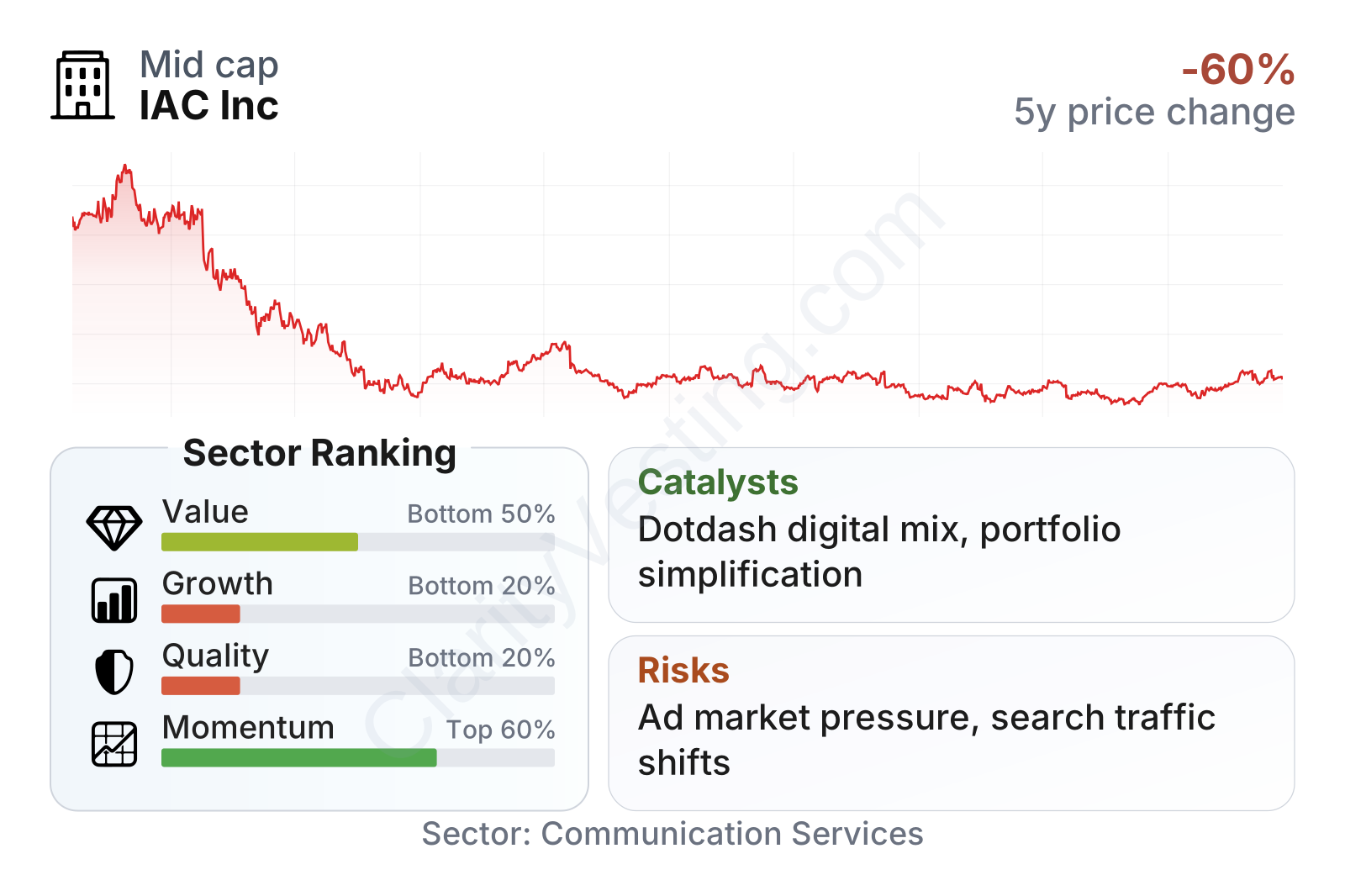
IAC is now a mid-sized internet and media company with stock volatility close to the broader market. The overall factor picture is mixed: recent price momentum has improved, but value, growth, and quality metrics still rank in the weaker part of the sector. In practical terms, the market appears to be recognizing some stabilization, while the underlying business still shows limited consistency compared with many peers.
The share price history reflects that tension. After trading above $100 in 2021, the stock fell sharply during the reset in digital media and internet valuations, then spent the last few years moving in a much lower range. More recently, the rebound toward 2026 suggests sentiment has improved, but the stock remains far below prior highs, showing that the market is still cautious about the company’s long-term earnings power.
Growth
IAC operates in segments that are still relevant for long-term digital demand, but not all of them are in fast-growth territory. Digital advertising remains a large and attractive market over time, and online services marketplaces such as caregiving can also expand as consumer behavior keeps shifting online. The challenge is that IAC’s main exposure today is not to the fastest-growing corners of the internet. Digital publishing is a real business with scale, but it is mature, highly competitive, and exposed to advertising cycles, search engine traffic changes, and platform dependence.
The company’s strategy still has a logical growth angle. Management has historically tried to improve assets operationally, streamline costs, and unlock value through corporate actions. For IAC today, the main growth question is less about launching a completely new giant business and more about whether Dotdash Meredith can grow digital revenue efficiently, improve monetization, and offset pressure in legacy print-related activities, while Care.com expands subscriptions and service penetration.
The recent revenue trend is the weakest part of the current picture. Year-over-year growth has been negative for an extended period, including a particularly sharp contraction through parts of 2024 and another notable decline entering 2026. That does not automatically rule out a turnaround, but it does mean the market is still waiting for proof that the company can return to sustained expansion.
Cash generation gives a slightly better signal than revenue alone. Free cash flow swung from negative territory to a strong recovery, although the latest trailing figure is well below the prior peak. This suggests IAC can still produce cash when operations stabilize, but the level is not yet strong enough to fully offset concerns about the uneven revenue base and profitability.
A meaningful catalyst is the ongoing transition of Dotdash Meredith toward a more digital and efficiency-focused model. If management can keep reducing lower-quality revenue exposure and strengthen higher-margin digital advertising and affiliate-style monetization, earnings could improve even without rapid top-line growth. Another catalyst is capital allocation: because IAC has a long history of restructuring and portfolio moves, asset sales, spin-offs, or further simplification could materially change how the market values the company.
Recent company updates have also pointed to operational streamlining and balance-sheet discipline rather than aggressive expansion. That can be constructive for future returns on capital, but it places more weight on execution. In short, the growth case exists, but at this stage it looks more like a turnaround and optimization case than a straightforward high-growth platform.
Risks
This article is for informational purposes only and does not constitute financial advice. Some content is AI-generated. See Disclaimer


