Stock Analysis · MarineMax Inc (HZO)
Overview
MarineMax Inc. is a large recreational boat and yacht retailer in the United States. The company sells new and used boats, arranges financing and insurance, provides maintenance and repair services, sells parts and accessories, and supports customers with marina, storage, and related yachting services. Through acquisitions over time, MarineMax has expanded beyond traditional boat dealerships into superyacht brokerage, marinas, and higher-end boating services.
Its business is still centered on selling boats, but the company has been building a broader ecosystem around boat ownership. That matters because recurring activities such as service, storage, finance commissions, and marina-related operations can be steadier than boat sales alone, which tend to move with consumer confidence and interest rates.
Based on recent annual filings, MarineMax’s revenue mix is dominated by boat sales, with a smaller contribution from services and other activities. The broad revenue sources can be summarized as follows:
- New and used boat sales: approximately 85% to 90% of revenue. This includes premium recreational boats, cruisers, fishing boats, and yachts sold through its dealership network.
- Finance and insurance, service, repair, parts, accessories, storage, marina, and other: approximately 10% to 15% of revenue combined. These activities include maintenance work, brokerage support, commissions on financing and insurance, and ownership-related services.
The business has meaningful scale for a specialty retailer, but it remains tied to discretionary spending. In recent years, revenue held at a high level after the post-pandemic boating boom, while profitability came under pressure as financing costs rose and demand normalized.
The business mix shows a clear pattern: revenue remained above $2 billion in recent years, but more of that revenue has been absorbed by operating costs and interest expense. Gross profit stayed relatively solid, yet net income fell sharply as selling costs stayed elevated and borrowing costs increased.
Key Figures
| Metric | Value | Sector ⓘ |
|---|---|---|
| Date | Sep 12, 2026 | |
| Context | ||
| Sector | Consumer Cyclical | |
| Industry | Specialty Retail | |
| Market Cap ⓘ | $1.15B | |
| Beta ⓘ | 1.67 | |
Value (Cheapness) | ||
| P/E Ratio ⓘ | 326.31 | 17.10 |
| FCF Yield ⓘ | 15.44% | 8.53% |
| EBIT / EV ⓘ | 3.20% | 6.46% |
| PEG ⓘ | 1.09 | |
Growth (Business expansion) | ||
| Revenue Growth ⓘ | -7.00% | 5.75% |
| RPS Growth (5Y CAGR) ⓘ | 3.79% | 9.14% |
| EPS Growth (5Y CAGR) ⓘ | -50.65% | -18.21% |
| Margin Growth (5Y Trend) ⓘ | -8.68% | -0.23% |
| FCF Growth (5Y CAGR) ⓘ | -56.95% | 4.91% |
Quality (Business durability) | ||
| ROIC (Latest) ⓘ | 2.43% | 12.61% |
| ROIC (5Y Median) ⓘ | 10.50% | 10.72% |
| Net Debt / EBIT (Latest) ⓘ | 13.99 | 2.10 |
| Net Debt / EBIT (5Y Median) ⓘ | 4.44 | 2.32 |
| Operating Margin (Latest) ⓘ | 3.04% | 9.25% |
| Operating Margin (5Y Median) ⓘ | 8.39% | 9.64% |
| Debt to Equity (Latest) ⓘ | 116.52% | 75.78% |
| Profit Margin (Latest) ⓘ | 0.18% | 5.33% |
| Free Cash Flow (Latest) ⓘ | $178.02M | |
Momentum (Price trend) | ||
| 3Y Return ⓘ | +63.98% | +14.53% |
| 12M Return (excl. last month) ⓘ | +109.69% | +3.08% |
| 6M Return ⓘ | +98.14% | +0.55% |
| Price vs. 200-Day MA ⓘ | +60.32% | -0.54% |
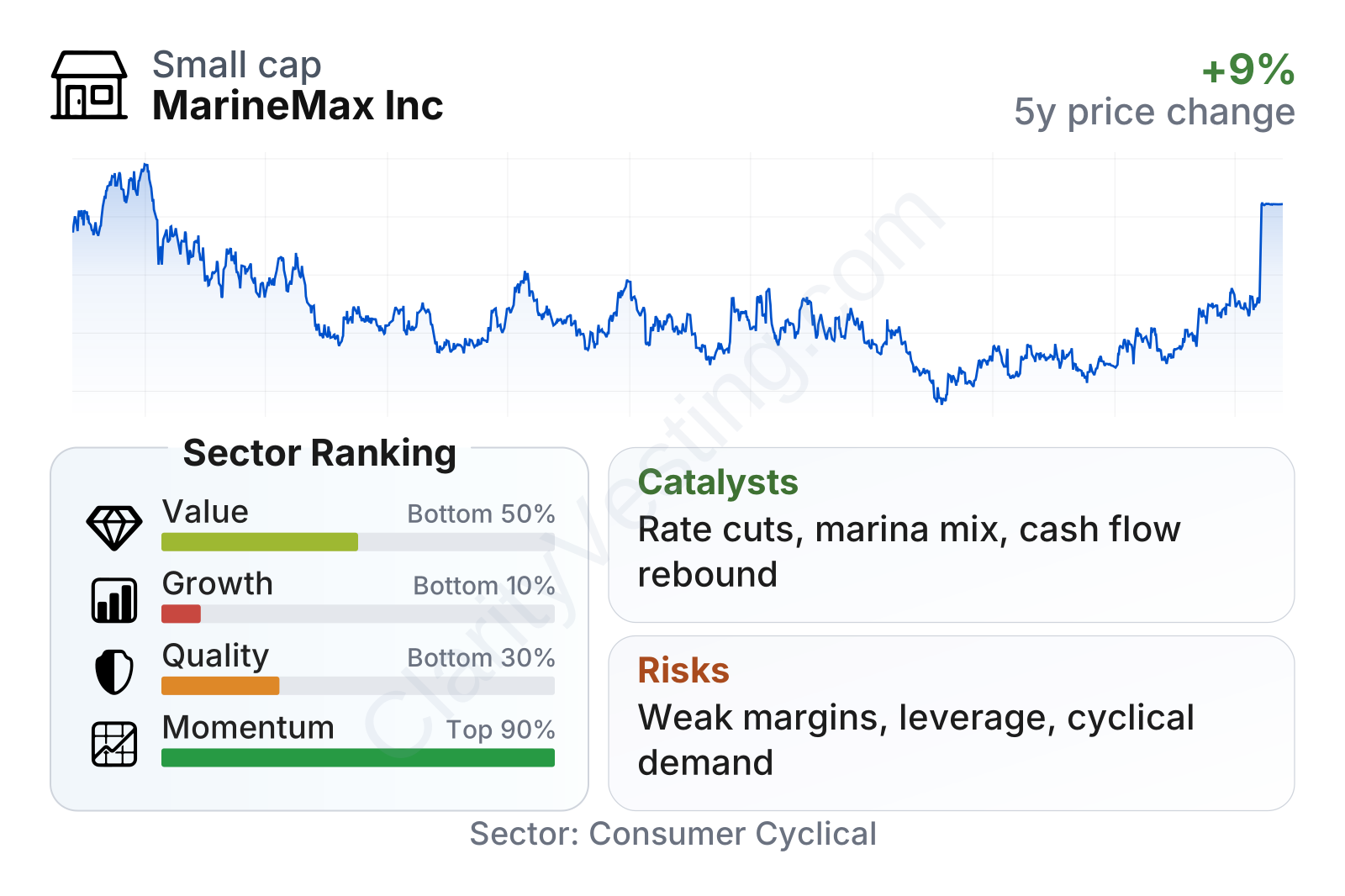
MarineMax is a mid-sized public company with a stock that has been notably volatile, as shown by its high beta. The latest factor breakdown is mixed. Value signals are inconsistent because free cash flow yield looks strong, but earnings-based valuation is distorted by very weak recent profits. Quality and growth currently rank below much of the sector, mainly because margins, returns on capital, and earnings trends have weakened. Momentum stands out as the strongest area, reflecting a sharp rebound in the share price over the last several months and over the past three years.
Growth
MarineMax operates in a sector that can grow over long periods, but not in a straight line. Recreational boating benefits from long-term drivers such as high-income consumer spending, marine tourism, marina scarcity in desirable coastal markets, and demand for experiences rather than only physical goods. Still, this is a cyclical market, and annual results can swing significantly with interest rates, consumer sentiment, and inventory conditions.
The company’s strategy makes practical sense for long-term expansion because it is not relying only on selling more boats. Management has spent years adding adjacent services, premium brands, marina assets, and superyacht capabilities. That broader platform can deepen customer relationships and increase revenue earned from each owner over time. It also gives MarineMax exposure to wealthier customers, who are often more resilient than mass-market buyers during softer economic periods.
Recent sales growth has been uneven. After strong gains earlier in the cycle, year-over-year revenue turned negative in several recent periods, including a decline of roughly 7% on the latest reading. That places MarineMax well below the sector median on recent growth and shows that demand has not fully stabilized yet.
Cash generation has improved materially after several weak periods. Free cash flow moved back into solidly positive territory over the trailing twelve months, which is an encouraging sign because it suggests inventory, working capital, and operating discipline have improved. For a retailer in a cyclical category, recovering cash flow can matter more than a single quarter of earnings.
A meaningful catalyst is the company’s push toward higher-value and service-linked activities, especially marinas, brokerage, and premium yacht-related offerings. If demand in larger boats and affluent customer segments remains healthier than the broader market, MarineMax may be able to support revenue quality even in a slower retail environment. Another potential tailwind is any future easing in interest rates, which could improve affordability and financing demand across the boating market.
Recent company updates have also emphasized inventory management, cost actions, and a focus on balancing margins with sales volume. That is not as exciting as a new product launch, but in a cyclical retail business it can be significant: preserving cash and avoiding excess discounting can materially affect future earnings power.
Risks
This article is for informational purposes only and does not constitute financial advice. Some content is AI-generated. See Disclaimer


