Stock Analysis · Hyliion Holdings Corp (HYLN)
Overview
Hyliion Holdings Corp is an energy technology company focused on power generation rather than traditional auto parts, despite its stock-market industry classification. After earlier efforts in electrified trucking, the company has repositioned around the KARNO generator, a fuel-agnostic power system designed to produce electricity for uses such as stationary prime power, backup power, EV charging, and potentially mobile applications. The core idea is to offer cleaner and more flexible on-site electricity using a system that can run on multiple fuels, including natural gas and hydrogen blends, while aiming for high efficiency and lower maintenance.
At this stage, Hyliion is still in the commercialization phase, so its revenue base remains small and uneven. Recent filings show that sales are not yet coming from a broad, mature installed base. Revenue has mainly been generated from limited product-related activity and development work tied to its technology platform, while the company continues to spend heavily on engineering, testing, and market entry.
The available disclosures do not provide a stable segment breakdown with precise recurring percentages for a mature business mix. Based on recent reporting, the revenue picture is best understood as follows:
- Early product and system-related revenue: the largest identifiable source, tied to initial commercialization activity around Hyliion’s power-generation platform.
- Engineering and development-related activity: smaller and less predictable contributions connected to technical collaboration or pre-commercial work.
- Legacy or other minor revenue streams: limited residual activity from earlier business lines, now far less central than the KARNO strategy.
What stands out more clearly than revenue mix is the company’s cost structure. Over the last several years, operating expenses have remained far above sales, but spending has come down materially from earlier peaks. Research and development once dominated the expense base, and while it is still important, Hyliion has reduced total operating costs substantially as it moved from broader experimentation toward a narrower commercialization plan.
The broad financial pattern is simple: revenue is still very small, gross profit has only recently approached break-even territory in some periods, and losses remain driven mainly by operating expenses rather than debt costs.
The operating picture has improved compared with the company’s earlier years, mostly because expenses have been cut sharply. That said, the business is still defined by a very large gap between commercialization ambition and current sales scale.
Key Figures
| Metric | Value | Sector ⓘ |
|---|---|---|
| Date | Sep 12, 2026 | |
| Context | ||
| Sector | Consumer Cyclical | |
| Industry | Auto Parts | |
| Market Cap ⓘ | $725.10M | |
| Beta ⓘ | 3.56 | |
Value (Cheapness) | ||
| P/E Ratio ⓘ | N/A | 17.10 |
| FCF Yield ⓘ | -7.81% | 8.53% |
| EBIT / EV ⓘ | -7.86% | 6.46% |
| PEG ⓘ | N/A | |
Growth (Business expansion) | ||
| Revenue Growth ⓘ | 226.30% | 5.75% |
| RPS Growth (5Y CAGR) ⓘ | 103.22% | 9.14% |
| EPS Growth (5Y CAGR) ⓘ | -39.97% | -18.21% |
| Margin Growth (5Y Trend) ⓘ | N/A | -0.23% |
| FCF Growth (5Y CAGR) ⓘ | -4.04% | 4.91% |
Quality (Business durability) | ||
| ROIC (Latest) ⓘ | -20.32% | 12.61% |
| ROIC (5Y Median) ⓘ | -20.44% | 10.72% |
| Net Debt / EBIT (Latest) ⓘ | N/A | 2.10 |
| Net Debt / EBIT (5Y Median) ⓘ | N/A | 2.32 |
| Operating Margin (Latest) ⓘ | -564.35% | 9.25% |
| Operating Margin (5Y Median) ⓘ | -7281.91% | 9.64% |
| Debt to Equity (Latest) ⓘ | 1.80% | 75.78% |
| Profit Margin (Latest) ⓘ | N/A | 5.33% |
| Free Cash Flow (Latest) ⓘ | -$56.62M | |
Momentum (Price trend) | ||
| 3Y Return ⓘ | +227.42% | +14.53% |
| 12M Return (excl. last month) ⓘ | +172.41% | +3.08% |
| 6M Return ⓘ | +104.02% | +0.55% |
| Price vs. 200-Day MA ⓘ | +36.95% | -0.54% |
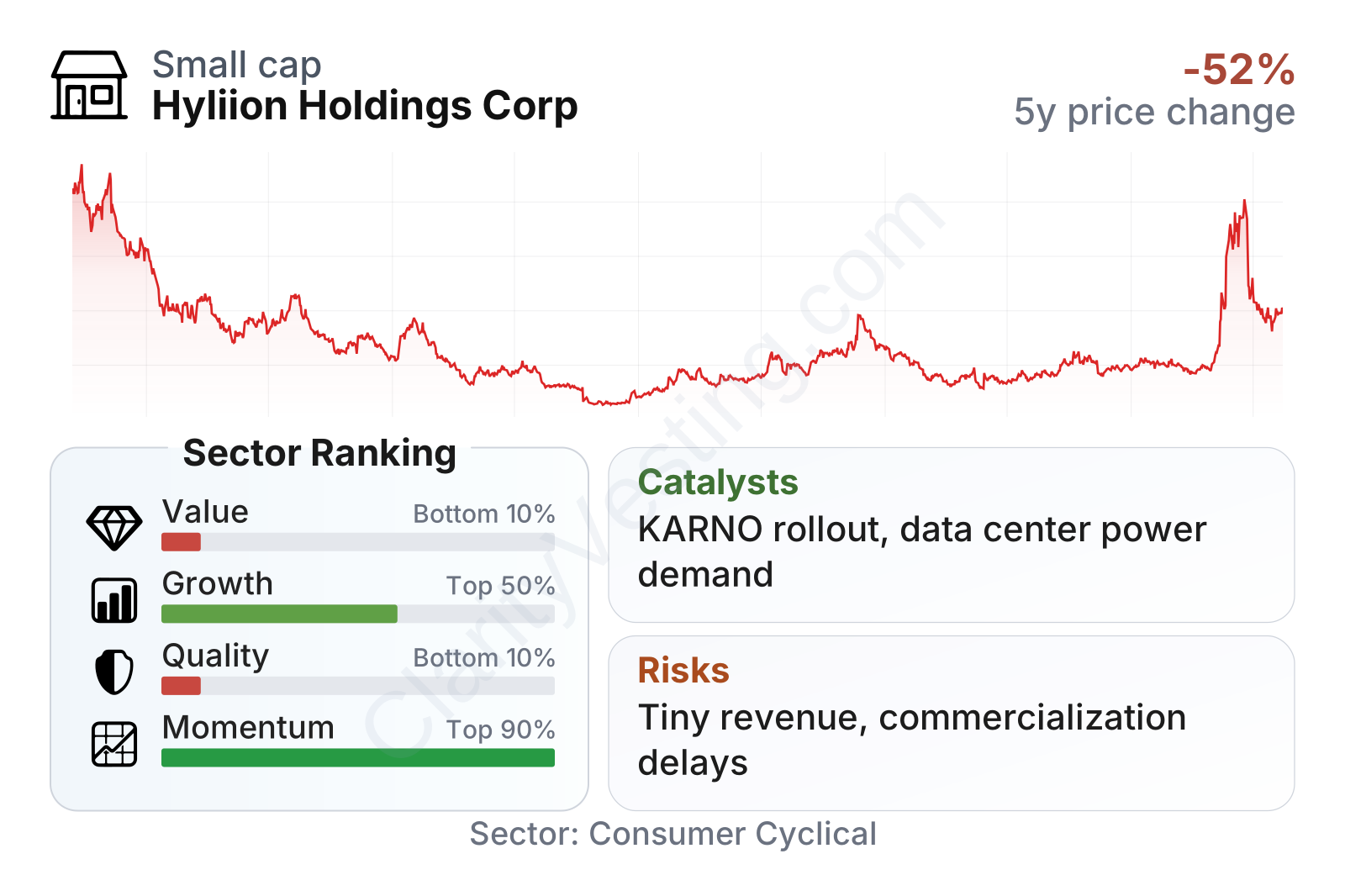
Hyliion is a small-cap company with unusually high share-price volatility, reflected in a beta well above the market average. The factor profile is mixed in a very clear way: growth signals look distorted by a tiny revenue base, quality and value metrics rank poorly because the company is still unprofitable and burning cash, while momentum has been exceptionally strong after the recent stock rebound. In short, the market has recently become much more optimistic, but the underlying financial profile still looks early-stage rather than established.
Growth
Hyliion operates in a part of the energy market that has long-term relevance: distributed power generation. Demand for on-site electricity is being supported by several structural trends, including grid reliability concerns, rising power needs from data infrastructure, electrification, and interest in lower-emission alternatives to conventional generators. A system that can use different fuels and potentially deliver cleaner operation than legacy solutions addresses a real market need if performance and economics prove competitive.
The company’s strategy also makes logical sense on paper. Instead of competing directly as a mass vehicle manufacturer, Hyliion is focusing on a technology platform that could fit multiple end markets. That gives it more than one path to commercial adoption. Stationary power is especially important because it can be easier to enter than heavy vehicle production: customers care about uptime, efficiency, fuel flexibility, and maintenance costs, and the sales cycle can be more practical if the product works as promised.
Reported revenue growth rates look dramatic, but they need to be read carefully. When sales start from a very low base, even modest absolute gains can create triple-digit percentage growth. The encouraging part is that revenue has recently moved upward again after earlier volatility. The less encouraging part is that the business is still far from a level that would demonstrate broad commercial traction.
Cash burn is still an important part of the growth discussion. Free cash outflow has improved meaningfully from the much deeper negative levels seen a few years ago, which suggests tighter expense control and a more disciplined operating structure. That improvement matters because it gives Hyliion more time to prove market demand. Still, the company has not yet crossed into self-funding territory, so future growth depends not just on technical progress but on converting that progress into real orders.
A notable catalyst is the market’s growing attention to flexible power solutions for data centers, EV charging, and behind-the-meter energy use. Hyliion has also highlighted progress around commercialization partnerships, testing milestones, and manufacturing readiness for KARNO. If those efforts lead to repeatable deployments rather than one-off demonstrations, the opportunity could become much more substantial. The strongest recent opportunity signal is not current scale, but the fact that Hyliion is now aligned with a market where power demand is rising and alternative generation options are getting more attention.
Risks
This article is for informational purposes only and does not constitute financial advice. Some content is AI-generated. See Disclaimer


